XWorm V3.0 RAT License Listed for Sale on Darknet
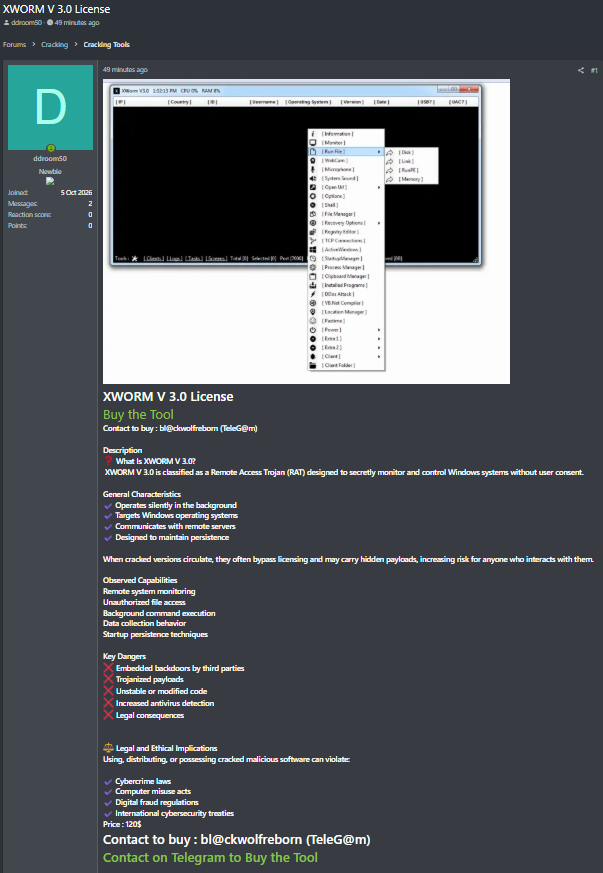
Underground advertisements offering commercial licenses for XWorm V3.0 highlight the persistent threat of modular Remote Access Trojans capable of surveillance, keylogging, and complete Windows endpoint compromise across enterprise environments.

Key Takeaways
- Underground threat actors are actively marketing commercial licenses for XWorm V3.0 Remote Access Trojan.
- XWorm leverages .NET architectures, AES-ECB encryption, and process hollowing into native Windows binaries to evade detection.
- The malware includes integrated keylogging, clipboard manipulation, credential theft, and remote shell capabilities.
- Detection requires endpoint behavioral monitoring for process injection and network filtering of custom TCP protocol traffic.
Security defenders must immediately review process execution telemetry and monitor non-standard outbound TCP beaconing as underground forums advertise commercial licenses for XWorm V3.0. This modular Remote Access Trojan (RAT) is engineered to establish stealthy persistence, bypass endpoint defenses, and grant threat actors covert remote execution capabilities across enterprise Windows environments. Proactive validation of host defenses through rigorous Penetration Testing remains essential to detect and eliminate the exposure paths that these commodity modular tools exploit.
Capabilities and Behavior of XWorm V3.0
XWorm is a commercially distributed malware family developed within the Microsoft .NET framework, commonly compiled using Visual Basic .NET or C# into MSIL binaries. Once executed on a target host, the malware establishes comprehensive administrative control, turning unmanaged workstations into remotely accessible botnet nodes. Its design combines information-stealing routines with broad remote surveillance features, allowing an operator to execute commands without user consent.
The internal architecture of XWorm V3.0 relies on dedicated namespaces and modules configured to perform targeted malicious actions:
Stub.Main: Acts as the primary orchestrator, managing initialization routines, sandbox detection checks, and configuration extraction.
Stub.AlgorithmAES: Provides symmetric AES-ECB encryption and decryption routines used to secure embedded configuration blocks and obfuscate outbound command and control communications.
Stub.ClientSocket: Manages persistent raw TCP socket channels, packet dispatching, keep-alive timers, and automated reconnection logic.
Stub.XLogger: Deploys low-level Windows keyboard hooks via the
SetWindowsHookExAPI to capture keystrokes across applications in real time.Stub.Messages: Houses the command parsing dispatcher, interpreting inbound tasking from the threat actor and invoking specific plugin routines.
Stub.Uninstaller: Handles clean artifact removal, deleting persistence keys and host binaries upon an operator termination command.
Beyond traditional remote administration, XWorm incorporates automated credential harvesting targeting stored web browser credentials, crypto wallet files, and desktop tokens. It also features clipboard-monitoring capabilities designed to substitute cryptocurrency wallet addresses with operator-controlled addresses in memory.
XWorm Infection and Execution Chain
- 1Initial Delivery
Malspam attachments (ZIP, LZH, ISO) or malicious LNK links
- 2Loader & Unpacking
In-memory reflection via System.Reflection.Assembly.Invoke
- 3Process Hollowing
Injection into vbc.exe, RegAsm.exe, or MSBuild.exe
- 4Persistence
Registry Run keys, Startup folder shortcuts, and Scheduled Tasks
- 5C2 & Objectives
AES-ECB encrypted TCP socket beaconing, keylogging, and credential harvesting
Infection Chain and Persistence Mechanisms
The typical delivery chain for XWorm involves multi-stage loaders engineered to evade static signature detection before releasing the core payload into system memory.
Delivery and Loader Execution
Threat actors deploy XWorm through high-volume malspam campaigns carrying weaponized archive attachments such as ZIP, LZH, or ISO containers. In other cases, malicious LNK shortcut files initiate background downloads via WebDAV or script interpreters. The outer loader stub uses high-entropy packing and dynamic invocation via System.Reflection.Assembly.Invoke to unpack the encrypted MSIL binary into RAM, avoiding early disk-based scanning.
Process Injection and Defense Evasion
To mask its presence during active operations, XWorm frequently employs process hollowing techniques. The loader spawns legitimate Windows binaries in a suspended state, such as vbc.exe, RegAsm.exe, svchost.exe, or MSBuild.exe. The loader then unmaps the legitimate executable code using native APIs, writes the decrypted XWorm payload into the allocated space, and resumes the primary thread.
Establishing Persistent Execution
To sustain unauthorized access through system reboots, XWorm configures multiple persistence footholds across the Windows operating system:
Registry Run Keys: Appending entries under
HKCU\Software\Microsoft\Windows\CurrentVersion\Runpointing directly to hidden payload drops in%APPDATA%or%TEMP%.Startup Directory Links: Creating disguised shortcut files within the user startup directory at
%APPDATA%\Microsoft\Windows\Start Menu\Programs\Startup.Windows Scheduled Tasks: Registering system tasks configured to trigger at logon or on repeating schedules under elevated execution contexts.
Organizations must continuously audit external perimeters and internet-facing endpoints through Attack Surface Management to detect exposed services and misconfigurations that facilitate these delivery chains.
MITRE ATT&CK Mapping for XWorm V3.0
Command and Control Infrastructure
Communication between the compromised host and the threat actor is governed by lightweight, low-overhead networking modules. XWorm establishes direct, raw TCP socket connections to remote IP addresses on non-standard ports, bypassing generic HTTP filtering when deep packet inspection is absent.
Network traffic sent across the command channel is wrapped in a custom delimiter protocol, utilizing markers such as <XWorm> or custom tag identifiers to structure data packets. Payload contents, telemetry strings, and harvested system details are encrypted using AES-ECB with a key baked into the client configuration. In specialized variants, operators can also configure fallback HTTP check-ins or leverage the Telegram Bot API to relay heartbeat telemetry when direct socket connections are blocked by perimeter firewalls.
Verified Indicators of Compromise (IoCs)
- hashb4ae0aa38f19cf8c917061bcd03ee501ec97faac1582d0b8ca488f8c97c00a53Core Payload Hash (SHA-256)hashb4ae0aa38f19cf8c917061bcd03ee501ec97faac1582d0b8ca488f8c97c00a53Core Payload Hash (SHA-256)
- hash21432bcec2d1df855e85a64b3bfbcae8f5031ce449f2c4652076db7bdea375a2Delivery Sample Hash (SHA-256)hash21432bcec2d1df855e85a64b3bfbcae8f5031ce449f2c4652076db7bdea375a2Delivery Sample Hash (SHA-256)
- hash372d7d8ca222e03afa5970848cf88efa6a3bc5146d20398601285fc7eaea6735Secondary Payload Hash (SHA-256)hash372d7d8ca222e03afa5970848cf88efa6a3bc5146d20398601285fc7eaea6735Secondary Payload Hash (SHA-256)
- ip103.231.12.27Hardcoded C2 IPv4 Addressip103.231.12.27Hardcoded C2 IPv4 Address
- domainharivo.vipC2 Campaign Domaindomainharivo.vipC2 Campaign Domain
Detection Logic and Indicators of Compromise
Detecting XWorm requires a combination of behavioral analysis on the endpoint and network-layer inspection for unauthorized socket activity.
Host-Based Behavioral Signatures
Security Operations Center (SOC) teams should configure Endpoint Detection and Response (EDR) platforms to flag the following indicators:
Script engines such as
wscript.exe,cscript.exe, orpowershell.exespawning from user writable directories (%TEMP%,%APPDATA%) and establishing external network sockets.Native Windows utilities like
vbc.exeorRegAsm.exeinitiating unexpected outbound network connections.API sequences typical of process hollowing, notably
VirtualAllocEx,WriteProcessMemory, andResumeThreadcalls executed between unrelated processes.
YARA Detection Rule
rule Trojan_Win32_XWorm_Ident
{
    meta:
        description = "Detects structural indicators and classes of XWorm RAT"
        threat_level = "High"
    strings:
        $cls1 = "Stub.AlgorithmAES" ascii wide
        $cls2 = "Stub.ClientSocket" ascii wide
        $cls3 = "Stub.XLogger" ascii wide
        $cls4 = "Stub.Messages" ascii wide
        $proto1 = "<XWorm>" ascii wide
        $proto2 = "[XWORM V" ascii wide
    condition:
        uint16(0) == 0x5A4D and (2 of ($cls*) or (1 of ($cls*) and 1 of ($proto*)))
}
Indicators of Compromise (IoCs)
The following technical indicators have been associated with active XWorm distribution campaigns and command infrastructure:
Core Payload Hash (SHA-256):
b4ae0aa38f19cf8c917061bcd03ee501ec97faac1582d0b8ca488f8c97c00a53Delivery Sample Hash (SHA-256):
21432bcec2d1df855e85a64b3bfbcae8f5031ce449f2c4652076db7bdea375a2Secondary Payload Hash (SHA-256):
372d7d8ca222e03afa5970848cf88efa6a3bc5146d20398601285fc7eaea6735C2 IPv4 Address:
103.231.12.27C2 Domain Name:
harivo.vip
Free exposure check
Dark Web Scanner
check dark web mentions, compromised account indicators, malware log signals, public breach exposure, and recent underground market activity for your domain.
Incident Response & Containment Workflow
- Isolate affected endpointsDisconnect host from local network, Wi-Fi, and active VPN connections immediately.
- Invalidate and reset credentialsRevoke Active Directory passwords, cloud sessions, and MFA tokens accessed from the host.
- Terminate malicious processes and drop artifactsKill hollowed host processes and remove files from %APPDATA% and %TEMP%.
- Purge persistence mechanismsDelete Registry Run keys and scheduled tasks associated with the payload.
- Reimage infected endpointDeploy known-good gold image to eliminate hidden secondary payloads.
- Block C2 indicators at network perimeterBlock outbound traffic to 103.231.12.27 and harivo.vip, and inspect non-standard TCP ports.
Removal and Recovery Procedures
When an active XWorm infection is confirmed on an enterprise system, incident response teams must follow a structured containment and eradication workflow:
Network Isolation: Disconnect the infected host immediately from corporate local networks, Wi-Fi, and active VPN tunnels to terminate the interactive C2 channel and stop potential lateral movement.
Credential Invalidation: Because XWorm actively logs keystrokes and extracts browser credential stores, all Active Directory passwords, cloud account sessions, and multi-factor authentication tokens accessed from that device must be revoked and reset.
Process Termination and Persistence Eradication: Terminate the hollowed host process using EDR controls, delete dropped executable files from
%APPDATA%and%TEMP%, and remove corresponding Registry Run keys and scheduled tasks.System Reimaging: In enterprise environments, full endpoint reimaging from a known-good gold image is strongly advised to eliminate stealthy secondary payloads or rootkits deposited during the intrusion.
Firewall Ingress and Egress Review: Block outbound communication to known C2 IP addresses and audit perimeter firewall policies to restrict arbitrary high-port outbound TCP sockets.
How to Defend Against Similar Threats
- Block outbound TCP connections on non-standard ports to unverified external IP addresses at the perimeter firewall.
- Deploy behavioral EDR rules alerting on LOLBin process hollowing into binaries like vbc.exe and RegAsm.exe.
- Enforce strict application control policies preventing unauthorized executable execution from %APPDATA% and %TEMP% folders.
- Immediately isolate compromised hosts and rotate all corporate and browser-stored credentials used on infected machines.
Threat Intel FAQ
What is XWorm V3.0?
How does XWorm maintain persistence on compromised Windows systems?
What are the primary detection strategies for XWorm?
Could a similar threat affect your organization?
If your team may be exposed to a similar threat, FemtoSec can help validate blast radius, prioritize remediation, and connect the issue to a practical security program.
Related Threats
October 7, 2026
AbkoRAT License Sale Fuels Remote Surveillance Threat
Underground forums have observed threat actors commercializing AbkoRAT, a commercial Remote Access Trojan engineered for stealthy surveillance, multimedia interception, credential harvesting, and arbitrary command execution across compromised enterprise hosts.
October 19, 2026
Rwanda Health Ministry 5.7 GB Data Breach Analysis
An illicit forum listing claims the exfiltration and sale of 5.7 GB of citizen and staff records from the Rwanda Ministry of Health, exposing personal identifiers and highlighting the threat of upstream infostealer compromises.
October 1, 2026
FATETRAFFIC Threat Actor Sells Stealer Logs
A threat actor has advertised a batch of 3,100 FATETRAFFIC stealer logs on underground cybercrime forums. The archive contains harvested browser credentials, active session tokens, and endpoint metadata collected through widespread information-stealer malware operations.