Detection Logic and Indicators
Defenders must deploy multi-layered detection strategies across endpoint, network, and identity telemetry to identify RedLine activity and intercept stolen credential usage.
Endpoint Behavioral Detection
Security operations centers should monitor for anomalous processes accessing protected browser directories. Non-browser binaries, PowerShell scripts, and command-line utilities accessing the following paths should immediately trigger high-priority alerts:
*\User Data\Default\Login Data
*\User Data\Default\Network\Cookies
*\User Data\Default\Web Data
*\AppData\Roaming\FileZilla\recentservers.xml
Network Signatures
Network security monitoring tools can identify RedLine C2 traffic by detecting characteristic SOAP and WCF traffic headers. A representative Snort/Suricata rule for identifying typical RedLine TCP traffic includes:
alert tcp $HOME_NET any -> $EXTERNAL_NET any (msg:"ET MALWARE RedLine Stealer TCP/WCF C2 Traffic"; flow:established,to_server; content:"http://tempuri.org/"; depth:100; content:"Entity/Id"; distance:0; classtype:trojan-activity; sid:2035001; rev:1;)
Identity Anomalies and Threat Indicators
Identity providers must be configured to detect session cookie replay attacks. Key telemetry signals include interactive logins originating from new IP ranges or device configurations that bypass primary authentication prompts, or immediate access to administrative portals using previously established session tokens without matching device health certificates.
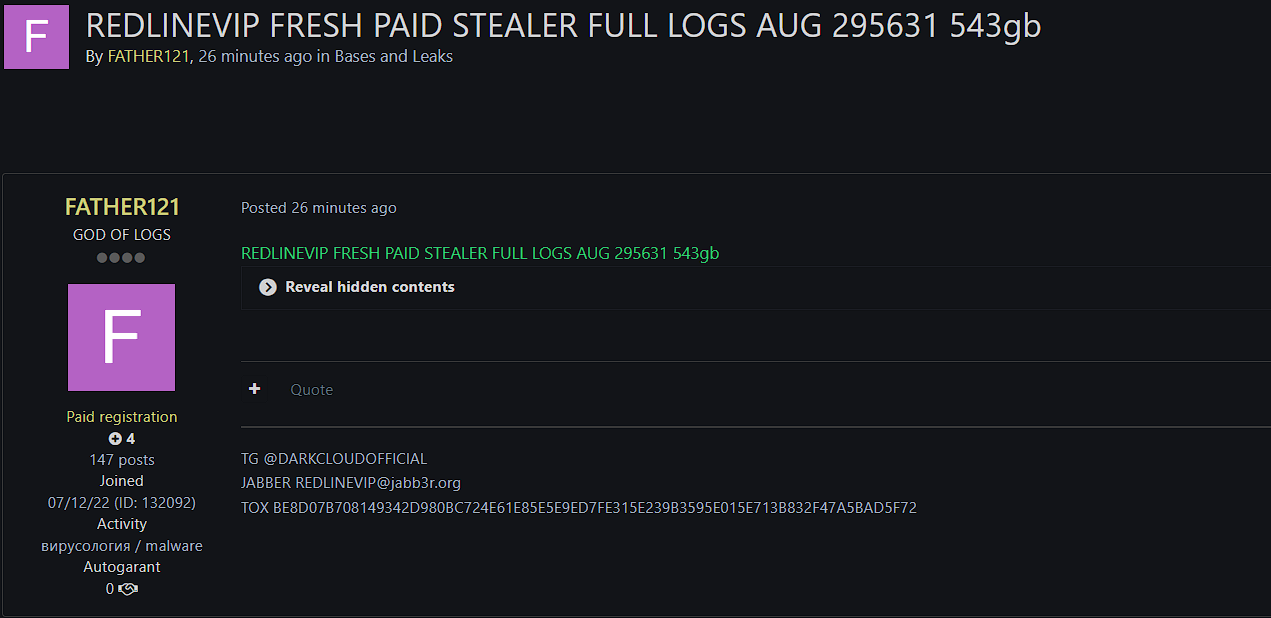
Known threat actor contact points and distribution handles associated with this log sale include:
Primary Log Cloud Telegram: @DARKCLOUDOFFICIAL
Distribution Channel Telegram: @fatherofcarders
Private Telegram Channel: https://t.me/RLREBORN
Sales Contact Jabber: [email protected]
Session ID: 05410d9625647cb0ac78125ae30c973b3ff114b55a21866176f2150321f64dd44b
Removal and Recovery
When an endpoint infection is confirmed or corporate credentials appear in stealer logs, organizations must follow a structured containment and recovery protocol to prevent subsequent lateral movement.
Immediate Containment and Endpoint Remediation
Remediation begins with isolating the affected host from the internal network to halt further exfiltration. Security teams must terminate malicious processes, remove malicious startup entries from the registry, and conduct a thorough scan using updated endpoint detection agents. If the workstation handled privileged administrative credentials, full system re-imaging is strongly advised.
Credential Revocation and Identity Hardening
Because infostealers harvest active session tokens alongside static passwords, password resets alone are insufficient to neutralize the threat:
Global Session Invalidation: Terminate all active sessions across identity providers, cloud consoles, single sign-on (SSO) platforms, and VPN portals for compromised user accounts.
Mandatory Credential Resets: Enforce complete password rotation for all accounts associated with the compromised endpoint.
FIDO2 MFA Enforcement: Migrate users from legacy SMS or push-based MFA to phishing-resistant hardware security keys (FIDO2/WebAuthn), preventing adversaries from using stolen cookies or replay attacks to access corporate assets.
Browser Hardening Policies: Implement Group Policy Objects (GPO) or Mobile Device Management (MDM) profiles to disable native browser password storage (PasswordManagerEnabled = 0 in Chrome and Edge), enforcing the use of enterprise-managed password vaults protected by device-bound keys.