Capabilities and Behavior of Infostealer Payloads
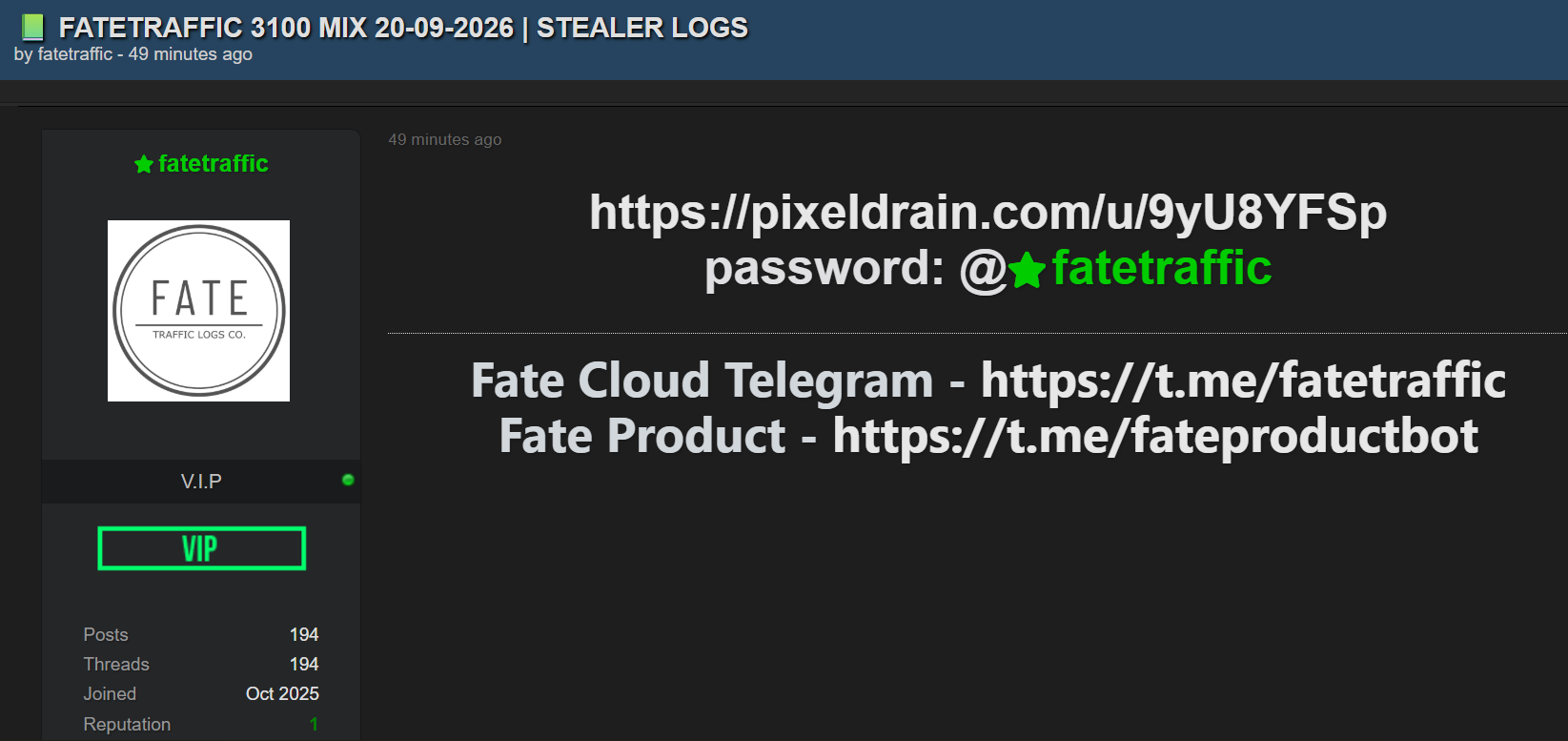
The dataset advertised by FATETRAFFIC originates from commodity infostealer families, predominantly Lumma Stealer alongside variants such as Vidar, Stealc, and RedLine. These malicious binaries are engineered specifically to extract sensitive cryptographic material, authentication secrets, and environment fingerprints from infected workstations.
When executed on a target host, the malware exhibits systematic data collection behavior:
Browser Database Extraction: The malware locates and extracts local SQLite databases storing autofill records, saved credentials, and web history across Chromium-based and Gecko-based browsers.
Session Cookie Ingestion: By decrypting local state files and querying cookie storage directories, the stealer captures active session cookies, granting attackers the ability to bypass multi-factor authentication (MFA) mechanisms via session replay.
Cryptographic and Wallet Harvesting: The binary scans endpoint directories and browser extensions for non-custodial cryptocurrency wallet datastores, seed phrases, and private keys.
Client Application Secrets: Payloads systematically harvest saved authentication tokens and profiles from FTP clients, SSH key stores, remote desktop configuration files, and corporate VPN profiles.
System Metadata Discovery: The software gathers detailed hardware identifiers, operating system build versions, active IP addresses, running processes, and installed security software to compile a comprehensive profile of the infected machine.
Infection Chain and Persistence Mechanisms
The execution lifecycle leading to the generation of stealer logs relies heavily on deceptive initial access vectors rather than direct software vulnerability exploitation.
Initial Delivery Vectors
Threat actors deploy infostealers through diverse distribution channels. These include malvertising campaigns on major search engines, poisoned software repositories, weaponized cracked software installers, and drive-by social engineering schemes such as fake browser update lures and ClickFix clipboard manipulation scripts. In enterprise contexts, deceptive spearphishing emails carrying malicious archive attachments or weaponized macro documents serve as primary access routes.
Execution and Evasion
Upon initial download, the dropper initiates execution using multi-stage payload delivery. Modern stealer variants employ evasion techniques to avoid heuristic security engines:
Process Injection: Payloads frequently utilize process hollowing or asynchronous procedure call (APC) injection into legitimate Windows binaries such as explorer.exe or svchost.exe.
Anti-Analysis Checks: The executable probes for virtualized environments, hypervisor artifacts, sandbox debugging hooks, and analysis tools before executing malicious routines.
Memory-Only Extraction: Data harvesting logic runs directly inside memory spaces to minimize disk-based forensic footprints.
Persistence Considerations
Most modern stealer variants function as swift, tactical extractors rather than maintaining persistent backdoors. Once credential gathering completes, the binary transfers the consolidated archive and self-terminates to minimize detection windows. However, secondary droppers or loaders may simultaneously establish persistent registry run keys or scheduled tasks to facilitate follow-on adversary access.