Malwaremedium
Understanding the Threat of Rottie RAT Malware
A new remote access trojan dubbed Rottie RAT has emerged on underground forums. We analyze its delivery mechanisms and provide actionable steps to secure your environment.
A new remote access trojan dubbed Rottie RAT has emerged on underground forums. We analyze its delivery mechanisms and provide actionable steps to secure your environment.
In the evolving landscape of digital threats, the appearance of new malware variants requires immediate attention. A remote access trojan known as Rottie RAT has recently been identified on underground forums, with threat actors marketing its capabilities to facilitate unauthorized control over compromised systems. For enterprise organizations in the GCC, understanding the mechanics of such tools is vital for maintaining a robust security posture.
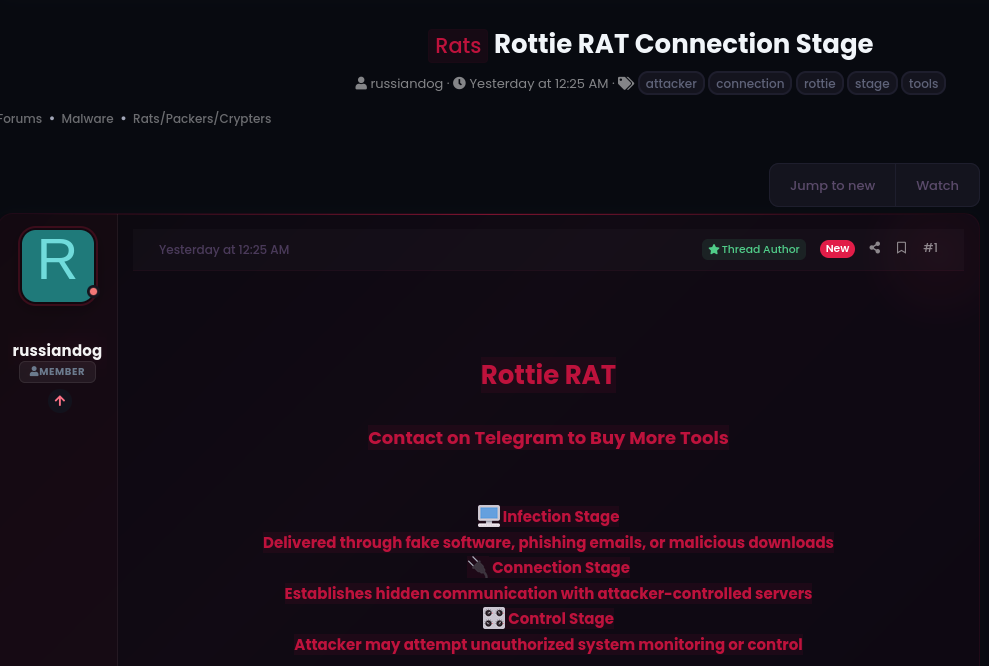
Based on initial reports, Rottie RAT is designed to establish persistent communication with attacker-controlled command-and-control servers. Once a system is infected, the malware enables unauthorized monitoring and system control. The primary delivery vectors noted include malicious downloads, phishing campaigns, and masquerading as legitimate software. These methods leverage social engineering to bypass perimeter defenses, making user awareness and endpoint security critical components of any defense strategy. When internal systems are breached, the risk of data exfiltration and further lateral movement increases significantly, necessitating regular Penetration Testing to identify potential entry points before they are weaponized.
Enterprise cybersecurity demands a proactive approach rather than a reactive one. Because tools like Rottie RAT often rely on deceptive delivery methods, organizations must implement comprehensive security awareness training to ensure employees can recognize and report suspicious activity. Furthermore, verifying the integrity of software downloads and securing email gateways are fundamental steps in blocking the initial compromise. For organizations looking to identify potential gaps in their perimeter, our Attack Surface Management services offer a continuous view of exposed assets and misconfigurations that attackers might target. If you suspect that your organization may have already been exposed through compromised credentials or malicious log signals, we recommend leveraging our diagnostic tools. Free domain exposure scan: Use FemtoSec's Dark Web Scanner to check dark web mentions, compromised account indicators, malware log signals, public breach exposure, and recent underground market activity for your domain.
The commoditization of malware kits on dark web forums lowers the barrier to entry for novice attackers, increasing the volume of opportunistic threats facing enterprises. A compliance-first operating model, as practiced at FemtoSec, ensures that security controls are not only implemented but are also effective against real-world adversary simulations. By combining threat intelligence with rigorous offensive security, businesses can stay ahead of emerging variants like Rottie RAT. Whether through securing codebases against vulnerabilities or auditing infrastructure, the focus remains on closing the gap between potential exploitation and remediation. We advocate for a multi-layered security strategy that integrates endpoint protection, continuous monitoring, and employee education. In an environment where threats are constantly shifting, having a dedicated partner with deep regional expertise is essential for navigating the complex threat landscape of the GCC. Our team is prepared to assist your organization in auditing its defenses and hardening systems against unauthorized access.
If your team may be exposed to a similar threat, FemtoSec can help validate blast radius, prioritize remediation, and connect the issue to a practical security program.
October 7, 2026
Underground forums have observed threat actors commercializing AbkoRAT, a commercial Remote Access Trojan engineered for stealthy surveillance, multimedia interception, credential harvesting, and arbitrary command execution across compromised enterprise hosts.
September 18, 2026
A new malware-as-a-service offering named Hermes has surfaced on underground forums, bundling hidden virtual desktop control, browser credential harvesting, crypto wallet theft, and remote command execution.
July 25, 2026
Defenders prioritizing mobile endpoint integrity must immediately audit Android Accessibility Service authorizations to counter BTMOB RAT v4.6. This technical analysis explores the malware's delivery vectors, capabilities like 2FA bypass, and step-by-step containment protocols.