1. Initial Access and Social Engineering Lures
BTMOB RAT campaigns do not typically rely on zero-day exploits to achieve execution. Instead, the malware leverages meticulously designed social engineering schemes. Threat actors deploy dedicated landing pages that mimic popular utility platforms, secure communication apps, and system updates. Common lures include forged versions of Google Chrome, Avast Antivirus, Starlink utilities, and custom communication wrappers like GB WhatsApp. In more sophisticated deployments, actors utilize multi-stage delivery systems. A primary loader, such as the MiningDropper family, installs the BTMOB package under the guise of an optimized system file. This multi-stage packaging is designed specifically to slip past static signature-based detection layers in mobile security tools.
2. Execution and Privilege Escalation via Accessibility Abuse
Once the target downloads and launches the malicious Android Package Kit (APK), the implant initiates its core compromise loop. BTMOB prompts the victim to enable Android's Accessibility Services. It generates persistent, realistic-looking dialog boxes that claim the service is required for proper runtime optimization or protection. Once a user grants the BIND_ACCESSIBILITY_SERVICE permission, the RAT ceases to rely on human interaction. It uses accessibility APIs to programmatically simulate physical touch events, silent clicks, and keyboard inputs. The malware uses this automated authority to auto-approve high-level permissions, completely disable Google Play Protect, register a background WakeLock to prevent the device from entering sleep state, and strip its icon from the launcher menu.
3. Real-Time Command and Control Communication
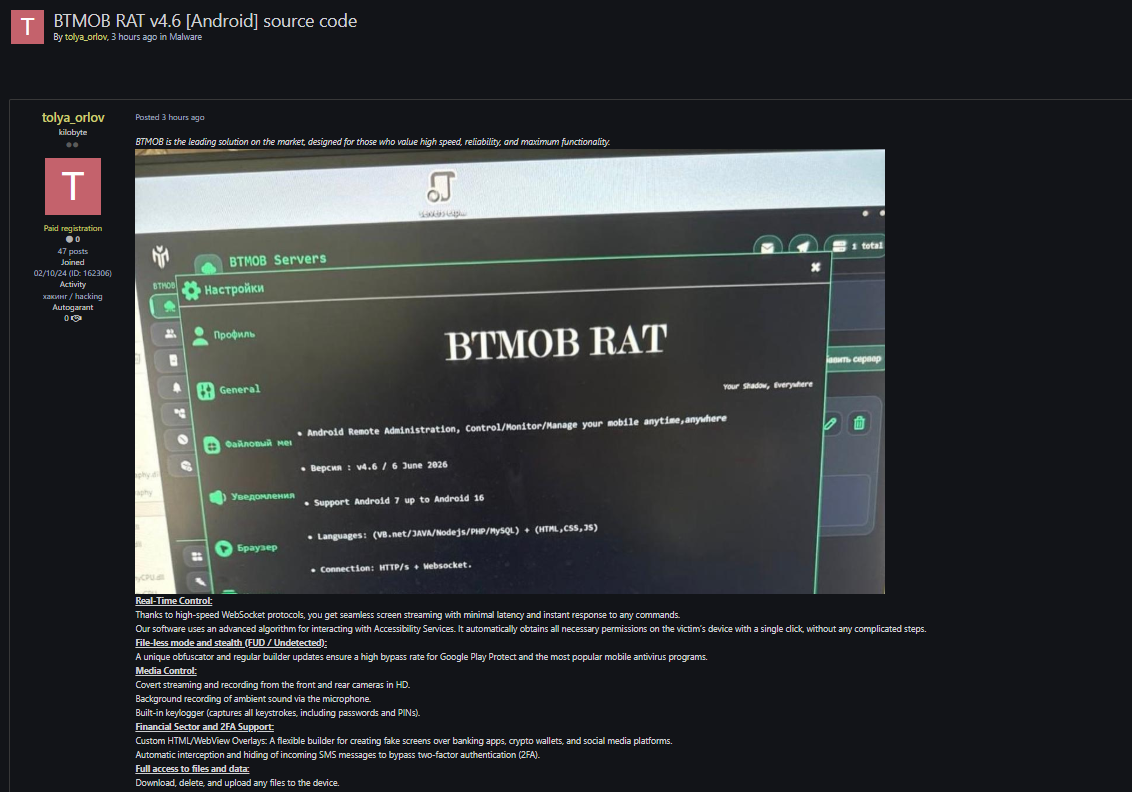
Older malware families relied on latent HTTP polling cycles, which introduced significant lag and made them vulnerable to behavioral detection. BTMOB RAT v4.6 utilizes persistent, real-time secure WebSocket connections to link the infected endpoint directly to the operator's web-based C2 panel. This persistent bidirectional socket allows the attacker to execute interactive commands immediately, bypass firewalls, and maintain stable remote desktop streaming even on high-latency mobile networks.
4. Critical Exploitation Capabilities and 2FA Bypass
The ultimate objective of BTMOB RAT is data monetization and financial compromise. The malware implements several highly damaging capabilities:
VNC-like Screen Streaming: Using the native Android Media Projection APIs, the attacker can view the victim's screen in real time, capturing transaction screens, multi-factor codes, and private conversations.
Automated Keylogging: The implant monitors and records every keystroke entered across the operating system, capturing master passwords, lock screen PINs, and personal notes.
SMS Interception: The RAT monitors incoming messages to hijack 2FA validation codes, allowing attackers to log in to corporate cloud services, banking sites, and email systems undetected.
Dynamic Web View Overlays: BTMOB parses the list of installed applications. When a targeted banking, crypto-wallet, or corporate application is launched, the RAT dynamically injects an aesthetic, WebView-based login overlay. The victim enters their credentials into a forged portal, which transmits the data directly to the C2 panel.
Enterprise Exposure and the Risk to Hybrid Workforces
The proliferation of BTMOB RAT v4.6 poses an acute threat to modern enterprises, particularly in regions like the GCC where hybrid work and Bring Your Own Device (BYOD) architectures are standard. Because employees frequently access corporate mail, cloud databases, and single sign-on (SSO) gateways from personal Android devices, a mobile compromise is functionally equivalent to an enterprise network breach.
If a user with administrative or privileged access is infected, the attacker can capture SSO session cookies, bypass multi-factor authentication (MFA) challenges through SMS harvesting, and initiate lateral movement. To establish a robust perimeter defense, organizations must continuously assess their external exposure and review policies. Implementing Attack Surface Management enables defenders to trace exposed endpoints, misconfigured mobile gateways, and external interfaces that threat actors exploit during lateral movement phases.
If you suspect that your domain or corporate credentials have already been compromised through mobile-related phishing campaigns, checking underground forums is essential. If the domain already looks exposed, use Dark Web Scanner before requesting a full report.