AbkoRAT License Sale Fuels Remote Surveillance Threat
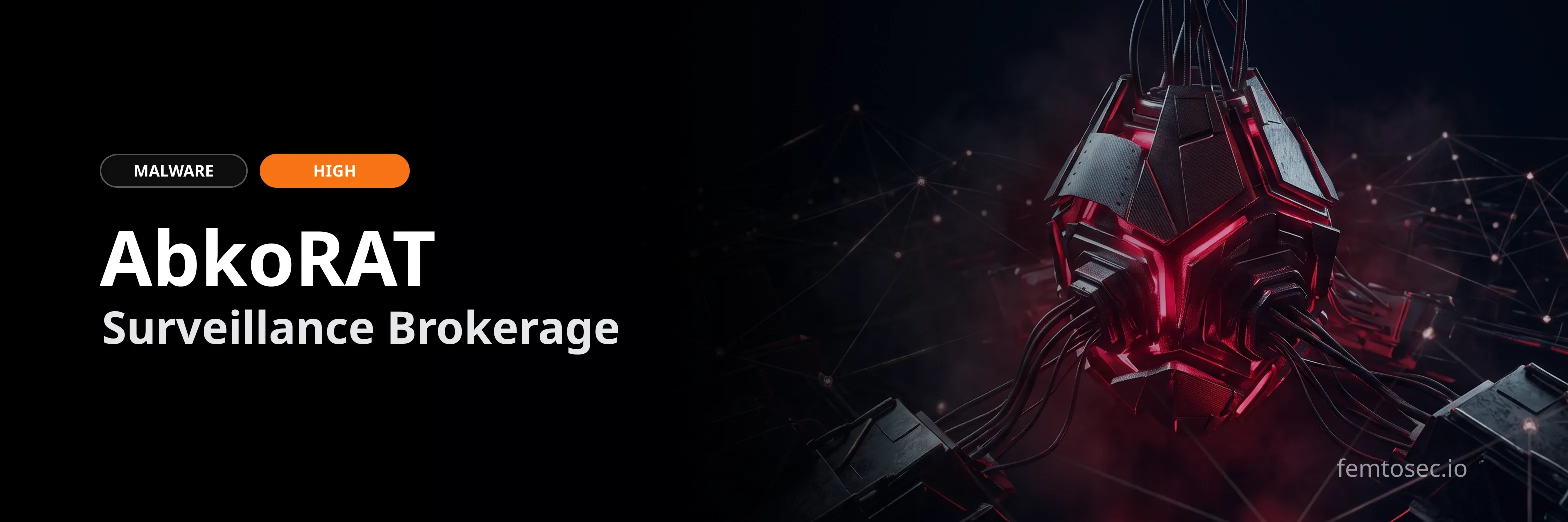
Underground forums have observed threat actors commercializing AbkoRAT, a commercial Remote Access Trojan engineered for stealthy surveillance, multimedia interception, credential harvesting, and arbitrary command execution across compromised enterprise hosts.

Key Takeaways
- AbkoRAT is a commercial Remote Access Trojan being actively advertised on underground cybercrime channels.
- The malware provides operators with silent user surveillance, audio and webcam capture, keylogging, and full remote command execution.
- Packers like .NET Reactor and Themida are commonly employed to obfuscate payloads and bypass static signature detection.
- Comprehensive recovery requires host network isolation, enterprise credential revocation, and complete endpoint re-imaging.
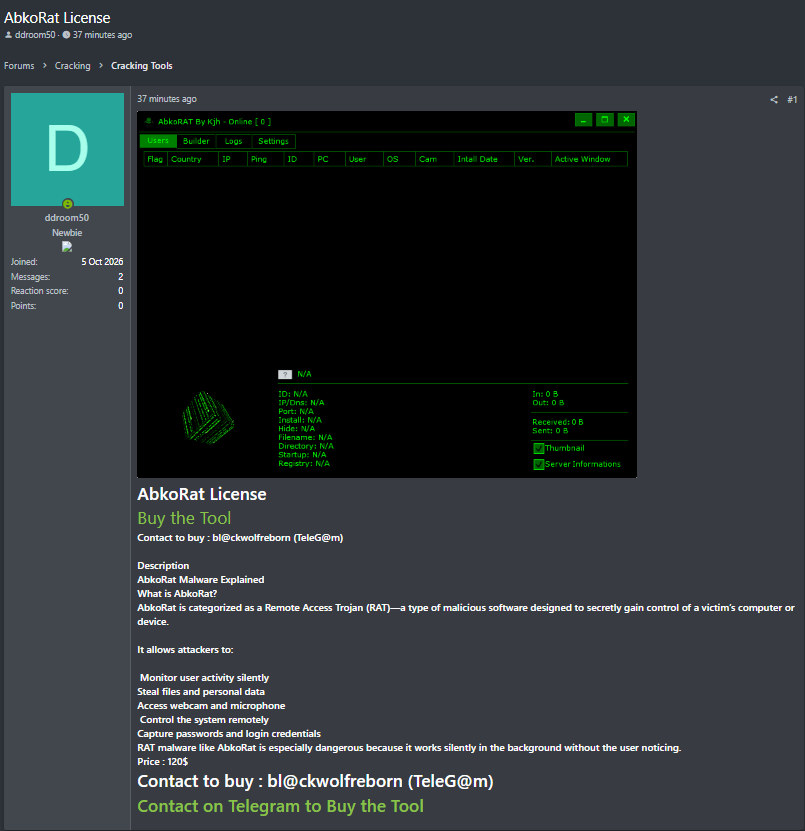
Underground cybercrime marketplaces have surfaced advertisements for commercial licenses to AbkoRAT, a modular Remote Access Trojan (RAT) engineered to grant threat actors persistent and covert administration over compromised endpoints. The commercial offering advertises extensive surveillance features, including unauthorized microphone and webcam recording, keystroke logging, credential harvesting, and interactive remote shell execution. By lowering the barrier to entry for commodity espionage and corporate network penetration, the monetization of tools like AbkoRAT introduces significant operational risk for organizations across all sectors.
As commercial RAT distributions proliferate, defending against multi-stage intrusions requires continuous visibility across exposed digital perimeters and endpoint behaviors. Organizations looking to evaluate their defensive posture against malicious payload execution and lateral movement can leverage comprehensive Penetration Testing to identify structural vulnerabilities before threat actors exploit them.
Adversary & Tool Profile
- Motivation
- Financial (Commercial License Sales)
- TTPs
- Social engineering & trojanized software luresThemida and .NET Reactor payload packingDynamic DNS (DynDNS) resilient C2 routingWebcam and microphone media stream capture
Capabilities and Behavior
AbkoRAT exhibits a wide spectrum of offensive capabilities designed to establish stealthy post-exploitation control over target endpoints. Once established on a system, the malware operates silently in the background while exposing an extensive command suite to the remote operator. Its primary objective centers on comprehensive surveillance and identity compromise.
The threat actor marketing the malware highlights several high-impact functional modules:
Audio and Video Surveillance: AbkoRAT interacts directly with local multimedia capture interfaces, enabling attackers to covertly activate system webcams and microphones to intercept confidential conversations and room environments.
Credential and Token Theft: The payload extracts cached passwords, browser session cookies, and local authentication tokens from common enterprise applications, facilitating immediate account takeover.
Keystroke and Clipboard Interception: Integrated keylogger components log user input and clipboard contents, capturing sensitive data such as master passwords, authentication secrets, and internal correspondence in real time.
Interactive Host Control: Operators can execute arbitrary command shell instructions, terminate critical processes, manage filesystem hierarchies, and transfer files between the host and remote nodes.
Secondary Payload Staging: The Trojan acts as a reliable initial foothold, enabling operators to download and deploy follow-on malware, such as ransomware or memory-resident post-exploitation toolkits.
Enterprise Impact and Identity Risk
The convergence of audio and video interception with credential theft makes AbkoRAT particularly hazardous to corporate governance. Stolen administrative credentials frequently bypass perimeter protections, while intercepted executive communications provide fodder for targeted extortion or sophisticated spear-phishing campaigns. If your team suspects prior identity compromise, utilizing FemtoSec's Dark Web Scanner can help identify exposed corporate credentials and breach signals circulating across underground platforms.
AbkoRAT Attack Modules & Capabilities
- Audio & Video Surveillancehigh
- Credential & Token Extractionhigh
- Keystroke & Clipboard Logginghigh
- Interactive Remote Shell Executionmedium
- Secondary Payload Stagingmedium
Infection Chain and Persistence
The infection chain for AbkoRAT typically begins with social engineering and deceptive packaging. Cybercriminals utilizing commercial RAT builders often wrap the compiled client payload within layered evasion frameworks before deploying it via malicious email attachments, trojanized software downloads, or compromised web portals.
Initial Delivery and Execution
Threat actors often package AbkoRAT payloads inside software bundles or masquerade them as legitimate enterprise utilities, cracking tools, or invoice documents. Upon initial download and user execution, the binary commonly deploys anti-analysis measures. Malware samples associated with the AbkoRAT family frequently utilize binary protection software, such as .NET Reactor or Themida, to obfuscate internal strings, scramble API calls, and thwart basic signature-based antivirus solutions.
During early execution, the payload performs initial host profiling, querying system properties such as the BIOS version, machine name, and current user privileges. This discovery step allows the malware to determine whether it is executing inside an automated dynamic analysis sandbox or a legitimate victim environment.
Persistent Host Mechanics
To ensure persistent access across system restarts, AbkoRAT establishes automated startup hooks using standard Windows configuration mechanisms. The malware typically achieves persistence through:
Registry Run Keys: Writing payload path entries under
HKCU\Software\Microsoft\Windows\CurrentVersion\Runor system-levelHKLMkeys.Scheduled Tasks: Generating automated background tasks configured to trigger on user logon or scheduled system events.
Startup Folder Droppers: Staging executable shortcuts within the user Startup directory to guarantee silent execution upon desktop initialization.
Continuous validation of exposed infrastructure and internal defenses through Attack Surface Management helps ensure unmanaged assets and misconfigured ingress points do not serve as unmonitored launchpads for such payload execution chains.
Infection & Execution Lifecycle
- 1Delivery & Masquerading
Phishing attachments or trojanized bundles
- 2Unpacking & Execution
Protected via .NET Reactor or Themida
- 3Environment Discovery
Interrogates BIOS and computer name
- 4Persistence Installation
Registry Run keys and Startup shortcuts
Command and Control
AbkoRAT relies on a robust Command and Control (C2) communication structure to maintain bidirectional communication between the compromised host and the attacker console. The malware opens outbound network sockets to transmit captured telemetry and receive real-time operator instructions.
To maintain resilience against domain takedowns and IP blacklisting, operators frequently deploy Dynamic DNS (DynDNS) routing services. This dynamic addressing strategy allows the threat actor to pivot the underlying C2 server IP address without needing to recompile or redeploy active malware agents across victim networks.
The outbound C2 communication channel facilitates:
Heartbeat Signals: Periodic beacons sent from the infected endpoint to notify the operator console of active host availability and current user status.
Exfiltration Channels: Structured data streams that transmit stolen authentication files, keystroke logs, and recorded multimedia files back to the attacker infrastructure.
Remote Command Ingestion: Parsing inbound operational taskings, including requests for interactive command execution, registry modifications, and secondary binary distribution.
Detection Logic and Indicators
Detecting AbkoRAT requires a multi-layered security approach combining host-level behavior monitoring, endpoint detection and response (EDR) telemetry, and strict network traffic inspection. Because commercial packers often obscure static payload signatures, defenders must focus on runtime behavior patterns and telemetry anomalies.
Endpoint Behavioral Detection Logic
Security operations centers (SOC) should construct detection rules to identify typical behaviors exhibited during AbkoRAT execution:
Suspicious Device Access: Monitor for non-standard, unverified processes initiating continuous open handles to audio capture or webcam device drivers (such as DirectShow interfaces).
System Reconnaissance via WMI: Flag processes querying low-level system attributes, such as BIOS serial numbers or motherboard hardware descriptors via
Win32_BIOSor registry lookups inHARDWARE\DESCRIPTION\System\BIOSimmediately prior to initiating outbound network connections.Unsigned Binary Execution from Temporary Directories: Alert on executables running directly from
%APPDATA%,%TEMP%, orC:\Users\Public\that create autostart registry entries or schedule tasks.File Metadata Signatures: Inspect internal binary metadata for indicators such as
InternalName = "AbkoRAT.exe"or related builder artifacts.
Network Indicators and Telemetry Rules
At the network boundary, defenders should implement rules to monitor outbound traffic anomalies:
Flag internal endpoints establishing continuous outbound TCP connections directly to dynamic DNS provider domains (e.g., DuckDNS, No-IP, DynDNS) outside approved enterprise channels.
Analyze irregular outbound telemetry volumes originating from non-administrative desktop workstations, which may indicate active file exfiltration or live media streaming.
# Conceptual Yara rule for identifying unpacked AbkoRAT artifacts
rule Malware_Win32_AbkoRAT_Strings {
    meta:
        description = "Detects identifiable strings and metadata in AbkoRAT binaries"
        threat_level = "High"
    strings:
        $s1 = "AbkoRAT.exe" ascii wide nocase
        $s2 = "AbkoRAT_By_Kjh" ascii wide nocase
        $s3 = "server.exe" ascii wide nocase
    condition:
        uint16(0) == 0x5A4D and any of ($s*)
}
Removal and Recovery
Remediating an endpoint compromised by AbkoRAT requires disciplined containment to prevent further lateral movement, credential abuse, and data exfiltration. Because remote access trojans grant operators arbitrary access, simple antivirus quarantine may leave secondary persistence mechanisms or dropped backdoors intact.
Containment and Incident Triage
Execute the following containment protocol upon confirming an active infection:
Immediate Host Isolation: Sever network connectivity (both wired and wireless) on the affected endpoint to instantly disrupt C2 interaction and prevent ongoing surveillance streaming.
Volatile Memory Preservation: If required for deep forensics, capture a full RAM dump before powering down the machine to preserve injected memory modules and extract cleartext C2 network configurations.
Enterprise Credential Invalidation: Force an immediate password and active session revocation for any user accounts, administrative identities, and enterprise services accessed from the affected host.
Eradication and Recovery
Because AbkoRAT enables secondary payload distribution and deep registry persistence, the safest recovery path involves wiping the compromised device. IT teams should format the local storage drives and re-image the operating system using verified, pristine baseline images. Following re-deployment, review perimeter telemetry to confirm no additional internal hosts are communicating with the identified C2 endpoints.
How to Defend Against Similar Threats
- Configure EDR alerts for unverified processes accessing webcam and microphone hardware interfaces.
- Block or inspect outbound network connections from internal workstations to dynamic DNS provider domains.
- Implement application control policies restricting executable files from running directly within user temp directories.
- Mandate prompt credential resets for any user or administrative account active on an infected system.
Threat Intel FAQ
What is AbkoRAT and what are its primary capabilities?
How do threat actors typically distribute AbkoRAT?
Why is endpoint re-imaging recommended after an AbkoRAT infection?
Could a similar threat affect your organization?
If your team may be exposed to a similar threat, FemtoSec can help validate blast radius, prioritize remediation, and connect the issue to a practical security program.
Related Threats
September 18, 2026
Hermes Stealer Emerges with HVNC and Token Theft
A new malware-as-a-service offering named Hermes has surfaced on underground forums, bundling hidden virtual desktop control, browser credential harvesting, crypto wallet theft, and remote command execution.
August 6, 2026
Anonymous Mobile RAT v6 Analysis
Underground threat actors have announced the release of Anonymous Mobile RAT v6, an advanced Android Remote Access Trojan designed to capture credentials, record screens, and abuse accessibility settings, creating severe risks for enterprise mobile security.
July 25, 2026
BTMOB RAT v4.6 Mobile Malware Threat Analysis
Defenders prioritizing mobile endpoint integrity must immediately audit Android Accessibility Service authorizations to counter BTMOB RAT v4.6. This technical analysis explores the malware's delivery vectors, capabilities like 2FA bypass, and step-by-step containment protocols.