Malwaremedium
Risks of Unauthorized UnlockTool Pro Usage
Analysis of the recent circulation of UnlockTool Pro, an Android mobile servicing toolkit, highlights significant security risks for organizations using mobile hardware.

Analysis of the recent circulation of UnlockTool Pro, an Android mobile servicing toolkit, highlights significant security risks for organizations using mobile hardware.
Recent reports indicate that UnlockTool Pro, a professional Android mobile servicing toolkit, is being offered across underground forums. Marketed as a comprehensive utility for device unlocking, flashing, FRP bypass, factory resets, and bootloader operations, the toolkit claims compatibility with a wide range of major smartphone brands including Samsung, Xiaomi, Motorola, and Huawei. While such tools are often sought after for hardware maintenance or device recovery, the unauthorized distribution of these applications presents a substantial security risk to enterprise environments.
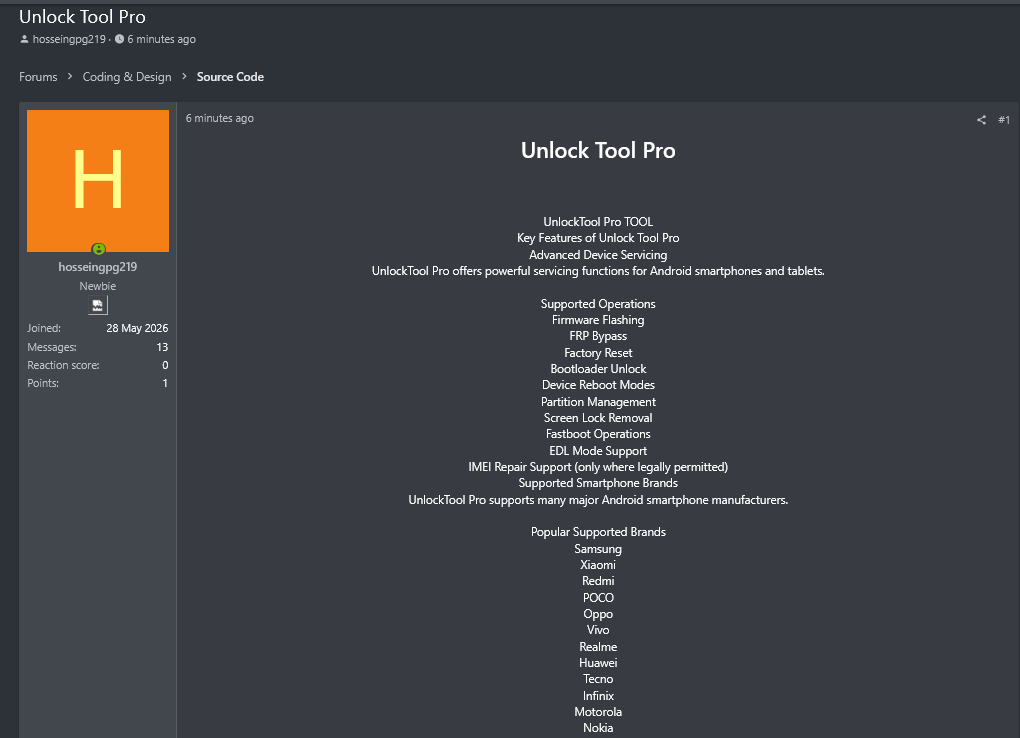
The use of unverified, third-party software for device manipulation creates a dangerous vector for malware introduction. When employees or IT staff utilize unofficial toolkits to bypass security features like Factory Reset Protection (FRP) or screen locks, they often inadvertently expose the device to telemetry harvesting, backdoors, or malicious code embedded within the toolkit itself. These tools often require escalated privileges, effectively giving the software administrative control over the mobile device. This level of access is precisely what corporate security policies aim to restrict.
For businesses, the primary risk lies in the compromise of corporate data residing on mobile devices. If an employee uses an unauthorized tool on a work-issued smartphone, the integrity of the entire mobile endpoint is compromised. This can lead to unauthorized access to company email, VPN tokens, and sensitive internal documentation. In addition to potential malware, relying on tools from dubious origins undermines the fundamental premise of a secure, managed device environment.
To assess your organization's exposure, it is critical to perform regular audits of mobile fleet security. You can leverage Vulnerability Assessments to understand how unauthorized tools and misconfigurations might leave your endpoints open to exploitation.
Organizations must adopt a proactive stance toward mobile device management. This includes strictly enforcing policies that prohibit the installation of unverified software. Furthermore, regular Penetration Testing can help identify how mobile device management (MDM) systems might be bypassed and ensure that your security controls are functioning as intended.
Free exposure check
Dark Web Scanner
check dark web mentions, compromised account indicators, malware log signals, public breach exposure, and recent underground market activity for your domain.
Ultimately, the risks posed by tools like UnlockTool Pro demonstrate why a compliance-first approach to security is necessary. By ensuring that all hardware and software used in the business context adhere to rigorous standards, enterprises can mitigate the threat of shadow IT and unauthorized hardware modification.
If your team may be exposed to a similar threat, FemtoSec can help validate blast radius, prioritize remediation, and connect the issue to a practical security program.

July 25, 2026
Defenders prioritizing mobile endpoint integrity must immediately audit Android Accessibility Service authorizations to counter BTMOB RAT v4.6. This technical analysis explores the malware's delivery vectors, capabilities like 2FA bypass, and step-by-step containment protocols.

October 7, 2026
Underground forums have observed threat actors commercializing AbkoRAT, a commercial Remote Access Trojan engineered for stealthy surveillance, multimedia interception, credential harvesting, and arbitrary command execution across compromised enterprise hosts.

October 1, 2026
A threat actor has advertised a batch of 3,100 FATETRAFFIC stealer logs on underground cybercrime forums. The archive contains harvested browser credentials, active session tokens, and endpoint metadata collected through widespread information-stealer malware operations.