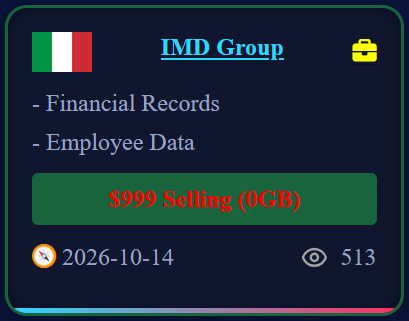
Healthcare and specialized medical manufacturing organizations face acute operational exposure from targeted ransomware incursions. The proprietary designs, regulatory compliance documentation, and firmware specifications managed by medical device engineering firms represent high-leverage assets during extortion. Although the group has not published the full telemetry of the breach, public listings on dark web data repositories indicate that threat operators completed exfiltration milestones prior to attempting destructive disruption.
For organizations operating across sensitive manufacturing and healthcare supply chains, early breach discovery is essential. Verifying whether infrastructure identities or executive credentials have already appeared across underground markets can be evaluated immediately through FemtoSec's Dark Web Scanner, allowing defenders to intercept credential abuse before lateral compromise occurs.
How the Ransomware Operates: Technical Execution and Behavior
NightSpire operators employ a Go-compiled ransomware binary that exhibits distinctive static compilation characteristics. Statically compiled Portable Executable binaries written in Golang present unique analysis hurdles for traditional antivirus solutions due to their large runtime footprint and non-standard symbol layout. By using Go, the operators gain cross-platform compilation flexibility and rapid execution capabilities across corporate endpoints.
Attack Chain: Initial Access to Execution
The operational attack chain deployed by NightSpire operators progresses through methodical stages designed to bypass perimeter defenses, harvest elevated rights, and harvest valuable enterprise records:
Initial Access: Intrusion vectors frequently leverage external remote services such as exposed Remote Desktop Protocol interfaces, brute-force credential spraying, or unpatched edge devices. Operators also deploy weaponized email attachments containing droppers that initiate command execution via native system binaries like conhost.exe.
Defense Evasion: The executable routinely drops into staging paths such as temporary directories or user profiles, utilizing masquerading techniques to mimic benign utility binaries. Payload sections are frequently obfuscated using XOR or RC4 routines to delay heuristic endpoint detection.
Persistence and Privilege Escalation: Attackers establish persistence by spawning rogue administrative user accounts, registering unauthorized Windows services, or configuring scheduled tasks. Operators frequently deploy remote management tooling such as AnyDesk to maintain redundant external control channels.
Discovery and Lateral Movement: Reconnaissance across the internal subnet relies on utility tooling such as Advanced IP Scanner and the standalone search utility Everything.exe for rapid indexed discovery of valuable data repositories. Credential extraction is accomplished by targeting the Local Security Authority Subsystem Service (LSASS) using tools like Mimikatz, after which operators pivot laterally via PsExec (PSEXESVC.exe) and Windows Management Instrumentation (WMI).
Cryptographic Scheme and File System Impact
Once lateral movement achieves administrative coverage, the ransomware binary activates its hybrid cryptographic sequence. The encryptor relies on a combination of AES-256 for symmetric payload speed and RSA-2048 for master key protection. To optimize encryption speed across large enterprise datasets, virtual hard disks, and backup archives, the encryptor implements block-level intermittent encryption, transforming 1MB blocks rather than entire multi-gigabyte containers.
Encrypted records receive the appended extension .nspire, while shadow copies and recovery points are deleted using native utilities to inhibit local recovery. Within every accessed directory, the encryptor drops the ransom advisory text file _nightspire_readme.txt, providing victims with TOR negotiation links, qTox communication identifiers, and payment instructions.
Data Exfiltration Staging
Double extortion forms the core of NightSpire's economic leverage. Before activating the Go encryptor, operators assemble selected file trees containing financial audits, human resource records, engineering schematics, and confidential corporate communications. The operators package these files into password-protected multi-part archives using 7-Zip (7z.exe) and stream the staging archives to cloud repositories through automated utilities such as Rclone, MEGACmd, or WinSCP.