What Happened in the Vinson Process Controls Attack
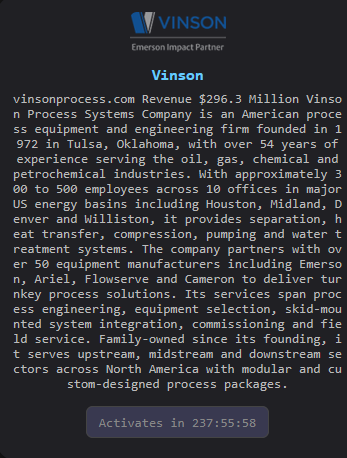
The Gentlemen ransomware operation publicly listed Vinson Process Controls, a United States-based distributor and solutions provider specializing in industrial automation and process control systems, on its dark web disclosure platform. According to the syndicate, adversary operators successfully exfiltrated proprietary corporate and operational data prior to issuing their extortion demand. The group imposed a strict deadline, stating that stolen information will be released in ten days if negotiations fail.
Industrial control service providers occupy a critical position in manufacturing, energy, and automated facility pipelines. By maintaining administrative integrations, proprietary network documentation, telemetry data, and remote operational configurations for industrial clients, firms in this sector present high-value targets for ransomware cartels. Although the initial disclosure primarily highlights corporate data exfiltration, extortion threats against industrial automation vendors consistently introduce downstream supply chain anxiety for asset owners relying on third-party engineering support.
Organizations concerned about exposure can conduct initial verification through rapid discovery tooling. Free domain exposure scan: Use FemtoSec's Dark Web Scanner to check dark web mentions, compromised account indicators, malware log signals, public breach exposure, and recent underground market activity for your domain.
How the Ransomware Operates across Enterprise Networks
The Gentlemen, tracked by external threat researchers under designations such as Storm-2697, GOLD SHERWOOD, and Phantom Mantis, leverages a sophisticated technical attack framework designed for high-velocity compromise and defense evasion. The operational lifecycle typically progresses through distinct stages, beginning with perimeter penetration and culminating in rapid, multi-threaded intermittent encryption.
Initial Perimeter Access and Credential Acquisition
Affiliates associated with The Gentlemen frequently gain initial footholds through known perimeter vulnerabilities across internet-facing gateways and hypervisors. Typical targets include edge infrastructure running vulnerable Fortinet FortiOS solutions, exposed VMware ESXi hypervisor management interfaces, and unprotected Veeam Backup and Replication instances. In parallel, operators acquire initial access from illicit underground brokers or execute credential-stuffing campaigns against single-factor enterprise VPNs and remote desktop services.
Defense Evasion and BYOVD Driver Impairment
Once inside the target environment, the operators deploy specialized evasion tooling designed to blind security operations centers. The group routinely utilizes Bring Your Own Vulnerable Driver (BYOVD) tactics, deploying tools known as GentleKiller or loaders like All.exe paired with vulnerable signed drivers such as ThrottleBlood.sys. Operating with kernel-level authority, these components strip process tokens, terminate security services, and disable Endpoint Detection and Response (EDR) sensors. Concurrently, native system components are manipulated to suppress defenses:
Event Log Eradication: The attackers invoke wevtutil cl across Security, System, and Application logs to disrupt forensic timelines.
Antivirus Disablement: Execution of PowerShell cmdlets such as Set-MpPreference -DisableRealtimeMonitoring $true blinds default host protections.
Recovery Invalidation: Deletion of Volume Shadow Copies through vssadmin delete shadows /all /quiet prevents straightforward system rollbacks.
Lateral Movement and Rapid Go-Based Cryptography
The core encryptor payload associated with The Gentlemen is engineered in Go and protected with the Garble obfuscator. Lateral propagation across Active Directory architectures relies on compromised administrative credentials piped through Server Message Block (SMB), Remote Desktop Protocol (RDP), Windows Management Instrumentation (WMI), and malicious Group Policy Objects (GPOs).
To evade storage throughput bottlenecks, the encryptor utilizes intermittent encryption mechanics. Rather than encrypting entire files, it targets distributed blocks ranging from 0.3 percent to 9 percent of large enterprise documents. The cryptographic routine combines ephemeral Curve25519 elliptic-curve key exchange with the XChaCha20 stream cipher, generating unique 24-byte nonces and appending the base64-encoded public key to file footers alongside dynamic six-character extensions. Prior to detonating the encryptor, operators stage and exfiltrate structured assets using utilities like Rclone and WinSCP to remote cloud storage endpoints.
Who Is Behind the Gentlemen Ransomware Operation
Cybersecurity researchers assess that The Gentlemen operates as a Ransomware-as-a-Service (RaaS) syndicate that emerged around mid-2025. Technical telemetry and code overlap suggest the group functions as a splinter faction originating from the Qilin ransomware ecosystem, breaking away following internal affiliate disputes. The syndicate operates a dedicated Tor data leak blog and recruits seasoned network penetration specialists from underground illicit forums.
The group relies on a distributed affiliate model, providing core payload builders, negotiation infrastructure, and leak site management while external affiliates execute environment-specific reconnaissance, privilege escalation, and data staging. The tactical maturity demonstrated across their intrusions reflects a calculated focus on high-revenue commercial targets where operational downtime and proprietary engineering exposure produce intense financial leverage.
Enterprise Impact and Extortion Pressure on Process Control Vendors
The extortion pressure applied by The Gentlemen relies on an aggressive double-extortion framework. By coupling proprietary data exfiltration with time-limited public disclosure clocks, the syndicate attempts to force victims into private negotiations before incident responders can complete forensic scoping. For organizations operating within the industrial controls and manufacturing domain, this dynamic creates layered operational risks:
Compromise of Client Network Topologies: Industrial solutions providers retain schematic layouts, SCADA network configurations, remote telemetry credentials, and maintenance schedules for external asset owners. Exfiltration of this material introduces downstream vulnerability across the broader client ecosystem.
Regulatory and Contractual Breach Exposure: Corporate disclosures involving engineering files, intellectual property, and proprietary trade agreements trigger strict contractual reporting mandates and reputational harm.
Extended Operational Stoppages: If domain controllers, hypervisors, and industrial engineering workstations suffer encryption, enterprise operations face prolonged recovery delays unless immutable offline backups are available.
Organizations seeking to uncover hidden vulnerabilities within their perimeter and Active Directory environments can engage FemtoSec's proactive Penetration Testing services, while teams wanting an adversarial evaluation of their detection controls should evaluate targeted Red Team Operations.
Detection and Containment Guidance for Defenders
Defending against high-velocity RaaS operations demands immediate containment playbooks, rigorous perimeter vulnerability hygiene, and automated host-level behavioral detection rules. Security teams should deploy the following detection and containment actions across enterprise networks:
High-Priority Containment Procedures
Endpoint and Subnet Quarantine: Immediately sever network connections for any host displaying mass file renaming, abnormal service termination, or unauthorized SMB/WMI remote execution to block lateral propagation.
Revocation of Privileged Credentials: Force enterprise-wide password resets for all Domain Admins and service accounts, and terminate all active Kerberos ticket granting sessions.
Hypervisor and Perimeter Isolation: Disconnect administrative interfaces for VMware ESXi, Veeam backup clusters, and perimeter VPN firewalls until firmware patches and configuration audits are completed.
Host and Network Detection Rules
Security Operations Centers should implement targeted detection logic across their SIEM and EDR platforms:
Vulnerable Driver Invocations: Monitor Windows Event ID 7045 and Sysmon Event ID 6 for newly registered kernel services matching untrusted driver hashes or known BYOVD utilities like ThrottleBlood.sys.
Host Tampering Telemetry: Trigger high-priority alerts on process creation events where vssadmin.exe, wevtutil.exe, or PowerRun.exe execute with suppression arguments.
Outbound Staging Activity: Inspect network border firewalls for unexpected high-volume outbound data transfers channeled through command-line utilities such as rclone.exe or winscp.exe toward public cloud storage services.
To eliminate initial access pathways, organizations should maintain continuous exposure tracking through structured Vulnerability Management programs, validate external assets with Attack Surface Management, and enforce immutable, air-gapped backup protocols across critical operational environments.