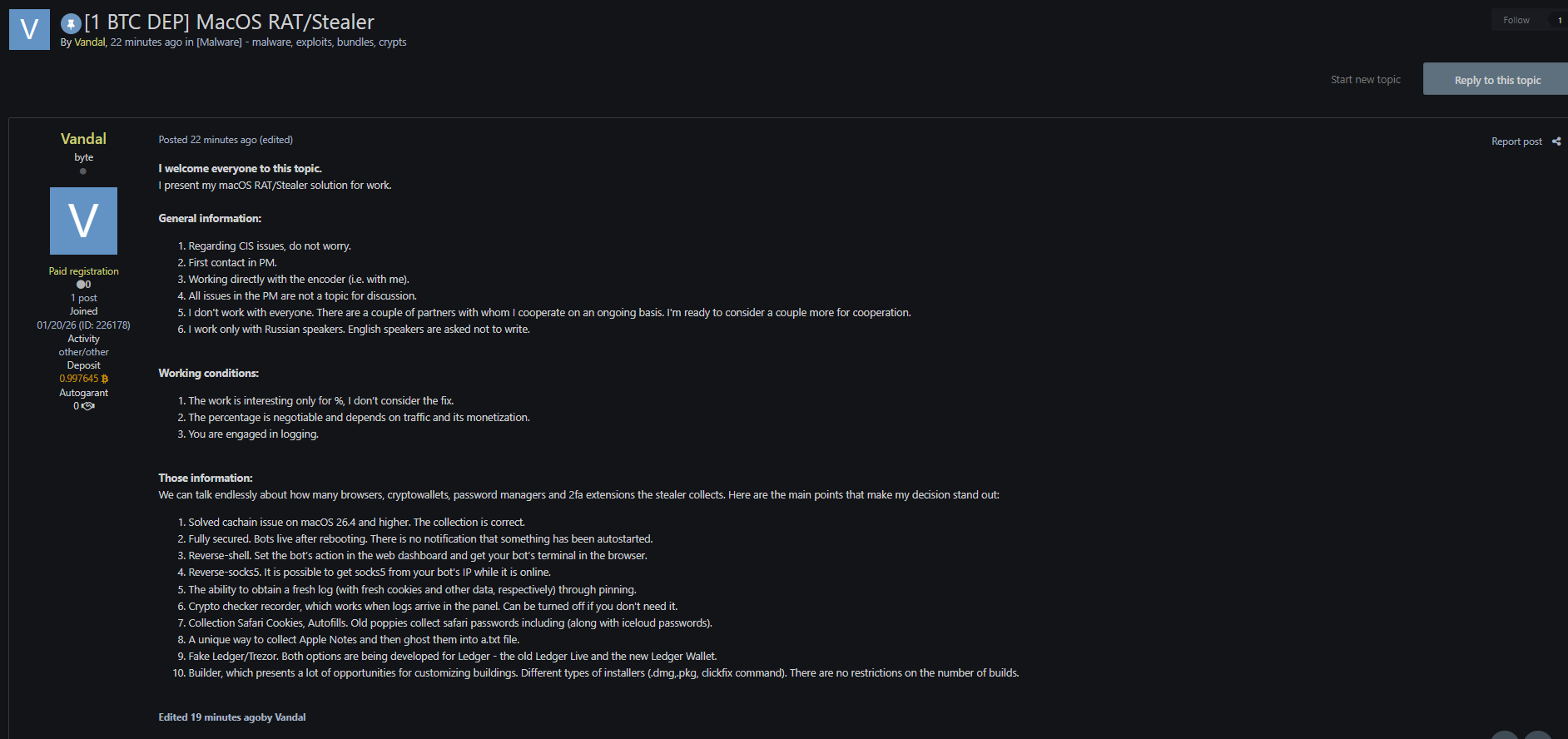
The threat actor claims that this tool provides remote administration capabilities and SOCKS proxy functionality. From a defender perspective, these features are critical as they enable an adversary to maintain long-term persistence and pivot within a network. If an attacker gains control of a single endpoint, they can use the SOCKS proxy to tunnel traffic, effectively bypassing perimeter defenses and reaching internal resources that would otherwise be inaccessible.
Understanding the risk requires looking at the data exfiltration potential. When authentication tokens and browser session data are compromised, standard multi-factor authentication (MFA) mechanisms may be bypassed or rendered ineffective, as the attacker essentially hijacks an already authenticated user session. This is a significant escalation for organizations that rely on cloud-based productivity suites and SaaS platforms.
Enterprise Implications and Defensive Strategy
To defend against sophisticated macOS threats, your organization must adopt a multi-layered approach that moves beyond simple signature-based detection. This involves rigorous Vulnerability Assessments to identify unpatched software that could serve as an initial entry point for malicious payloads. Furthermore, the ability to monitor the dark web for signs of corporate exposure is vital for preemptive defense. You can use FemtoSec's Dark Web Scanner to check for leaked credentials, malware log signals, and signs of domain-specific threats before they escalate into full-scale enterprise breaches.
For teams operating in the GCC, where enterprise macOS adoption is high within creative and technical sectors, the risk of data exfiltration is elevated. Attackers often target the most privileged accounts first. Implementing strict endpoint controls and ensuring that sensitive browser-stored data is protected through hardware-backed security modules can help mitigate the impact of an information stealer infection.
Validation and Response
If an endpoint is suspected to be compromised, the response must be rapid and comprehensive. Simply wiping a device is insufficient if the threat actor has already leveraged the RAT to steal credentials or sessions. Incident response must include a full review of identity and access management logs. Organizations should perform proactive Penetration Testing to simulate how an adversary would move laterally if they gained a foothold on a macOS machine. By understanding the exploit path, security teams can implement compensating controls that restrict the malware's ability to communicate with its command and control server.
Proactive monitoring of the Attack Surface Management landscape also remains critical. By continuously identifying exposed assets and misconfigurations, you can reduce the number of ways an attacker can introduce an info-stealer into your environment. Cybersecurity is not a static challenge, and as attackers pivot to macOS, the need for deep technical validation becomes paramount to protecting your enterprise from evolving threats.