Flash USDT Sender Tool: Risks to Crypto Asset Integrity
A threat actor has surfaced a 'Flash USDT Sender' tool capable of multi-network transfers. This development highlights growing threats to blockchain integrity and the necessity for robust smart contract auditing.

Key Takeaways
- Threat actors are actively promoting Flash USDT Sender tools targeting major blockchain networks.
- These tools pose significant risks to smart contract integrity and secure transaction processing.
- Organizations must shift toward rigorous, audit-first security models for all Web3 infrastructure.
- Proactive monitoring of both network assets and underground forum activity is vital for threat intelligence.
Emerging Threats in Crypto Transfers
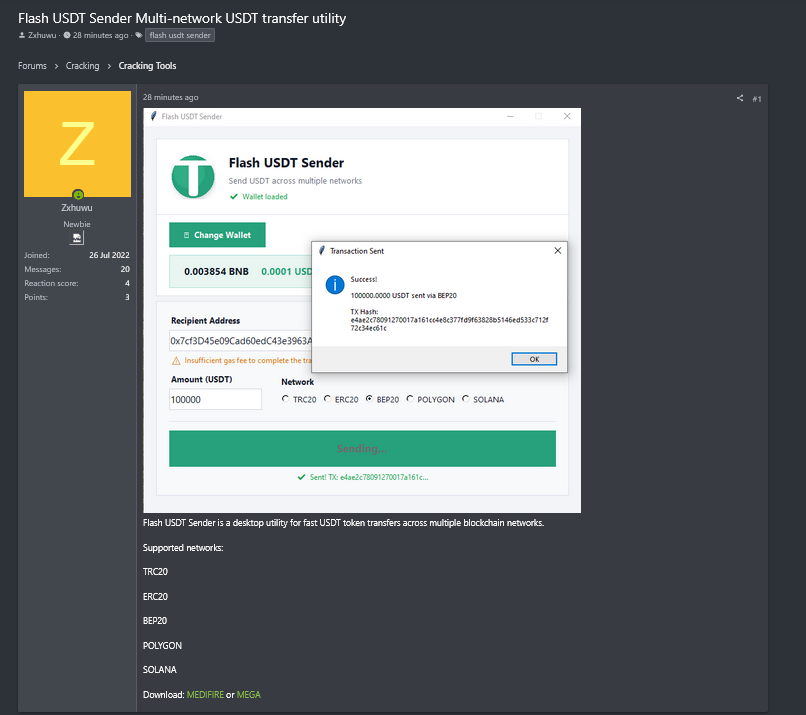
The appearance of a Flash USDT Sender tool in underground forums marks an ongoing evolution in digital asset threats. By targeting multiple blockchain networks including TRC20, ERC20, BEP20, Polygon, and Solana, the threat actor claims to provide a utility capable of facilitating complex multi-network transfers. For enterprises operating in the Web3 space, such tools represent a tangible risk to ledger integrity and asset security.
As digital assets remain a prime target for malicious actors, companies must pivot toward a proactive defensive posture. Understanding how these tools function is the first step in mitigating potential exposure. Security teams should prioritize comprehensive Smart Contract Auditing to identify logic flaws or vulnerabilities that could be exploited by such tools to manipulate transfer flows or simulate unauthorized transactions.
The Dangers of Malicious Utility Tools
Tools designed to simulate or 'flash' cryptocurrency transactions often leverage underlying weaknesses in how blockchain platforms handle pending state changes or contract interactions. Whether they intend to deceive liquidity pools, exploit exchange APIs, or commit fraudulent transfers, the presence of these tools in the wild signals an increased risk of social engineering and technical exploitation against crypto-native infrastructure.
Enterprises need to move beyond standard security perimeters and focus on the security of their transaction logic. If your organization processes high-value digital assets, relying on automated checks is insufficient. You require in-depth assessment to ensure that your smart contracts are resilient against sophisticated, multi-chain manipulation tactics.
Proactive Defense and Exposure Reduction
The first line of defense is ensuring that your entire attack surface is visible and hardened. By continuously monitoring for unauthorized activity or misconfigurations, you can reduce the window of opportunity for attackers. Furthermore, understanding your digital footprint is essential to preventing credential theft or service-based exploits that often precede the deployment of these malicious tools.
Free exposure check
Dark Web Scanner
check dark web mentions, compromised account indicators, malware log signals, public breach exposure, and recent underground market activity for your domain.
In addition to technical monitoring, organizations should engage in regular Penetration Testing to simulate how an adversary would utilize such tools against your specific infrastructure. This process allows you to uncover hidden weaknesses in your API integrations and wallet management systems, ensuring that your enterprise remains secure in an increasingly volatile digital landscape.
How to Defend Against Similar Threats
- Perform a deep-dive security review of all active smart contracts to identify potential exploit vectors.
- Implement continuous attack surface management to identify and harden exposed API and transaction endpoints.
- Utilize dark web monitoring to stay ahead of discussions involving your enterprise or domain in underground markets.
- Conduct regular red team exercises to simulate real-world adversary attempts to manipulate asset transfer flows.
Threat Intel FAQ
What is a Flash USDT Sender tool?
How can I protect my organization against these types of threats?
Could a similar threat affect your organization?
If your team may be exposed to a similar threat, FemtoSec can help validate blast radius, prioritize remediation, and connect the issue to a practical security program.
Related Threats
October 7, 2026
AbkoRAT License Sale Fuels Remote Surveillance Threat
Underground forums have observed threat actors commercializing AbkoRAT, a commercial Remote Access Trojan engineered for stealthy surveillance, multimedia interception, credential harvesting, and arbitrary command execution across compromised enterprise hosts.
October 1, 2026
FATETRAFFIC Threat Actor Sells Stealer Logs
A threat actor has advertised a batch of 3,100 FATETRAFFIC stealer logs on underground cybercrime forums. The archive contains harvested browser credentials, active session tokens, and endpoint metadata collected through widespread information-stealer malware operations.
September 18, 2026
Hermes Stealer Emerges with HVNC and Token Theft
A new malware-as-a-service offering named Hermes has surfaced on underground forums, bundling hidden virtual desktop control, browser credential harvesting, crypto wallet theft, and remote command execution.