Malwarehigh
TRC20 Wallet Drainer Emerges on Dark Web
A threat actor has begun offering a TRC20 wallet drainer dubbed the Grand Theft Crypto System, marking a rise in targeted crypto-malware services. Explore defensive measures.
A threat actor has begun offering a TRC20 wallet drainer dubbed the Grand Theft Crypto System, marking a rise in targeted crypto-malware services. Explore defensive measures.
Recent threat intelligence indicates that a malicious actor is offering a new TRC20/TRON blockchain wallet drainer for sale. This tool, marketed as a Malware-as-a-Service (MaaS) product under the brand name Grand Theft Crypto (GTC) System, is designed to automate the theft of cryptocurrency directly from unsuspecting users' wallets. The availability of this technology on underground forums underscores the professionalization of crypto-crime, where attackers no longer need to be sophisticated developers to execute large-scale financial theft.
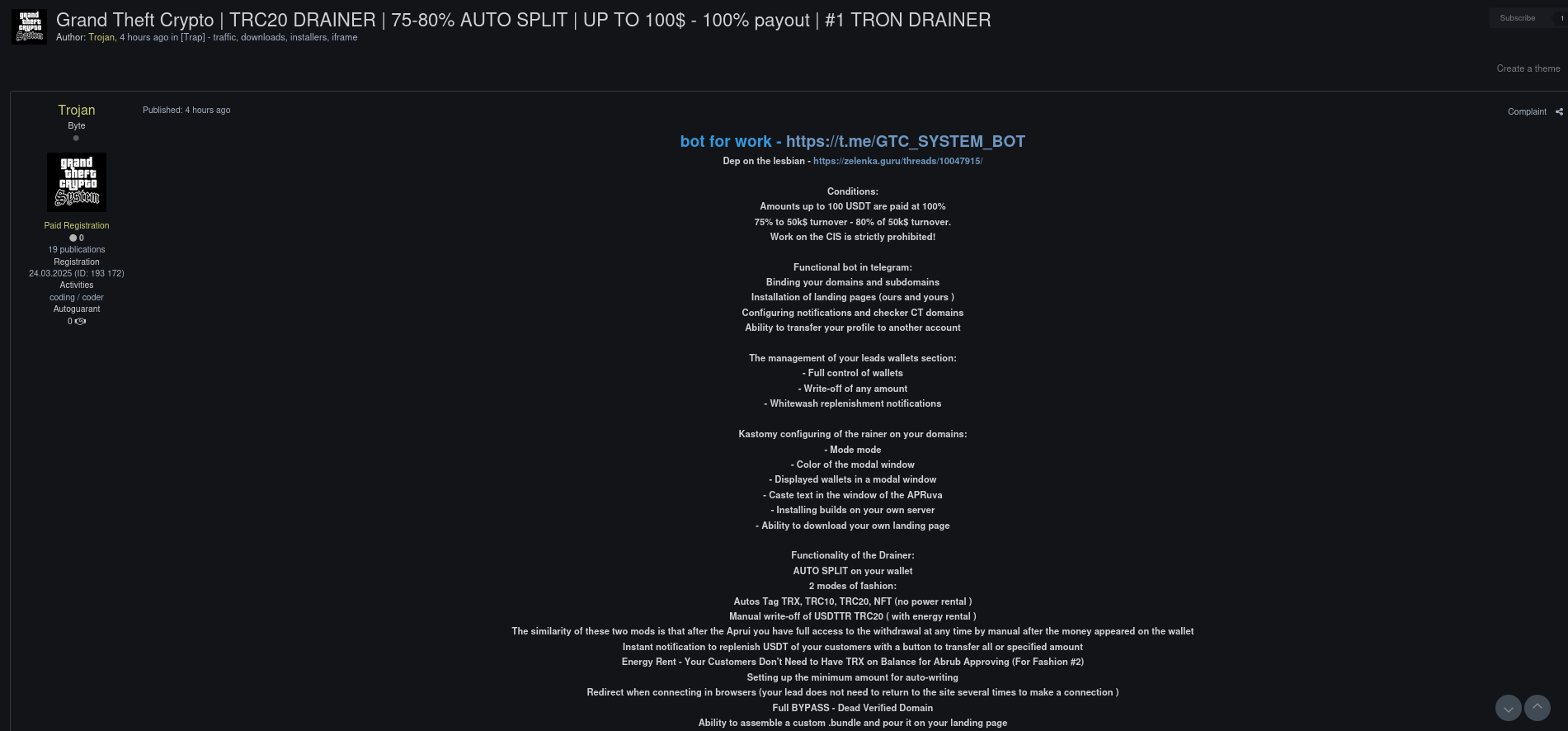
As blockchain-based financial systems expand in the GCC region, the threat of specialized malware targeting digital assets becomes increasingly relevant for both enterprises and individual stakeholders. The GTC System represents a shift toward more accessible, ready-to-use exploit kits specifically tailored for TRC20-based protocols.
The rise of MaaS models for wallet draining signifies a lower barrier to entry for adversaries. When a threat actor can purchase an off-the-shelf exploit kit, the frequency and volume of attacks often spike. Organizations operating in the Web3 space or handling significant crypto-treasuries must recognize that their attack surface extends far beyond traditional network perimeters. A robust defense strategy requires continuous Smart Contract Auditing to ensure that internal protocols are not being bypassed by these evolving malware strains.
Furthermore, the threat is not just limited to the smart contract layer. Attackers frequently use social engineering to trick users into connecting their wallets to malicious front-ends, where the drainer script executes. This reinforces the need for organizational maturity in security posture. If your organization is involved in decentralized finance or crypto-asset management, proactively assessing your exposure through Attack Surface Management is essential to prevent unauthorized access.
Free exposure check
Dark Web Scanner
check dark web mentions, compromised account indicators, malware log signals, public breach exposure, and recent underground market activity for your domain.
Addressing these threats requires a multi-layered approach. The ability to defend against specialized crypto-malware starts with visibility. Threat actors frequently iterate on their code to evade detection. By maintaining a proactive security posture, enterprises can identify weaknesses in their deployment pipelines and user access controls before they are weaponized by the GTC System or similar tools.
Compliance and security governance are not just regulatory hurdles; they are the bedrock of operational resilience in an era where malicious actors are weaponizing legitimate-looking services. For businesses, the focus must remain on hardening the infrastructure, educating end-users, and ensuring that no single point of failure exists within their digital financial workflows.
FemtoSec provides a comprehensive range of defensive services, including offensive security and vulnerability assessments, designed to protect your organization from sophisticated threats. Our team operates with deep regional knowledge, ensuring that your security measures are not only compliant with international standards like PCI-DSS and SOC 2 but also specifically optimized for the threat landscape in the GCC region.
If your team may be exposed to a similar threat, FemtoSec can help validate blast radius, prioritize remediation, and connect the issue to a practical security program.
July 25, 2026
Defenders prioritizing mobile endpoint integrity must immediately audit Android Accessibility Service authorizations to counter BTMOB RAT v4.6. This technical analysis explores the malware's delivery vectors, capabilities like 2FA bypass, and step-by-step containment protocols.
October 7, 2026
Underground forums have observed threat actors commercializing AbkoRAT, a commercial Remote Access Trojan engineered for stealthy surveillance, multimedia interception, credential harvesting, and arbitrary command execution across compromised enterprise hosts.
October 1, 2026
A threat actor has advertised a batch of 3,100 FATETRAFFIC stealer logs on underground cybercrime forums. The archive contains harvested browser credentials, active session tokens, and endpoint metadata collected through widespread information-stealer malware operations.