Malwaremedium
Threat Actor Offers CRUNCHY Account Checker Tool
A threat actor has surfaced with a high-speed credential validation tool named CRUNCHY. We analyze the implications for account security and enterprise risk.

A threat actor has surfaced with a high-speed credential validation tool named CRUNCHY. We analyze the implications for account security and enterprise risk.
In the evolving landscape of automated credential abuse, a new threat has emerged with the appearance of a tool dubbed CRUNCHY. This software is specifically engineered as a high-speed account checker, designed to ingest large lists of username and password combinations—typically in the common EMAIL:PASS format—and validate them against target services. The existence of such tools highlights the persistent threat of automated account takeover (ATO) attacks, where malicious actors attempt to gain unauthorized access to accounts using credentials harvested from past breaches.
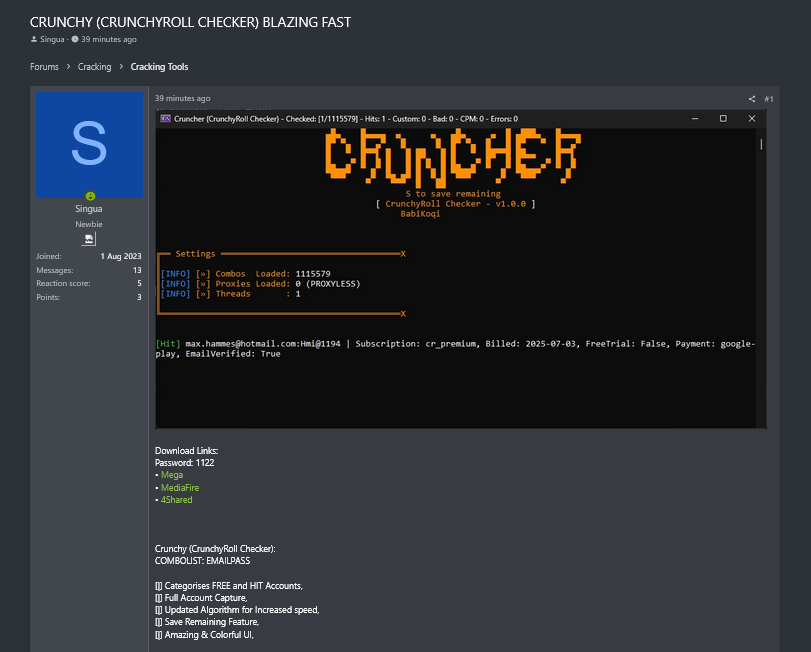
The CRUNCHY tool provides sophisticated features that streamline the malicious process for threat actors. These include the ability to categorize accounts as either 'FREE' or 'HIT' (confirmed valid credentials), automated checking capabilities, and the capacity to save remaining unverified combinations for future attempts. Furthermore, the tool includes an updated algorithm for faster processing, which allows attackers to bypass rate limiting or security delays that might otherwise protect service providers.
While tools like CRUNCHY are often developed to target consumer services, the underlying methodology poses a significant risk to enterprises. The phenomenon of credential stuffing relies on the fact that users frequently reuse passwords across multiple platforms. If a user utilizes the same corporate password for a personal account that gets compromised and validated by tools like CRUNCHY, the attacker gains a high-value entry point into the organization's ecosystem. Free domain exposure scan: Use FemtoSec's Dark Web Scanner to check dark web mentions, compromised account indicators, malware log signals, public breach exposure, and recent underground market activity for your domain.
Addressing these threats requires a proactive stance that goes beyond simple password policies. Enterprises must integrate comprehensive Dark Web Monitoring to identify if corporate credentials are actively being traded or checked in underground forums. When credentials are known to be compromised, the risk of automated tools being utilized against company portals increases exponentially, necessitating constant vigilance.
Defending against automated credential validation requires a multi-layered security strategy. First, security teams must implement robust multi-factor authentication (MFA) that is resistant to traditional credential stuffing. Second, organizations should ensure their Attack Surface Management strategies account for all entry points, ensuring that administrative portals and employee-facing applications are not exposed to the public internet without necessary safeguards like geo-blocking, rate limiting, and behavioral analysis. Attackers are constantly refining their algorithms; our defense must be equally dynamic. By conducting regular Penetration Testing, organizations can identify where their authentication processes might be susceptible to automated brute-forcing or dictionary attacks, allowing for remediation before threat actors successfully leverage such tools against corporate resources. Maintaining a posture of zero trust is no longer optional in an era where high-speed credential validation is a commodity available to low-skill actors.
If your team may be exposed to a similar threat, FemtoSec can help validate blast radius, prioritize remediation, and connect the issue to a practical security program.
August 19, 2026
A threat actor on the Exploit forum is selling ZXCHECKER, a multi-chain cryptocurrency wallet validator designed to check balances across BTC, LTC, DOGE, DASH, and ETH. Discover the threat profile, technical attack chain, and steps to protect enterprise keys.
July 25, 2026
Defenders prioritizing mobile endpoint integrity must immediately audit Android Accessibility Service authorizations to counter BTMOB RAT v4.6. This technical analysis explores the malware's delivery vectors, capabilities like 2FA bypass, and step-by-step containment protocols.
July 24, 2026
The full-chain DarkSword iOS exploit kit source code has been leaked on an underground forum. We analyze the technical mechanics of the multi-stage execution framework, its in-memory implants, and critical containment steps for enterprise environments.