Telegram Bot Scraping Services Pose New Enterprise Risks
A surge in illicit Telegram bot scraping and parsing services creates new challenges for enterprise data security and automated business processes, requiring proactive defense strategies.

Key Takeaways
- Threat actors are selling automated Telegram scraping services capable of bypassing existing bot protections.
- Scraped data includes product listings, pricing, and inventory information, facilitating unauthorized arbitrage.
- The use of AI-assisted scraping tools enables threat actors to scale their operations quickly.
- Businesses need to prioritize securing their bot interfaces just as they secure traditional web applications.
The Rise of Automated Telegram Scraping
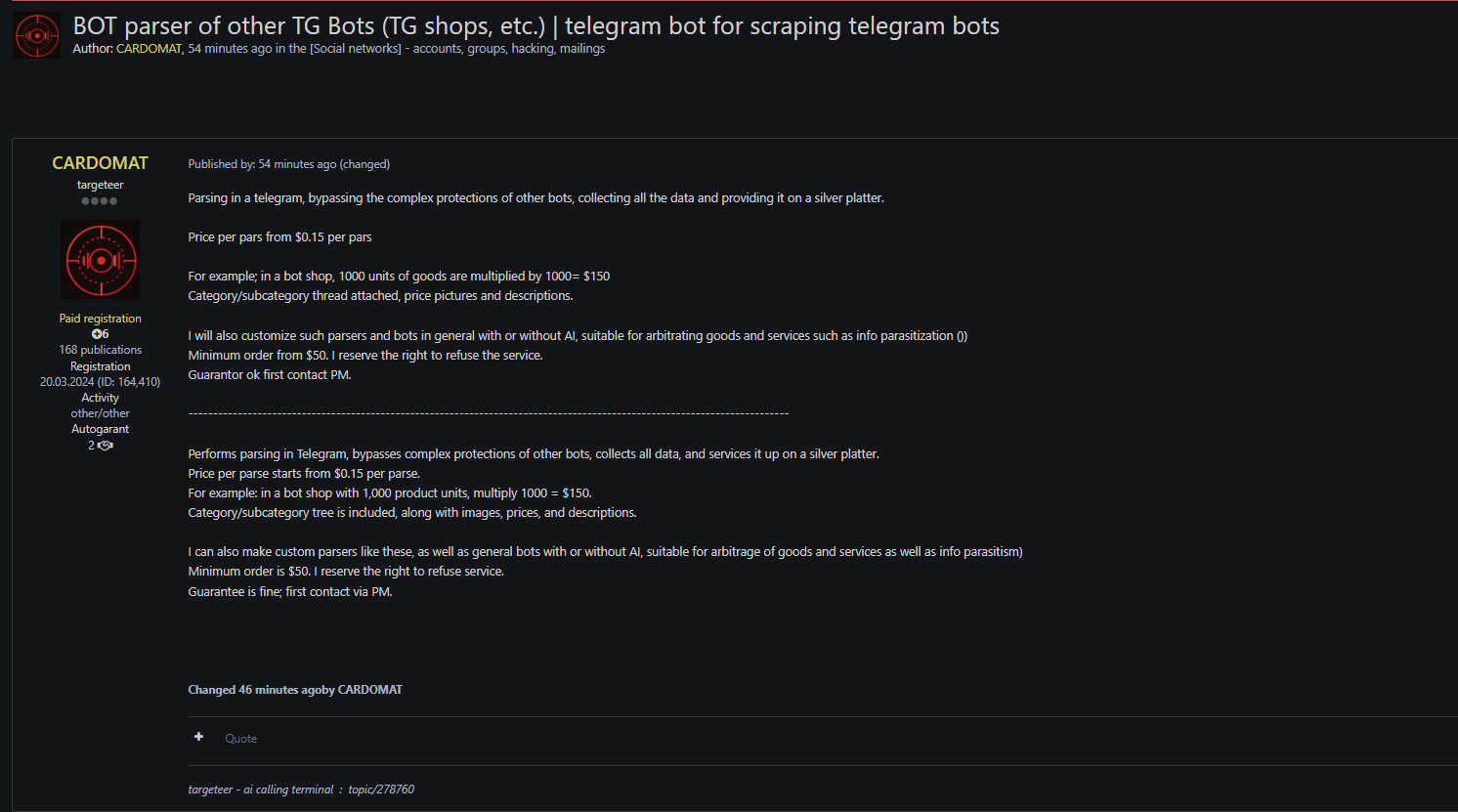
Recent threat intelligence reports from forums like exploit.in have highlighted an emerging market for Telegram bot scraping and parsing services. Threat actors are actively advertising capabilities designed to bypass standard protections on Telegram-based commercial bots. By harvesting structured data such as product listings, pricing details, and inventory imagery, these actors are building tools that threaten the operational integrity of businesses relying on automated Telegram commerce.
Beyond Simple Data Harvesting
The danger is not limited to mere content duplication. The reported services are specifically designed to facilitate arbitrage and mass data aggregation. This shift toward AI-assisted scraping allows threat actors to automate complex tasks, effectively turning enterprise-facing bots into sources for unauthorized third-party profit. This development serves as a critical reminder that any digital interaction, including those within messaging apps, is an extension of the enterprise attack surface management challenge.
The Strategic Risk to Enterprises
For organizations operating in the GCC, these developments highlight a broader need for visibility into how company assets are being consumed or manipulated by external actors. When a malicious actor can systematically extract product pricing or sensitive category information, they are not only conducting a privacy intrusion but are also positioning themselves to disrupt competitive pricing strategies and supply chain transparency. A robust defense begins with rigorous vulnerability assessments that evaluate how automated interfaces are secured against unauthorized access.
Mitigating Data Exposure and Scraping Threats
Enterprises must adopt a multi-layered security approach to counteract these scraping threats. It is no longer sufficient to rely on basic authentication. Security teams should ensure that all API endpoints and bot interfaces undergo continuous testing. Furthermore, monitoring the dark web for mentions of your organization or your specific bot identifiers is essential to stay ahead of automated threat campaigns. By proactively identifying leaked credentials or patterns of abuse, companies can block unauthorized scrapers before they scale their activities.
As these tools become more sophisticated, leveraging AI for data aggregation, the defense must also be agile. This implies a transition toward continuous, automated testing cycles that can detect weaknesses in bot logic and response mechanisms. Proactive defense ensures that your business logic remains under your control, mitigating the risk of data theft or unauthorized exploitation.
Why Proactive Defense Matters
At FemtoSec, we understand that modern enterprises require more than just reactive security; they need an offensive-minded strategy that anticipates how attackers think. Whether it is securing APIs or monitoring for signs of targeted scraping, our team supports GCC enterprises in fortifying their digital perimeters. Reach out to our consultants to discuss how you can implement comprehensive protection measures tailored to your unique infrastructure.
How to Defend Against Similar Threats
- Conduct regular security assessments of all customer-facing bot architectures and APIs.
- Implement rate limiting and behavioral analytics to identify and block automated scraping activity.
- Engage in continuous dark web monitoring to detect if your business assets are targets of data harvesting.
- Rotate API keys and strengthen authentication mechanisms for all automated service endpoints.
Threat Intel FAQ
How can I protect my enterprise Telegram bots from automated scrapers?
Are these scraping services specific to one industry?
Could a similar threat affect your organization?
If your team may be exposed to a similar threat, FemtoSec can help validate blast radius, prioritize remediation, and connect the issue to a practical security program.
Related Threats
July 25, 2026
BTMOB RAT v4.6 Mobile Malware Threat Analysis
Defenders prioritizing mobile endpoint integrity must immediately audit Android Accessibility Service authorizations to counter BTMOB RAT v4.6. This technical analysis explores the malware's delivery vectors, capabilities like 2FA bypass, and step-by-step containment protocols.
September 13, 2026
Cloud Module Breach Sparks Automated Resource Theft
A cloud authentication misconfiguration enabled automated external actors to gain unauthorized access to backend modules in an educational software ecosystem. While personal databases remained secure, the incident highlights critical supply chain and cloud access risks.
October 7, 2026
AbkoRAT License Sale Fuels Remote Surveillance Threat
Underground forums have observed threat actors commercializing AbkoRAT, a commercial Remote Access Trojan engineered for stealthy surveillance, multimedia interception, credential harvesting, and arbitrary command execution across compromised enterprise hosts.