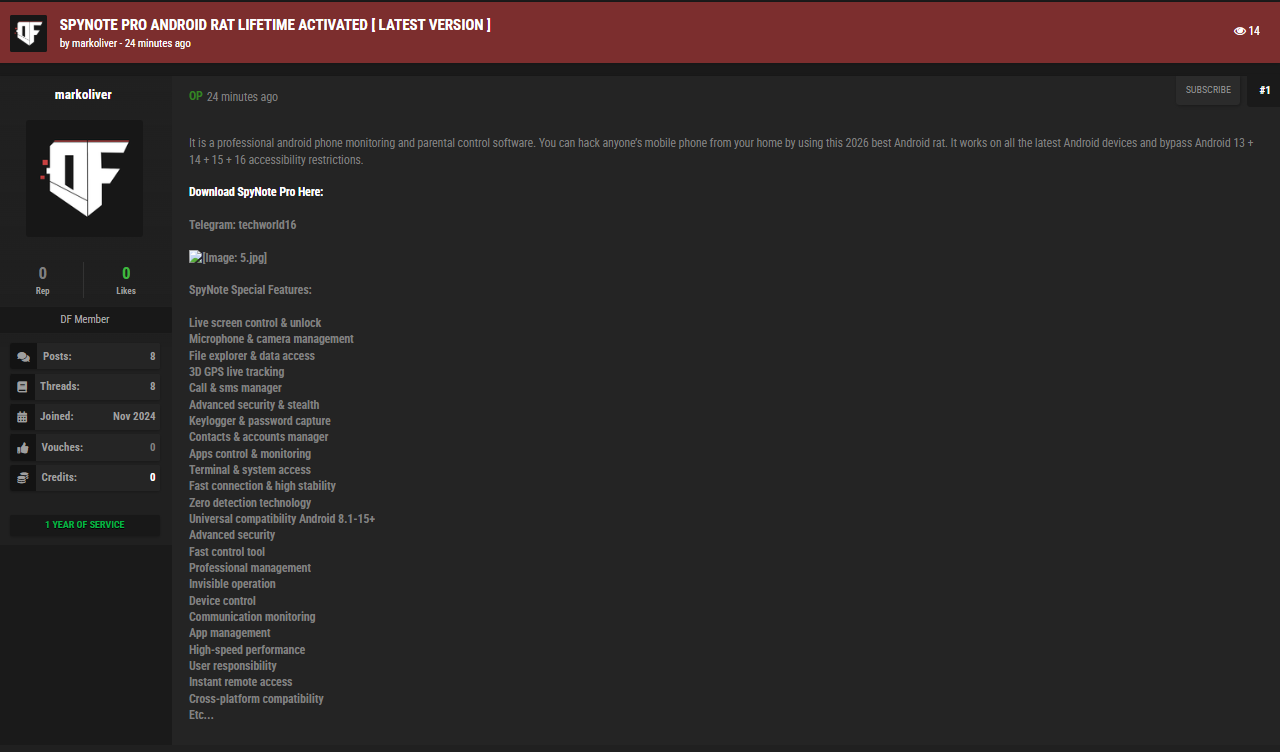
The commercial sale of SpyNote Pro Android RAT on underground forums highlights a growing mobile threat. Discover how this malware abuses accessibility services, performs dynamic payload execution, and executes overlay attacks to steal sensitive corporate credentials and bypass multi-factor authentication.


If your team may be exposed to a similar threat, FemtoSec can help validate blast radius, prioritize remediation, and connect the issue to a practical security program.
The alleged sale of Seedox malware on underground forums exposes cryptocurrency holdings to severe risk. This specialized tool monitors clipboards and scans local and removable drives to extract wallet recovery seed phrases, allowing cybercriminals to bypass traditional cryptographic protections.

The alleged sale of the Stealc_v2 information-stealing malware source code on the exploit.in forum introduces major corporate security challenges. Featuring a PHP administration panel, customizable builders, and Telegram bot integrations, this leak enables rapid deployment of stealthy credential-harvesting campaigns.

June 25, 2026
A threat actor is selling the source code of the Predator 1.6 remote access trojan and file binder on the cybercrime forum Spear. This development lowers the technical barrier for deploying persistent backdoors, posing immediate security risks that demand behavioral EDR rules and path restrictions.
Sideloaded Android application packages (APKs) that bypass traditional static signature detection represent a persistent vector for mobile enterprise intrusion. The active advertising and sale of SpyNote Pro on dark web marketplaces and hacker forums such as demonforums.net highlights the expanding availability of advanced Android Remote Access Trojans (RATs) to cybercriminals. Operating under a malware-as-a-service (MaaS) distribution model, this highly intrusive toolkit enables complete remote device control, surveillance, credential theft, and overlay fraud. By misusing administrative capabilities on target mobile operating systems, SpyNote Pro systematically strips away on-device privacy protections, creating a severe operational and financial risk for modern enterprises supporting remote workforces. Understanding the mechanisms of this threat is vital for security teams charged with protecting corporate mobile fleets.
rule Android_SpyNote_RAT_Custom {
meta:
description = The SpyNote family, which includes closely related variants such as SpyMax and CypherRat, has a long history of underground development dating back to mid-2016. Its commercial iteration, SpyNote Pro, has evolved into a highly professional software suite marketed actively on hacking boards and Telegram channels. Cybercriminals favor this particular RAT because of its sophisticated builder interface, which allows even low-skilled attackers to compile custom malicious APKs. The builder features options for fully undetectable (FUD) obfuscation, dynamic payload packing, and the ability to bind the malicious payload to legitimate applications like web browsers or utilities.
Furthermore, the SpyNote Pro variant is built to systematically evade modern defense mechanisms, including the native Google Play Protect service. By using advanced payload packing and randomized string structures, the malware minimizes its static signature footprint, rendering traditional on-device antivirus solutions ineffective. It also incorporates specific operational checks to detect sandbox environments and security researcher emulators, terminating its execution if dynamic analysis tools are detected.
The operational workflow of SpyNote Pro is highly structured, moving from initial delivery to deep privilege exploitation and eventually payload delivery. Security teams must analyze each phase of this chain to design effective defense in depth strategies.
Because the malware cannot be listed on the official Google Play Store, attackers rely extensively on social engineering to achieve initial access. The typical delivery vector begins with smishing (SMS phishing) campaigns or social engineering links distributed through messaging applications. These links direct target users to highly convincing domain names that mimic official application updates or security tools, such as fake Google Chrome updates or cellular provider utilities. The destination web servers use cloned HTML and CSS templates to simulate an official Android marketplace interface. When a user clicks the download button, a malicious JavaScript function initiates the direct download of the Stage-1 dropper APK, prompting the user to bypass standard operating system warnings regarding installations from unknown sources.
Once the user runs the Stage-1 dropper, the application initiates an evasion process to dynamically load its core modules. Rather than storing the malicious code in plain text, the payload is encrypted and embedded within the app assets. The dropper dynamically extracts its own package details from the Android manifest file. In a verified campaign, the malware used the target package name of rogcysibz.wbnyvkrn.sstjjs to dynamically generate a 16-byte AES decryption key in hexadecimal form: 62646632363164386461323836333631.
Using this key, the dropper decrypts the encrypted payload stored in the application assets. It then utilizes DEX element injection, a sophisticated technique that loads the core Java classes directly into the running memory process at runtime. This dynamic loading bypasses disk-based scanners completely, since the malicious executable payload never exists as an independent file on the device file system.
Upon successful memory execution, the SpyNote Pro payload immediately displays intrusive prompts requesting access to Android's Accessibility Services (specifically using the android.permission.BIND_ACCESSIBILITY_SERVICE permission). This is the critical step in the compromise. Once the user grants accessibility access, SpyNote Pro abuses this service to programmatically grant itself all other required permissions without any further user interaction.
By simulating user clicks in the background, the malware automatically approves permissions to read SMS messages, track physical GPS location, record audio, and access the device camera. It also configures itself to bypass battery optimization settings, ensuring that the background communication processes are not terminated by the operating system power management services. Finally, to prevent removal, the malware abuses accessibility controls to immediately close any system settings menus if the user attempts to manually uninstall the application or revoke its administrative permissions.
With complete system control established, SpyNote Pro begins executing its malicious objectives. The Trojan is equipped with an overlay module that monitors running foreground applications. When it detects that the user is opening a targeted mobile banking portal, corporate single sign-on (SSO) gateway, or cryptocurrency wallet application, the malware dynamically injects a malicious HTML overlay screen directly over the legitimate interface. The user, believing they are interacting with a secure application, enters their login credentials, which are captured in real-time and exfiltrated to the attacker's command and control (C2) server.
Simultaneously, the keylogging module captures all on-screen keystrokes, while the SMS interception module actively monitors incoming messages. This allows the threat actor to harvest multi-factor authentication (MFA) codes and one-time passwords (OTPs) sent via SMS, effectively neutralizing enterprise identity protections.
For modern organizations, particularly those utilizing a Bring Your Own Device (BYOD) model or deploying corporate mobile devices, SpyNote Pro represents a severe point of exposure. Because the malware can capture SMS OTPs and keylog enterprise SSO portals, a single compromised mobile device can serve as the initial access point for a wider breach of corporate network infrastructure. Threat actors can use the stolen credentials to access corporate email accounts, cloud databases, and development environments.
Additionally, the threat poses high regulatory and compliance risks. With the capability to record audio via the microphone, capture video through the camera, and exfiltrate entire contact lists and call logs, SpyNote Pro can lead to significant corporate espionage and data leakage. This is particularly concerning for regulated sectors in the GCC region, where data protection compliance mandates strict controls over the handling of sensitive client information. Organizations must recognize that mobile endpoints are an active extension of their attack surface.
Defending against a sophisticated mobile threat like SpyNote Pro requires a combination of network monitoring, endpoint auditing, and automated controls. Security teams should implement validation and containment steps immediately if an infection is suspected.
To validate a potential compromise, administrators should audit device settings for any unknown services under the Accessibility menu. Another indicator is the sudden disappearance of an application icon immediately after installation, combined with high background battery consumption and continuous outbound TCP connections over non-standard ports (such as 8282 or 1935) targeting unusual domain names utilizing the `.top` top-level domain.
If an active compromise is confirmed, incident response teams should execute the following containment playbook:
Network Isolation: Place the affected mobile device in Airplane Mode immediately to terminate the active TCP socket connection with the C2 infrastructure, halting any ongoing exfiltration of credentials or surveillance feeds.
Safe Mode Boot: Boot the device into Safe Mode. This startup mode prevents third-party applications and malicious accessibility services from executing, allowing administrators to modify system configurations without automated interference from the malware.
Revoke Permissions and Uninstall: While in Safe Mode, navigate to the device security settings, revoke Device Administrator access for the suspicious application, disable its Accessibility permissions, and perform a clean uninstallation of the package.
Credential Rotation: Force an immediate password reset and session revocation across all corporate portals, email accounts, and financial services associated with the user of the compromised device. Because the malware keylogs keystrokes, any credentials typed on the device must be treated as fully compromised.
Factory Reset: Given the risk of persistent secondary payloads downloaded dynamically after initial execution, performing a complete factory reset of the mobile device is highly recommended to guarantee complete remediation.