Malwarehigh
ScreenConnect Loader Threat: Bypassing Endpoint Defenses
A newly reported custom CMD loader targeting ScreenConnect highlights evolving evasion tactics, allowing threat actors to bypass native Windows and browser security protocols.
A newly reported custom CMD loader targeting ScreenConnect highlights evolving evasion tactics, allowing threat actors to bypass native Windows and browser security protocols.
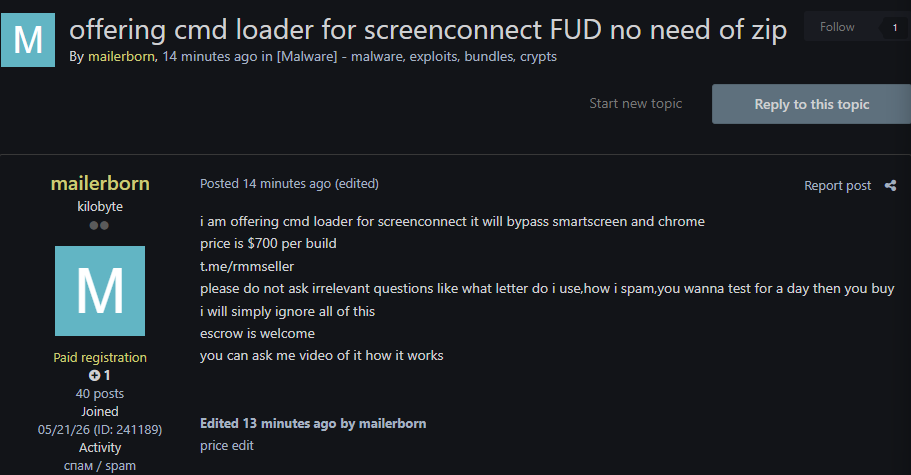
Recent threat intelligence reports from underground forums indicate that malicious actors are actively marketing a custom CMD loader specifically engineered to compromise ScreenConnect environments. This tool is explicitly designed to bypass native security mechanisms, including Microsoft SmartScreen and security protections integrated into the Google Chrome browser. By circumventing these controls, attackers aim to execute unauthorized payloads while effectively evading endpoint detection and response systems.
ScreenConnect, a widely utilized remote management and monitoring (RMM) solution, has historically been a high-value target for adversaries seeking persistent access to corporate networks. When an attacker gains the ability to deliver custom loaders that bypass established security boundaries, the risk of initial access, lateral movement, and subsequent ransomware deployment increases significantly. Organizations relying on remote support tools must understand that their edge management software often represents a primary vector for sophisticated threat actors.
The reported loader operates by manipulating the execution environment to trick user-centric security warnings. Microsoft SmartScreen and browser-based protection systems typically rely on reputation-based filtering and signature matching to block potentially malicious files. By crafting a loader that masquerades as legitimate traffic or utilizes obfuscated command chains, attackers attempt to normalize the execution of malicious instructions. For security teams, this signifies a shift toward more complex, multi-stage attack chains that prioritize evading initial detection phases.
If your organization utilizes remote access solutions, it is critical to assume that these tools are under constant surveillance by attackers. Continuous validation of your security posture is no longer optional. Proactive measures such as Penetration Testing can help identify how an attacker might leverage existing infrastructure to deploy similar payloads. Furthermore, ensuring that your Attack Surface Management strategy includes deep visibility into remote support binaries and their configuration is essential to preventing unauthorized execution.
Free exposure check
Dark Web Scanner
check dark web mentions, compromised account indicators, malware log signals, public breach exposure, and recent underground market activity for your domain.
Endpoint Hardening: Enforce strict application control policies that restrict the execution of unauthorized scripts and binaries, particularly those originating from RMM-related processes.
Network Segmentation: Isolate remote access infrastructure within dedicated network segments, restricting movement to and from critical internal assets.
Behavioral Analysis: Shift focus from signature-based detection to behavioral analysis of processes spawned by support tools. Monitor for unusual CMD, PowerShell, or WMI activity linked to the RMM service.
Access Lifecycle Management: Implement conditional access policies and ensure that credentials associated with remote access services are protected by robust multi-factor authentication (MFA) and rotated frequently.
By integrating comprehensive security intelligence into your operational workflow, you can effectively reduce the risk posed by advanced loaders and maintain organizational integrity against evolving threats.
If your team may be exposed to a similar threat, FemtoSec can help validate blast radius, prioritize remediation, and connect the issue to a practical security program.
October 7, 2026
Underground forums have observed threat actors commercializing AbkoRAT, a commercial Remote Access Trojan engineered for stealthy surveillance, multimedia interception, credential harvesting, and arbitrary command execution across compromised enterprise hosts.
October 5, 2026
Underground advertisements offering commercial licenses for XWorm V3.0 highlight the persistent threat of modular Remote Access Trojans capable of surveillance, keylogging, and complete Windows endpoint compromise across enterprise environments.
October 1, 2026
A threat actor has advertised a batch of 3,100 FATETRAFFIC stealer logs on underground cybercrime forums. The archive contains harvested browser credentials, active session tokens, and endpoint metadata collected through widespread information-stealer malware operations.