Malwarehigh
Raton RAT Malware: New Remote Access Threat Emerges
A new remote access trojan dubbed Raton RAT has surfaced on underground forums, offering sophisticated features including webcam and microphone surveillance.
A new remote access trojan dubbed Raton RAT has surfaced on underground forums, offering sophisticated features including webcam and microphone surveillance.
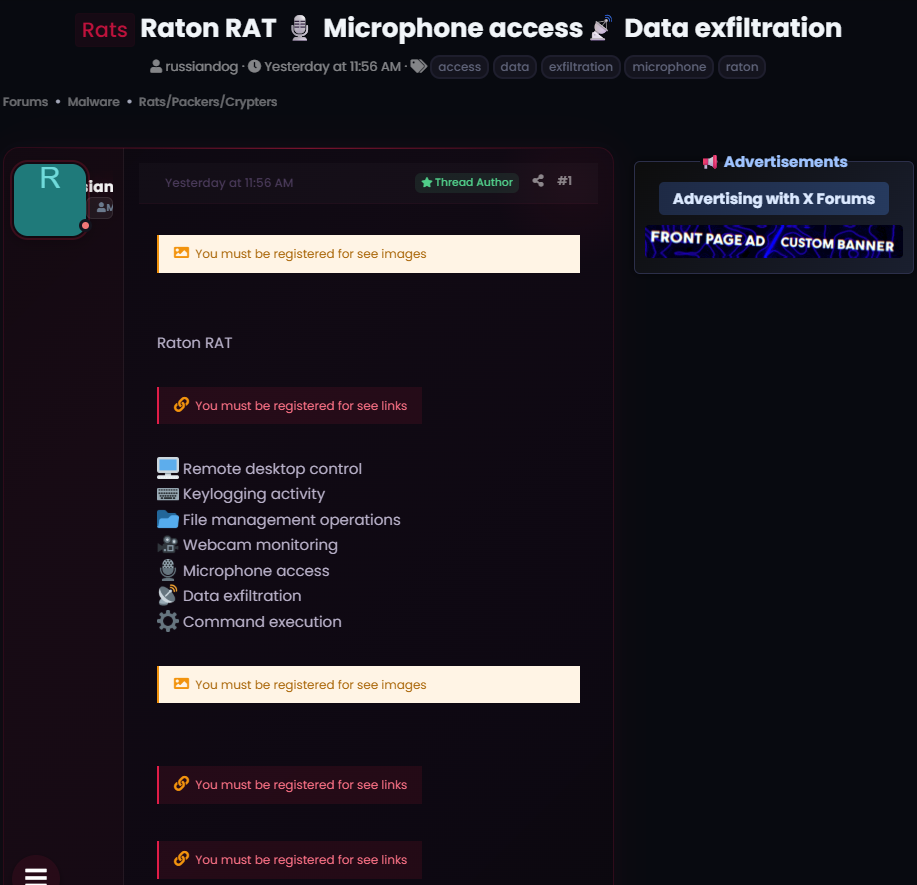
The emergence of the Raton RAT malware highlights an ongoing challenge for modern enterprise security teams. According to recent intelligence, this remote access trojan provides threat actors with a comprehensive suite of capabilities designed for full system compromise. The toolset reported includes remote desktop control, advanced keylogging, file management, and even invasive features like microphone access and webcam monitoring. For an organization, the presence of such tools indicates a high risk of long-term persistence and significant data exfiltration.
As enterprises continue to digitize their operations, the ability for an adversary to gain silent, persistent access to endpoints can be devastating. Because this malware facilitates remote command execution, it effectively grants the attacker the power to conduct internal reconnaissance and lateral movement across your network. Understanding how these tools function is the first step toward building a proactive defense strategy.
Remote access trojans like Raton RAT are rarely deployed in isolation. They are frequently used as the payload in larger attack chains involving social engineering or compromised credentials. Once a foothold is established, the adversary can transition from simple access to full data theft or operational disruption. To mitigate these risks, organizations must adopt a robust Attack Surface Management approach to ensure that internet-facing vulnerabilities are identified and remediated before they can be leveraged as entry points.
Free exposure check
Dark Web Scanner
check dark web mentions, compromised account indicators, malware log signals, public breach exposure, and recent underground market activity for your domain.
Conventional security measures are often bypassed by modern trojans that utilize evasive techniques to hide from standard endpoint protection. Security leaders in the GCC region, where industrial and government assets are prime targets, should move beyond basic signature-based defenses. Comprehensive Penetration Testing is essential to validate whether your current security posture can detect and block the lateral movement patterns typically associated with RAT infections.
By simulating the techniques employed by threat actors using tools like Raton RAT, our team at FemtoSec helps identify gaps in your monitoring and response protocols. We focus on ensuring that even if an initial exploit succeeds, the impact is minimized through layered security controls and rapid incident detection.
Securing your environment requires more than just defensive tools. It demands a culture of continuous monitoring and threat intelligence. As the threat landscape shifts, ensure your team is trained to recognize the symptoms of a compromise. In a rapidly evolving environment, relying on periodic checks is insufficient; you need a proactive, compliance-first operating model to maintain visibility over your critical infrastructure.
If you suspect unauthorized access or require a comprehensive assessment of your internal defenses, FemtoSec offers expert guidance backed by 15+ years of experience. We provide tailored solutions to help your organization stay resilient in the face of emerging malware and sophisticated adversary tactics.
If your team may be exposed to a similar threat, FemtoSec can help validate blast radius, prioritize remediation, and connect the issue to a practical security program.

July 25, 2026
Defenders prioritizing mobile endpoint integrity must immediately audit Android Accessibility Service authorizations to counter BTMOB RAT v4.6. This technical analysis explores the malware's delivery vectors, capabilities like 2FA bypass, and step-by-step containment protocols.
October 7, 2026
Underground forums have observed threat actors commercializing AbkoRAT, a commercial Remote Access Trojan engineered for stealthy surveillance, multimedia interception, credential harvesting, and arbitrary command execution across compromised enterprise hosts.
October 1, 2026
A threat actor has advertised a batch of 3,100 FATETRAFFIC stealer logs on underground cybercrime forums. The archive contains harvested browser credentials, active session tokens, and endpoint metadata collected through widespread information-stealer malware operations.