Needle Malware Targets Desktop and Hardware Wallets
Underground actors are advertising Needle, a sophisticated modular stealer and HVNC framework targeting hardware cryptocurrency wallets like Ledger and Trezor on Windows and macOS. The tool employs DLL side-loading, process hollowing, and desktop UI overlays to harvest recovery phrases.
Key Takeaways
- Needle malware specifically targets hardware cryptocurrency wallet bridge software including Ledger Live and Trezor Suite across Windows and macOS.
- The malware relies on DLL side-loading using signed Microsoft executables and process hollowing into RegAsm.exe to evade traditional endpoint detection.
- Hardware wallet seed phrases are stolen through deceptive Rust-based desktop GUI overlays that prompt users to re-synchronize their devices.
- Integrated HVNC and automated multi-chain balance sweeping scripts permit near-instant asset exfiltration upon seed acquisition.
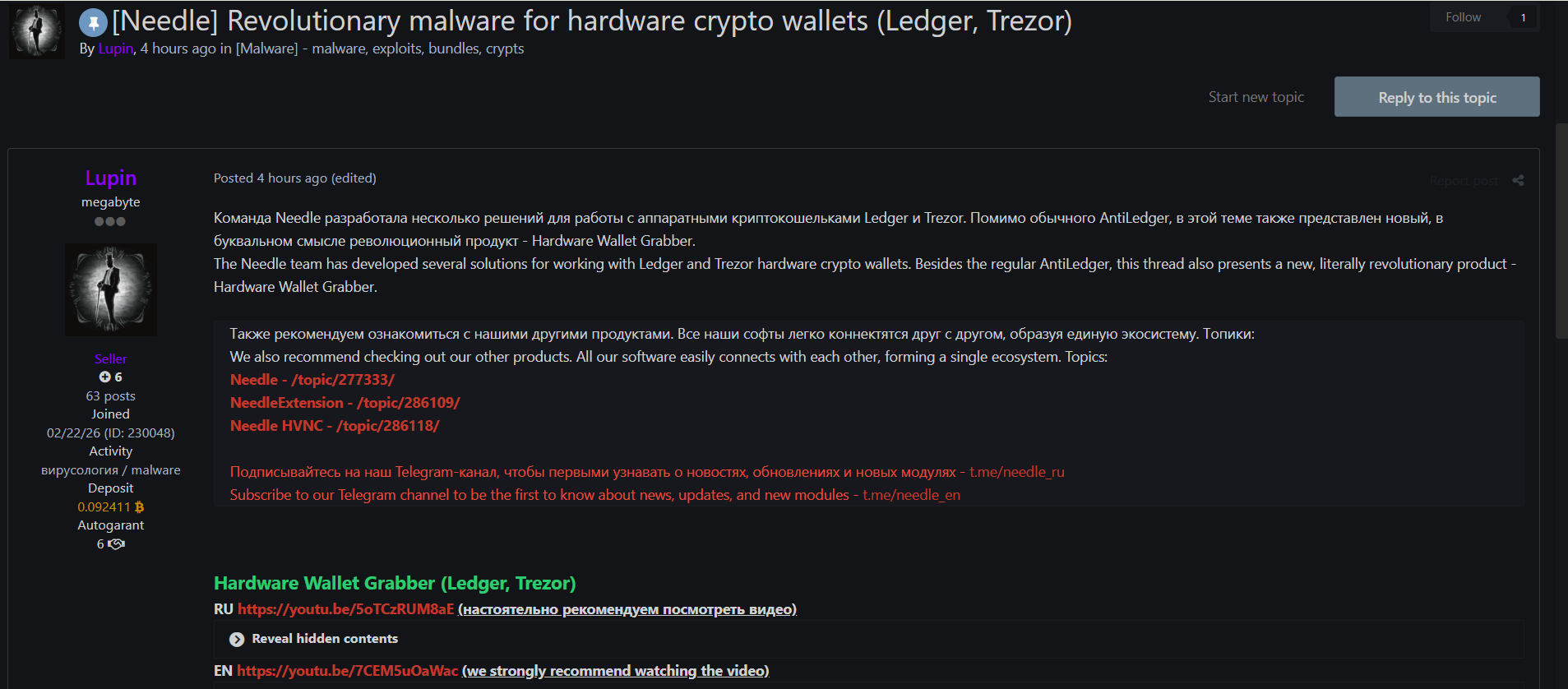
Underground cybercrime forums have seen the commercial listing of Needle, a modular infostealer and remote access tool engineered specifically to compromise non-custodial software wallets and hardware wallet bridge applications across Windows and macOS environments. The author distributes the threat via underground markets and private Telegram channels, offering integration with Hidden Virtual Network Computing (HVNC) modules, custom browser extensions, and an administrative control panel. Rather than attacking hardware cryptography directly, Needle abuses user interfaces and endpoint trust to harvest mnemonic recovery seed phrases and drain digital assets.
As digital assets increasingly move into enterprise treasuries, fintech platforms, and Web3 organizations, endpoint threats targeting hardware wallet bridges represent a critical risk to organizational holdings. Organizations assessing exposed endpoints and operational vulnerabilities must understand that hardware security keys and cold storage devices provide no immunity when endpoint operating environments are compromised. Simulating adversary techniques through advanced Penetration Testing allows organizations to detect initial access vectors before stealers manipulate privileged workstations.
Needle Stealer Target Scope
- Hardware Wallets (Ledger, Trezor)high
- Desktop Wallets (Exodus, Atomic)high
- Web3 Extensions (MetaMask, Phantom)high
- Telegram Desktop Sessionsmedium
- Browser Passwords & Cookiesmedium
- Multi-Chain Crypto Assetshigh
Capabilities and Behavior
Needle operates as a comprehensive financial interception and data extraction toolkit. The malware family incorporates system profiling routines, clipboard interception, automated filesystem discovery for sensitive credentials, and automated token extraction. Its core capabilities center on deceptive interface generation designed to trick experienced cryptocurrency holders.
Deceptive Interface Manipulation
The primary vector for compromising cold storage devices is the Desktop Wallet Spoofer module. Developed using modern graphical frameworks such as Rust egui, this component continuously polls running processes on the host. When it identifies executable names associated with bridge software such as Ledger Live, Trezor Suite, Exodus, or Atomic Wallet, it suppresses the legitimate interface or renders a persistent modal window directly over the running application.
This spoofed window displays an authentic-looking system message prompting the operator to complete a mandatory device resynchronization or wallet restoration. Victims are prompted to input their 12-to-24-word recovery seed phrase using their physical keyboard. To maintain operational secrecy, the malware features an evasion configuration parameter that launches the genuine wallet application as soon as a valid mnemonic seed is captured, ensuring the operator notices no operational friction.
Multi-Asset Balance Sweeping and HVNC Integration
Needle includes automated funds drainer logic capable of interacting directly with public blockchain RPC endpoints and indexing APIs such as TronGrid. When private keys or seed phrases are captured, automated multi-chain scripts verify available balances across Bitcoin, Ethereum, Solana, TRON, Litecoin, and Dogecoin networks, initiating transfers to threat actor destination addresses within seconds.
For complex decentralized finance (DeFi) positions or staked assets requiring manual execution, the operator can deploy the bundled HVNC module. This hidden virtual desktop enables threat actors to execute transactions, interact with active web sessions, and manipulate local application data without projecting mouse movements or window changes onto the user physical monitor.
Needle Attack and Execution Lifecycle
- 1Initial Lure
Fake AI trading utility (TradingClaw) or loader
- 2DLL Side-Loading
Signed OLEView binary loads rogue iviewers.dll
- 3Process Hollowing
Decrypted payload injected into RegAsm.exe
- 4Extension Staging
Rogue extension dropped in %LOCALAPPDATA%\Packages\Extensions
- 5UI Spoofing
Spoofed modal prompts victim for recovery seed phrase
- 6Asset Sweep
Multi-chain balance verification and automated drain
Infection Chain and Persistence
The delivery architecture for Needle relies on multi-stage social engineering campaigns and commodity malware distribution networks. Security researchers have traced active distribution campaigns to watering-hole infrastructure and typosquatted domains advertising automated trading utilities such as fake AI-driven TradingView tools.
Execution via Signed Binaries and Process Injection
The initial infection payload is commonly distributed within compressed archive files containing a legitimate, Microsoft-signed executable alongside a malicious dependency. The attack sequence unfolds across distinct execution stages:
Initial Execution: The user executes a renamed Microsoft Windows SDK utility, such as OLEView renamed to Trading Agent.exe. Because the binary carries a valid Microsoft digital signature, initial execution often bypasses traditional reputation filters and endpoint defenses.
DLL Side-Loading: Upon execution, the trusted binary resolves dependent dynamic link libraries from its current working directory, unknowingly loading a malicious library named iviewers.dll.
Process Hollowing: The malicious DLL decrypts the embedded Needle payload and initiates process hollowing against a legitimate Windows framework binary, typically RegAsm.exe located in the standard .NET Framework directory.
Persistence Mechanisms and Extension Staging
Once executing within the hollowed process context, Needle establishes persistence by creating scheduled tasks and Registry run keys configured to launch the desktop spoofer whenever the system restarts. In parallel, the malware stages a persistent rogue browser extension into user profile directories, specifically targeting the local package path at %LOCALAPPDATA%\Packages\Extensions\.
This companion extension registers under deceptive names mimicking legitimate Google software services. The extension monitors web application interaction, captures keystrokes, and modifies Document Object Model (DOM) elements on popular Web3 browser extension interfaces, including MetaMask, Phantom, and Coinbase Wallet.
Adversary TTPs (MITRE ATT&CK Mapping)
Command and Control
Needle relies on structured HTTP and HTTPS REST communications to interact with centralized management infrastructure. The administrative control panel, built with modern web frameworks, exposes distinct API endpoints designed to separate administrative oversight from high-volume automated data exfiltration.
Observed network communications demonstrate modular routing patterns across dedicated command nodes:
Configuration Retrieval: The payload queries endpoints such as /backup-domains/active to receive dynamic failover domains if primary command infrastructure is blocked.
Harvested Credential Ingestion: Exfiltration payloads containing compressed browser tokens, Telegram Desktop sessions, and extracted credentials are submitted via HTTP POST requests to the /upload endpoint.
Web Injection Scripts: The rogue browser extension connects to /scripts and /extension to download updated JavaScript rules, redirection URLs, and overlay templates targeting newly released wallet interfaces.
Drainer Configurations: Dedicated paths such as /api/v2/antiledger/settings deliver fresh receiver blockchain addresses and third-party RPC credentials used by the fund-sweeping engine.
Continuous monitoring of internet-facing infrastructure is essential to intercept adversary command nodes and identify compromised accounts before lateral movement takes place. Proactively cataloging organizational entry points through Attack Surface Management enables defenders to block unauthorized outbound access routes.
Free exposure check
Dark Web Scanner
check dark web mentions, compromised account indicators, malware log signals, public breach exposure, and recent underground market activity for your domain.
Indicators of Compromise
- hash95dcac62fc15e99d112d812f7687292e34de0e8e0a39e4f12082f726fa1b50edNeedle Stealer payload binaryhash95dcac62fc15e99d112d812f7687292e34de0e8e0a39e4f12082f726fa1b50edNeedle Stealer payload binary
- hash0d10a6472facabf7d7a8cfd2492fc990b890754c3d90888ef9fe5b2d2cca41c0Needle Stealer loader componenthash0d10a6472facabf7d7a8cfd2492fc990b890754c3d90888ef9fe5b2d2cca41c0Needle Stealer loader component
- hash3cc179a88902d76972d4bf4f98c0edf8138e81acabe711517dcdd31c14f73cc6Malicious installer bundle (tradingagent.html)hash3cc179a88902d76972d4bf4f98c0edf8138e81acabe711517dcdd31c14f73cc6Malicious installer bundle (tradingagent.html)
- domaintradingclaw.proPhishing lure distribution domaindomaintradingclaw.proPhishing lure distribution domain
- domainchrocustumapp.comMalicious extension C2 domaindomainchrocustumapp.comMalicious extension C2 domain
- domainchrocustomreversal.comMalicious extension C2 domaindomainchrocustomreversal.comMalicious extension C2 domain
- domaincoretest.digitalNeedle C2 administration paneldomaincoretest.digitalNeedle C2 administration panel
- domainreisen.workNeedle C2 administration paneldomainreisen.workNeedle C2 administration panel
- domaingoogle-services.ccLoader delivery infrastructuredomaingoogle-services.ccLoader delivery infrastructure
- ip178.16.55.234Needle C2 serverip178.16.55.234Needle C2 server
- ip185.11.61.149Needle C2 serverip185.11.61.149Needle C2 server
- ip37.221.66.27Needle C2 serverip37.221.66.27Needle C2 server
- ip2.56.179.16Needle C2 serverip2.56.179.16Needle C2 server
- ip209.17.118.17Needle C2 serverip209.17.118.17Needle C2 server
Detection Logic and Indicators
Detecting Needle requires behavioral analysis focusing on process lineage anomalies, unauthorized extension installations, and abnormal parent-child relationships involving standard Windows administrative binaries.
Detection Rules and Hunting Strategies
Security operations centers should deploy behavioral detection rules targeting DLL search-order hijacking and process hollowing. Key detection criteria include:
Unusual Process Creation: Monitor for instances of RegAsm.exe spawned without standard command-line parameters or parented by unexpected binaries located in user-writable directories such as %APPDATA% or %TEMP%.
Suspicious Library Loading: Alert on any load event for iviewers.dll occurring outside standard Microsoft Visual Studio or Windows SDK installation directories.
Unpacked Extension Staging: Inspect endpoint file creation events for script files (popup.js, content.js, background.js) created directly within %LOCALAPPDATA%\Packages\Extensions\.
Network Lineage Discrepancies: Monitor outbound external network connections originating from RegAsm.exe, which rarely requires direct external communication to unclassified public IP addresses.
Indicators of Compromise (IoCs)
Defenders should evaluate the following file hashes and network indicators across endpoint telemetry and perimeter controls:
File Hashes (SHA-256):
95dcac62fc15e99d112d812f7687292e34de0e8e0a39e4f12082f726fa1b50ed(Needle Payload)File Hashes (SHA-256):
0d10a6472facabf7d7a8cfd2492fc990b890754c3d90888ef9fe5b2d2cca41c0(Loader Component)File Hashes (SHA-256):
3cc179a88902d76972d4bf4f98c0edf8138e81acabe711517dcdd31c14f73cc6(Installer Bundle)Malicious Domains:
tradingclaw.pro,chrocustumapp.com,chrocustomreversal.com,coretest.digital,reisen.work,google-services.ccC2 IPv4 Addresses:
178.16.55.234,185.11.61.149,37.221.66.27,2.56.179.16,209.17.118.17
Removal and Recovery
Remediating a confirmed Needle infection requires decisive actions across both host systems and distributed cryptographic accounts. Because Needle prioritizes financial extraction, incident responders must treat all cryptographic assets associated with the host as actively compromised.
Containment and Endpoint Sanitation
Security teams responding to Needle detections must immediately execute the following procedures:
Host Isolation: Immediately disconnect the affected workstation from local network segments and wireless interfaces to disrupt active HVNC connections and halt automated exfiltration routines.
Process Termination: Terminate suspicious instances of RegAsm.exe running from user directories and unregister associated scheduled tasks or startup keys.
Directory Removal: Purge rogue extension directories located under %LOCALAPPDATA%\Packages\Extensions\ and inspect web browser preferences to remove untrusted developer-mode extensions.
Telemetry Blocking: Apply perimeter DNS sinkholes and IP blocks across internal gateways for all identified Needle command servers.
Cryptographic Asset Protection and Recovery
Endpoint cleanup alone is insufficient to protect organization-managed digital assets once seed phrases have been entered into spoofed forms:
Do Not Use Compromised Endpoints: Never attempt asset recovery or transaction signing from an infected device. Conduct all recovery tasks from an isolated, verifiably clean system.
Emergency Asset Migration: Generate new cryptographic addresses on a freshly initialized hardware wallet configured with an entirely new seed phrase. Transfer all remaining balances immediately to the new addresses.
Mnemonic Seed Invalidation: A hardware wallet private key is permanently invalidated once its 12-to-24-word recovery phrase has been typed into an endpoint keyboard. The compromised mnemonic must never be reused.
Session and Credential Revocation: Invalidate all active browser cookies, rotate enterprise credentials, and use Telegram Desktop account settings on a secure device to terminate all active sessions.
How to Defend Against Similar Threats
- Enforce strict application whitelisting and software restriction policies to block unauthorized executables from running in AppData or Temp paths.
- Educate personnel managing digital assets never to type a hardware wallet recovery phrase into any desktop dialog or web form.
- Inspect endpoint telemetry for abnormal child processes spawned by Microsoft-signed utilities and anomalous RegAsm.exe network activity.
- Deploy enterprise browser policies preventing the installation of unpacked or unauthorized third-party browser extensions.
Threat Intel FAQ
Can a hardware wallet protect assets if a computer is infected with Needle malware?
How does Needle malware evade standard antivirus detection during execution?
What is the immediate response required if an employee inputs a seed phrase into a suspected spoofed prompt?
Could a similar threat affect your organization?
If your team may be exposed to a similar threat, FemtoSec can help validate blast radius, prioritize remediation, and connect the issue to a practical security program.
Related Threats
October 19, 2026
Rwanda Health Ministry 5.7 GB Data Breach Analysis
An illicit forum listing claims the exfiltration and sale of 5.7 GB of citizen and staff records from the Rwanda Ministry of Health, exposing personal identifiers and highlighting the threat of upstream infostealer compromises.
October 7, 2026
AbkoRAT License Sale Fuels Remote Surveillance Threat
Underground forums have observed threat actors commercializing AbkoRAT, a commercial Remote Access Trojan engineered for stealthy surveillance, multimedia interception, credential harvesting, and arbitrary command execution across compromised enterprise hosts.
October 5, 2026
XWorm V3.0 RAT License Listed for Sale on Darknet
Underground advertisements offering commercial licenses for XWorm V3.0 highlight the persistent threat of modular Remote Access Trojans capable of surveillance, keylogging, and complete Windows endpoint compromise across enterprise environments.