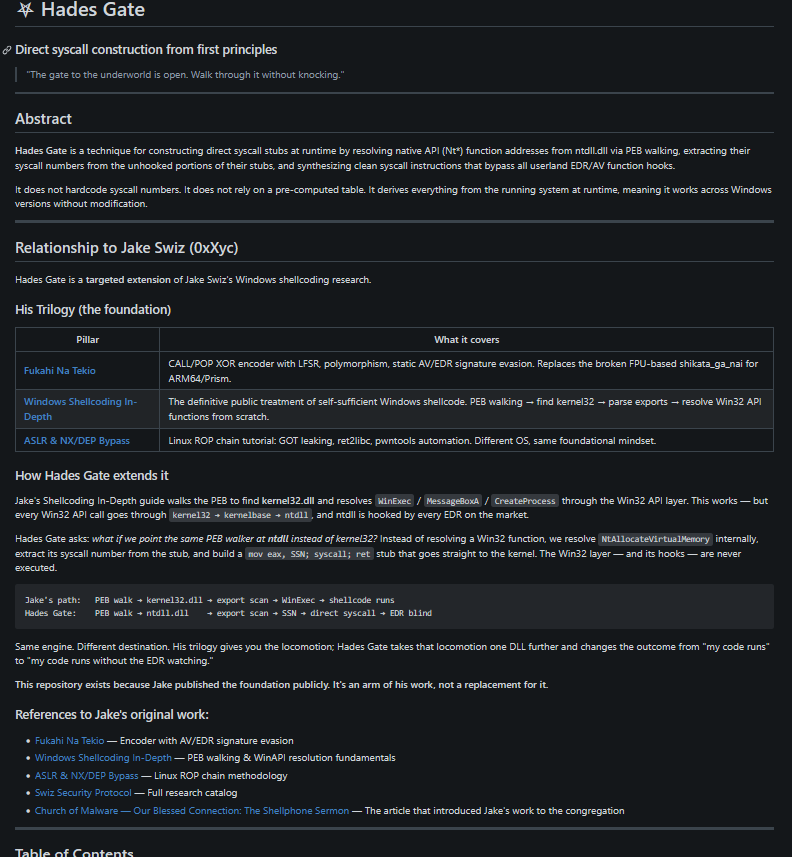
At its core, Hades Gate functions by reconstructing system calls at runtime. Traditional EDR tools often monitor for hooks placed on standard Windows API functions. By bypassing these hooks and generating direct syscall stubs through the parsing of Windows internal structures, adversaries aim to execute privileged operations without alerting defensive agents. This technique targets the core of how system service numbers (SSNs) are handled, providing a pathway for code execution that remains largely invisible to signature-based or basic heuristic detection systems.
Why Syscall Manipulation Matters
Direct syscall execution is not an entirely new concept, but the packaging and refinement seen in methods like Hades Gate demonstrate a clear shift toward highly specialized offensive tooling. For organizations, this means that simple endpoint monitoring may no longer suffice. Advanced adversaries are focusing on the underlying kernel interface, effectively stripping away the layers of security provided by user-mode hooks.
To defend against such sophisticated methodologies, security teams must adopt a layered approach. Relying solely on EDR is a risk, as the efficacy of these tools can be degraded by techniques that operate beneath their radar. Instead, organizations should prioritize Penetration Testing to identify how their specific EDR configurations handle non-standard execution patterns. Furthermore, continuous Red Teaming exercises can simulate these evasion attempts, allowing your team to validate whether existing sensors successfully capture the activity or if significant blind spots persist.
Proactive Defense in an Evolving Threat Environment
The rise of Hades Gate reinforces the necessity of adopting an offensive security mindset. When attackers innovate, the defense must iterate faster. Proactive validation of your attack surface is critical. If your organization is exposed to advanced threats, understanding your resilience is paramount.
Ultimately, the threat posed by syscall manipulation techniques requires moving toward behavioral analysis that does not rely on user-mode hooks. Enterprises should evaluate their security architecture to ensure they are capturing telemetry from multiple points across the stack, including kernel-level auditing where possible. Ensuring robust compliance and periodic security posture reviews with firms like FemtoSec helps align these defensive capabilities with the current threat reality.