Aura Drainer Toolkit-Threat Analysis
Cryptocurrency assets across EVM, TRON, TON, and XRP networks face heightened exposure following the public sale of the Aura Drainer toolkit on underground crime forums. This Drainer-as-a-Service threat utilizes social engineering and smart contract abuse to bypass wallet security controls.

Key Takeaways
- Aura Drainer is a commercial Drainer-as-a-Service toolkit targeting EVM, TRON, TON, and XRP ecosystems.
- The malware utilizes simulated browser extension update prompts to harvest seed phrases and drain wallet assets.
- Attackers abuse standard smart contract approval functions to gain perpetual control over victim digital assets.
- Defense relies on strict DNS monitoring of infrastructure, transaction simulation, and immediate allowance revocation.
Cryptocurrency assets and multi-chain digital wallets across the Ethereum Virtual Machine (EVM), TRON, TON, and XRP networks face a highly critical threat vector following the advertised sale of the Aura Drainer toolkit on underground crime forums. Cybercriminals frequently target these decentralised environments because of the irreversible nature of blockchain transactions. The public availability of this malicious software allows low-skilled affiliates to deploy highly complex phishing operations, threatening both individual digital custody accounts and enterprise treasury operations.
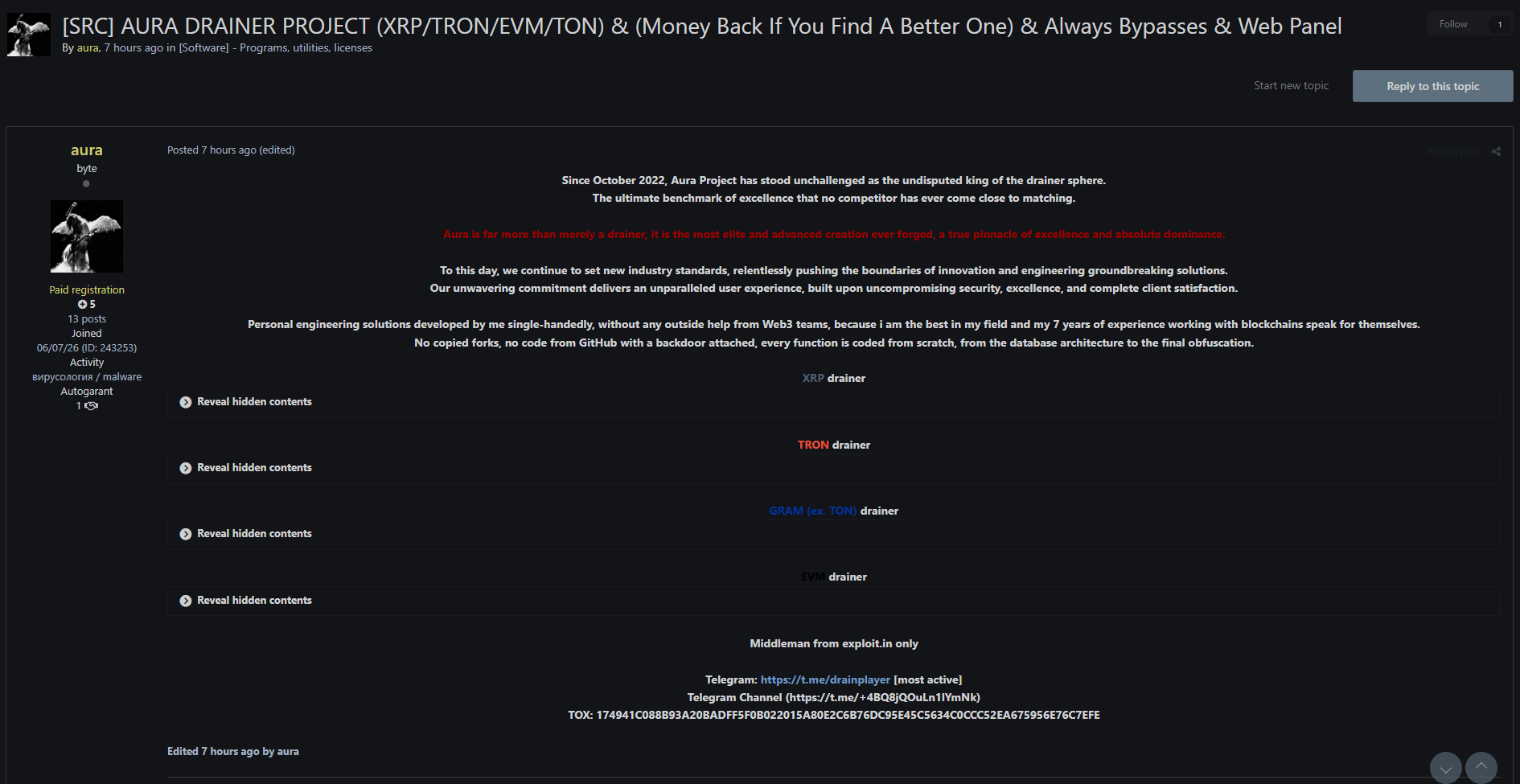
Underground Sale of the Aura Drainer Project
The threat actor behind the Aura Drainer project has officially put the malicious codebase and its associated infrastructure up for sale on the prominent Exploit.in cybercrime forum. Advertised with a comprehensive web-based administration panel and multiple automated extraction modules, the toolkit represents an advanced entry in the growing Drainer-as-a-Service (DaaS) market. Historically, the project has been maintained by operators linked to the WolfStore (WSTORE) brand and the AuraCorp threat group, who offer continuous technical updates, smart contract bypasses, and hosting setups in exchange for a percentage of the stolen assets or a flat subscription fee.
By selling the entire project, the developers are potentially democratizing access to a toolkit capable of bypassing many client-side wallet security extensions. The package includes customizable phishing templates, automated website cloners, and scripts that can simulate decentralised applications (dApps) to deceive users. For organizations managing Web3 assets or offering institutional digital asset custody in the GCC region, this development indicates an impending surge in targeted credential harvesting and transaction-signing attacks.
Operator Profile: WSTORE & AuraCorp
- Motivation
- Financial (Cryptocurrency Extraction)
- Targets
- EVM (Ethereum, BNB Chain, Polygon, etc.)SolanaTRONTONXRP
- TTPs
- Drainer-as-a-Service (DaaS) modelSmart contract approval exploitationKeitaro TDS IP/VPN redirectionBrowser extension update spoofing
Deep Technical Analysis of the Threat
The operational mechanics of Aura Drainer rely on a combination of social engineering, automated client-side script execution, and the abuse of standard smart contract protocols. Rather than exploiting zero-day software vulnerabilities, the toolkit exploits the trust relationship between Web3 users and their software-based non-custodial wallets.
Aura Drainer Three-Stage Attack Chain
- 1Initial Access
Phishing lures via fake airdrops, Keitaro TDS traffic distribution
- 2Execution & Harvest
Dynamic wallet asset queries, simulated extension alerts (seed harvesting)
- 3Asset Extraction
Token approval exploitation (approve/setApprovalForAll), auto-split withdrawal
The Three-Stage Attack Chain
Stage 1: Initial Access and Traffic Routing: Attackers drive traffic to malicious, cloned, or compromised websites using lures like fake token airdrops or simulated NFT minting events. The operators often utilize Traffic Distribution Systems (TDS) such as Keitaro to analyze incoming visitors. If a visitor does not match target profiles (e.g., if they are using a VPN, are located in an excluded region, or are using a known security analysis sandbox), they are redirected to a benign decoy site. Target visitors are seamlessly routed to the active drainer landing pages.
Stage 2: Execution and Script-Based Enumeration: Once the victim connects their Web3 wallet, client-side JavaScript executing in the browser inspects the connected address. The script queries the blockchain to evaluate native coin balances, ERC-20 token holdings, and high-value NFTs. Based on this real-time balance inspection, the malware prioritizes the most valuable assets for extraction. At this stage, the malware may trigger the "Aura Seed Phrase Drainer" module, injecting highly realistic, simulated browser extension update alerts (masquerading as MetaMask, Coinbase Wallet, or Phantom) inside the page. These alerts demand the victim input their 12-to-24 word recovery seed phrase to "verify" or "restore" the wallet connection. Alternatively, if the victim refuses or if the attacker prefers transaction-based theft, the script initiates a transaction request.
Stage 3: Smart Contract Abuse and Impact: The script prompts the victim to sign a transaction that manipulates standard blockchain approval functions, such as
approveorsetApprovalForAll. Once signed, this grants the attacker's smart contract full, unlimited permission to transfer the victim's tokens or NFTs. The automated backend then executes "auto-split" and priority-based extraction modules, instantly sweeping all valuable assets to wallets controlled by the threat actors.
MITRE ATT&CK Mapping
The behaviors observed in Aura Drainer campaigns align with several techniques outlined in the MITRE ATT&CK framework:
T1566 - Phishing: Delivery of fraudulent links via social media, spam emails, and airdrop lures.
T1204.001 - User Execution (Malicious Link): Deceiving users into navigating to cloned Web3 or dApp interfaces.
T1204.002 - User Execution (Malicious Script): Forcing users to click "Sign", "Approve", or input recovery phrases inside injected prompts.
T1036 - Masquerading: Simulating official browser extension notifications and security alerts.
T1059.007 - Command and Scripting Interpreter (JavaScript): Running client-side web scripts to interact with standard browser wallet APIs.
T1584 - Compromise Infrastructure: Hosting phishing payloads on wildcard subdomains of dynamic DNS providers or compromised domains (such as
*.gt.tc).T1102 - Web Service: Utilizing Telegram bots (such as
@aurav3botand@auraleak_bot) for administration, configuration updates, and logging.
Aura Drainer MITRE ATT&CK Mapping
Defensive Strategies: Detect, Validate, and Contain
To counter the multi-chain capabilities of Aura Drainer, security teams must deploy layered detection mechanisms across network, host, and smart contract layers. Traditional endpoint security is often blind to client-side smart contract interactions, making network visibility and browser-level controls paramount.
Network and DNS Detection Logic
Organizations must monitor outbound DNS requests and network traffic for connections to known malicious domains and IP addresses. Security teams can write custom rules to detect and alert on connections to dynamic hosting providers and wildcard domains:
# Example network detection logic for known infrastructure = alert dns any any -> any any (msg:"DNS Request to Aura Drainer Infrastructure"; dns.query; content:"gt.tc"; nocase; sid:1000001; rev:1;)
alert ip any any -> [185.27.134.167, 185.27.134.168] any (msg:"Connection to Known Aura Drainer Hosting IP"; sid:1000002; rev:1;)
Verified Indicators of Compromise
- domainwstore.liveOfficial sales site / C2domainwstore.liveOfficial sales site / C2
- domainauradrainer.gt.tcPhishing landing page / testing hostdomainauradrainer.gt.tcPhishing landing page / testing host
- domainsuportprotocolsdapp.gt.tcPhishing infrastructuredomainsuportprotocolsdapp.gt.tcPhishing infrastructure
- domainmmwalletsecurity.gt.tcPhishing infrastructuredomainmmwalletsecurity.gt.tcPhishing infrastructure
- domainacc-net-updt.gt.tcPhishing infrastructuredomainacc-net-updt.gt.tcPhishing infrastructure
- domainc00nfirm4ci0n-1n1ciar.gt.tcPhishing infrastructuredomainc00nfirm4ci0n-1n1ciar.gt.tcPhishing infrastructure
- ip185.27.134.167Hosting auradrainer.gt.tcip185.27.134.167Hosting auradrainer.gt.tc
- ip185.27.134.168Hosting c00nfirm4ci0n-1n1ciar.gt.tcip185.27.134.168Hosting c00nfirm4ci0n-1n1ciar.gt.tc
Outbound requests to sales and command-and-control interfaces such as wstore.live should also be strictly blocked and logged for forensic analysis.
Validation Steps
When analyzing suspicious Web3 interfaces, security personnel should perform the following validation steps:
Inspect Approval Parameters: Verify if any web application requests unlimited allowances for smart contracts that are not explicitly documented or verified by the parent protocol.
Analyze Extension Injections: Inspect the DOM for injected iframe or div elements that mimic extension dialogs. Real wallet extensions run in isolated browser contexts and do not render security prompts within the body of a webpage.
Transaction Simulation: Deploy security-focused browser extensions or simulation APIs that model the state changes of a transaction before it is sent to the blockchain network, highlighting when an interaction grants third-party control over assets.
Containment and Response Guidance
If a system within the enterprise network is suspected of interacting with an Aura Drainer phishing site, follow these containment steps:
Revoke Smart Contract Allowances: If an approval transaction was signed but assets have not yet been moved, immediately use verified tools like Revoke.cash or Etherscan's Token Approval interface to reset the token allowance to 0.
Isolate and Migrate Wallet Custody: If a seed phrase was entered into a suspicious prompt, assume the wallet is entirely compromised. Immediately transfer any remaining assets to a freshly generated, hardware-secured wallet on a clean machine. Do not reuse the compromised recovery phrase.
Domain Blacklisting: Block resolving capabilities for
*.gt.tcwildcard domains and associated IPs at the Secure Web Gateway (SWG) and DNS server levels.
Aura Drainer Defensive & Containment Checklist
- Deploy DNS Wildcard BlocksConfigure security gateway rules to block resolving capabilities for *.gt.tc subdomains.
- Blacklist Malicious IPsAdd 185.27.134.167 and 185.27.134.168 to firewall block rules.
- Revoke Active AllowancesUtilize Revoke.cash or Etherscan to immediately set token approval allowances to 0.
- Migrate Compromised CustodyIf a seed phrase was exposed, immediately sweep remaining assets to a fresh hardware-secured wallet.
Enterprise Risk and the Role of FemtoSec
For enterprises operating in the GCC region, particularly in financial hubs like Dubai, the rise of accessible DaaS toolkits like Aura Drainer demands robust threat intelligence and active defense. Under regional frameworks such as the Virtual Assets Regulatory Authority (VARA) compliance standards, safeguarding digital assets and customer funds is a strict operational mandate.
Femto Security provides GCC-based enterprises with comprehensive protection against underground threats. By actively scanning crime forums and underground markets, FemtoSec delivers proactive threat intelligence to identify when your brand assets or administrative domains are being targeted or cloned by phishing campaigns. Organizations can evaluate their current posture and dark web exposure immediately. Use FemtoSec's Dark Web Scanner to check dark web mentions, compromised account indicators, malware log signals, public breach exposure, and recent underground market activity for your domain.
In addition to quick diagnostic tools, protecting digital environments against advanced phishing and infrastructure compromise requires continuous validation. Through our Dark Web Monitoring service, FemtoSec helps companies monitor underground channels for leaked credentials, malware log signals, and compromised domains that attackers might use to build trust during targeted phishing campaigns. With over 15 years of experience and 50+ leading enterprises secured across the GCC, FemtoSec delivers the offensive security expertise needed to keep your operations resilient. Contact our Dubai-based experts today for a free consultation within 24 hours to secure your enterprise against modern cyber threats.
How to Defend Against Similar Threats
- Implement DNS and security gateway blocks for known phishing infrastructure, specifically targeting wildcard domains like gt.tc.
- Integrate real-time transaction simulation engines in user interfaces to flag anomalous token approval requests.
- Regularly review and revoke unauthorized smart contract allowances using tools like Revoke.cash or platform-specific block explorers.
- Leverage FemtoSec's Dark Web Monitoring service to detect exposed administrative credentials or compromised enterprise wallets.
Threat Intel FAQ
What is Aura Drainer and which blockchains does it target?
How does Aura Drainer steal funds from digital wallets?
How can enterprise networks protect against this Web3 threat?
Could a similar threat affect your organization?
If your team may be exposed to a similar threat, FemtoSec can help validate blast radius, prioritize remediation, and connect the issue to a practical security program.
Related Threats
August 19, 2026
ZXCHECKER Malware Exploits Cryptographic Seed Phrases
A threat actor on the Exploit forum is selling ZXCHECKER, a multi-chain cryptocurrency wallet validator designed to check balances across BTC, LTC, DOGE, DASH, and ETH. Discover the threat profile, technical attack chain, and steps to protect enterprise keys.
August 6, 2026
Anonymous Mobile RAT v6 Analysis
Underground threat actors have announced the release of Anonymous Mobile RAT v6, an advanced Android Remote Access Trojan designed to capture credentials, record screens, and abuse accessibility settings, creating severe risks for enterprise mobile security.
July 25, 2026
BTMOB RAT v4.6 Mobile Malware Threat Analysis
Defenders prioritizing mobile endpoint integrity must immediately audit Android Accessibility Service authorizations to counter BTMOB RAT v4.6. This technical analysis explores the malware's delivery vectors, capabilities like 2FA bypass, and step-by-step containment protocols.