Malwarehigh
Asacube Banking Botnet Analysis
An analysis of the Asacube Android banking botnet, covering its core malicious capabilities including credential theft, SMS interception, and mobile asset compromise.

An analysis of the Asacube Android banking botnet, covering its core malicious capabilities including credential theft, SMS interception, and mobile asset compromise.
The emergence of the Asacube Android Banking Botnet signifies a calculated expansion in mobile-focused threat actors seeking to compromise financial credentials and personal data. This malware platform is engineered to facilitate deep device manipulation, providing operators with functional modules that bypass standard mobile security controls. At its core, Asacube functions as a sophisticated multi-purpose tool, enabling persistent access to the compromised device. This allows for exfiltration of sensitive information while maintaining a stealthy presence on the infected handset.
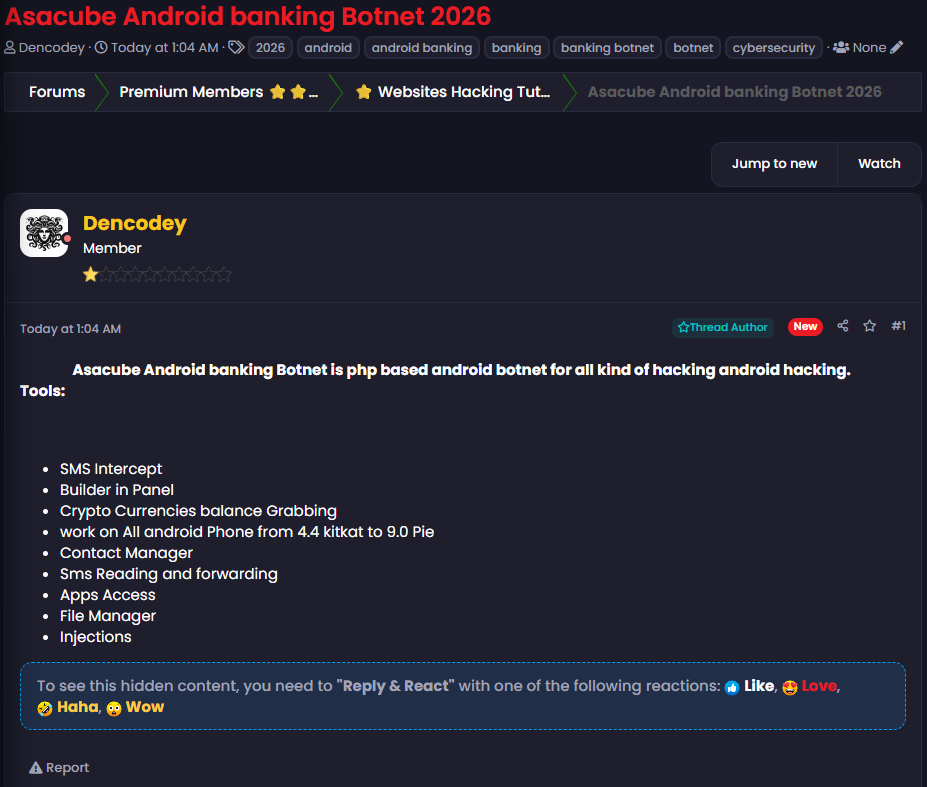
The botnet's toolkit includes advanced capabilities such as SMS interception, which is a critical threat vector for circumventing multi-factor authentication (MFA) protocols. By intercepting incoming SMS messages, threat actors can finalize unauthorized transactions by capturing one-time passwords (OTPs). Furthermore, its ability to manage applications, manipulate file systems, and perform unauthorized injections provides a high level of control to attackers looking to harvest banking credentials or gain access to cryptocurrency wallets.
Free exposure check
Dark Web Scanner
check dark web mentions, compromised account indicators, malware log signals, public breach exposure, and recent underground market activity for your domain.
For modern enterprises, the rise of mobile banking botnets poses a significant risk to the integrity of employee and customer digital identities. When corporate devices are compromised, the barrier between personal and professional data often blurs. An infected mobile device can serve as a beachhead for attackers to gain access to corporate emails, cloud tokens, and sensitive internal communications. The capability of Asacube to harvest contact lists also provides attackers with the necessary intelligence to launch more sophisticated, targeted spear-phishing campaigns against the rest of the organization.
Enterprises must prioritize a strategy that acknowledges the reality of mobile endpoint vulnerability. If the domain already looks exposed, use Dark Web Scanner before requesting a full report. Implementing a robust Attack Surface Management framework is essential to monitor for assets or credentials that may have already leaked into the wild, providing attackers with the foothold required to deploy secondary payloads like Asacube.
Defending against such threats requires a proactive stance on both endpoint and identity security. Organizations should focus on validating their mobile security posture through regular Penetration Testing. These exercises identify how easily mobile devices could be integrated into an attacker's kill chain. Furthermore, deploying advanced endpoint detection (EDR) solutions that can flag unauthorized API calls and injection attempts is crucial for identifying early-stage infections.
Regularly reviewing permissions for corporate applications and ensuring that employees are educated on the risks of sideloading applications from untrusted sources serves as a foundational defense. Organizations should adopt a policy of least privilege, ensuring that even if a device is compromised, the potential for lateral movement into core business systems is heavily restricted.
If your team may be exposed to a similar threat, FemtoSec can help validate blast radius, prioritize remediation, and connect the issue to a practical security program.
July 25, 2026
Defenders prioritizing mobile endpoint integrity must immediately audit Android Accessibility Service authorizations to counter BTMOB RAT v4.6. This technical analysis explores the malware's delivery vectors, capabilities like 2FA bypass, and step-by-step containment protocols.
October 7, 2026
Underground forums have observed threat actors commercializing AbkoRAT, a commercial Remote Access Trojan engineered for stealthy surveillance, multimedia interception, credential harvesting, and arbitrary command execution across compromised enterprise hosts.

September 18, 2026
A new malware-as-a-service offering named Hermes has surfaced on underground forums, bundling hidden virtual desktop control, browser credential harvesting, crypto wallet theft, and remote command execution.