Malwarehigh
XpertRAT v3.0.10 Malware Capabilities Exposed
A new release of XpertRAT v3.0.10 has emerged, featuring sophisticated credential harvesting and monitoring capabilities. Understand the risk and how to defend your infrastructure.
A new release of XpertRAT v3.0.10 has emerged, featuring sophisticated credential harvesting and monitoring capabilities. Understand the risk and how to defend your infrastructure.
The recent emergence of XpertRAT v3.0.10 highlights the ongoing evolution of remote access trojans and the risks they pose to enterprise environments across the GCC. As threat actors continue to refine their toolsets, security teams must understand the specific capabilities of such malware to build resilient defenses. XpertRAT is a known class of malware that provides attackers with significant control over compromised endpoints, allowing for persistent surveillance and data exfiltration.
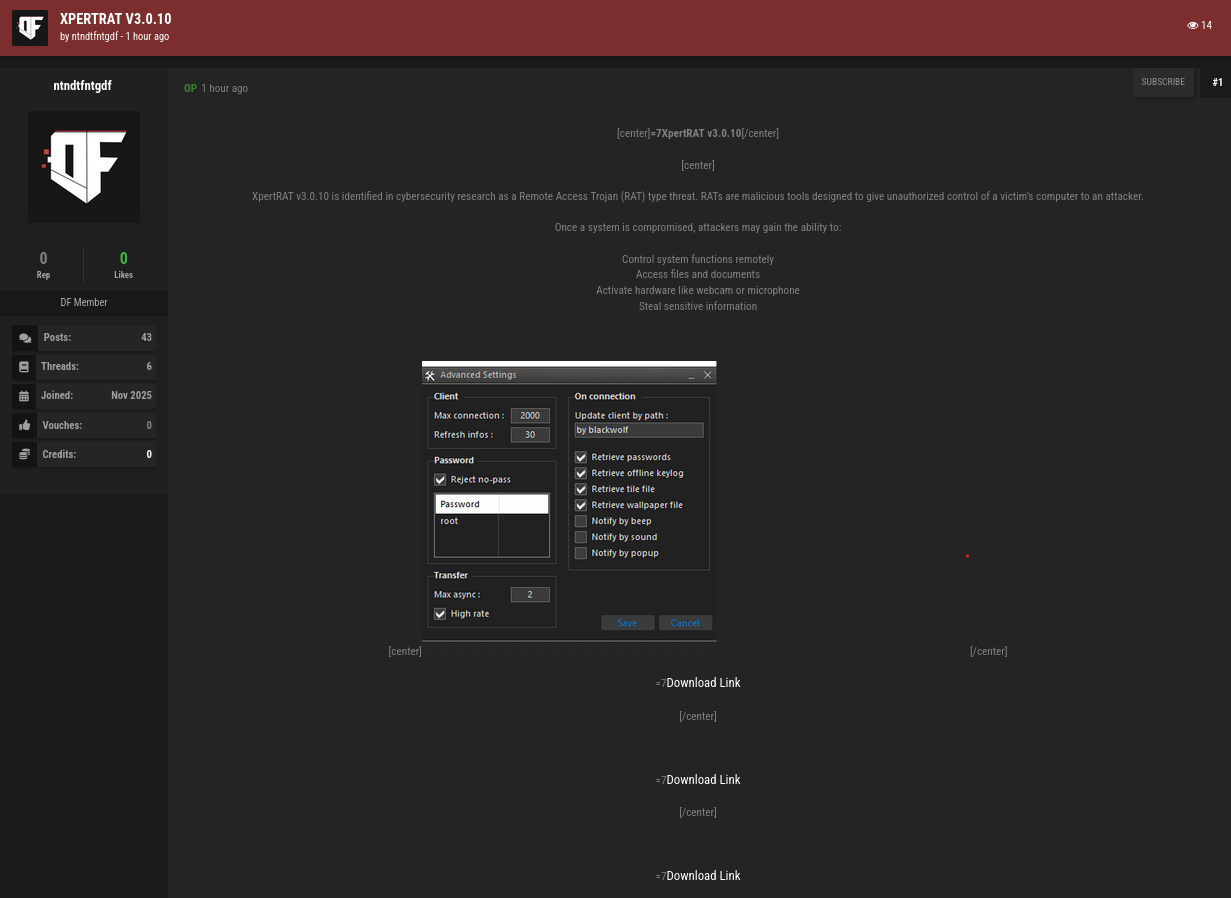
Detailed analysis of the configuration interface for XpertRAT v3.0.10 reveals several key automated execution routines that trigger upon client connection. These features are designed to maximize the utility of an infection for the operator. The toolset includes capabilities such as:
Password Retrieval: Automated extraction of saved credentials from browsers and system stores.
Offline Keylogging: Continuous recording of keystrokes even when the malware does not maintain an active network connection, ensuring data capture is not lost.
Tile Extraction: Specialized functionality for capturing screen content and metadata from the host system.
Wallpaper Hijack: A classic but effective method for signaling control or psychological impact to the user.
The focus on credential harvesting is particularly concerning, as it allows attackers to pivot from an initial workstation compromise to broader network access. By capturing passwords, threat actors can bypass traditional perimeter defenses and move laterally within a corporate network.
Enterprise resilience requires a layered security model. Given the nature of XpertRAT, relying solely on legacy endpoint protection is insufficient. Organizations should implement comprehensive vulnerability assessments to ensure that the initial vectors used by such malware—often unpatched software or weak configurations—are systematically reduced. Furthermore, maintaining a rigorous attack surface management program ensures that exposed assets and misconfigurations that might invite a malware payload are monitored and addressed in real time.
Free exposure check
Dark Web Scanner
check dark web mentions, compromised account indicators, malware log signals, public breach exposure, and recent underground market activity for your domain.
Ultimately, the threat from tools like XpertRAT is not just about the malware itself but the access it provides to motivated attackers. Protecting your organization requires deep visibility into both external risks and internal weaknesses. Enterprises should treat every unauthorized system access as a precursor to a larger incident and maintain high visibility over their environment.
If your team may be exposed to a similar threat, FemtoSec can help validate blast radius, prioritize remediation, and connect the issue to a practical security program.

July 25, 2026
Defenders prioritizing mobile endpoint integrity must immediately audit Android Accessibility Service authorizations to counter BTMOB RAT v4.6. This technical analysis explores the malware's delivery vectors, capabilities like 2FA bypass, and step-by-step containment protocols.
October 7, 2026
Underground forums have observed threat actors commercializing AbkoRAT, a commercial Remote Access Trojan engineered for stealthy surveillance, multimedia interception, credential harvesting, and arbitrary command execution across compromised enterprise hosts.

September 18, 2026
A new malware-as-a-service offering named Hermes has surfaced on underground forums, bundling hidden virtual desktop control, browser credential harvesting, crypto wallet theft, and remote command execution.