Data Leak Incident: Wamin Wittaya School Thailand Analysis
A significant data breach involving staff details from Wamin Wittaya School has been reported. FemtoSec provides a professional analysis of the risks and how educational organizations can strengthen their defense posture.

Key Takeaways
- Educational institutions are increasingly targeted due to the sensitivity of personnel and student data.
- Unmanaged web assets often serve as the primary entry point for attackers.
- Proactive measures like Dark Web monitoring are essential for early detection of leaked information.
- Compliance and regular penetration testing are the foundations of a resilient security strategy.
Incident Overview: Wamin Wittaya School Data Breach
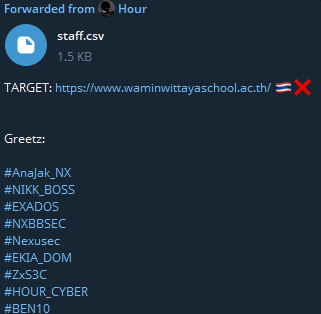
The recent reports regarding an alleged data leak at Wamin Wittaya School in Thailand serve as a sobering reminder of the growing threat landscape facing the education sector. The incident involves the exposure of staff details associated with the institution's web domain, waminwittayaschool.ac.th. While the full extent of the compromised data is currently being assessed, such events underscore the critical need for schools and academic organizations to treat their internet-facing infrastructure with the same level of security rigor as financial or government institutions.
Why Educational Institutions Are Prime Targets
Educational organizations often serve as soft targets for malicious actors. These institutions hold substantial amounts of sensitive information, including PII, payroll data, and proprietary research, while often lacking the dedicated resources of a large enterprise. This discrepancy creates an asymmetric risk profile. Attackers frequently exploit misconfigured web applications or outdated software to gain unauthorized access. Once initial access is achieved, lateral movement can lead to more significant exfiltration of sensitive personnel records.
For any institution, the first step in remediation is understanding the breadth of the exposure. If you suspect that your domain or staff credentials have been impacted, use FemtoSec's Dark Web Scanner to check for leaked credentials, malware log signals, and public breach exposure. This diagnostic tool provides an instant snapshot of your external risk posture.
Proactive Defense and Risk Mitigation
Security is not a static state, but a continuous process of verification and adaptation. Organizations must prioritize Attack Surface Management to ensure that every entry point into their digital network is accounted for and hardened against exploitation. Many breaches occur simply because a forgotten sub-domain or an unpatched application remains visible to the public internet, acting as an open door for automated scanners used by cybercriminals.
Furthermore, organizations should consider the following strategic shifts in their security posture:
Continuous Offensive Validation: Move away from annual check-ups. Real-world threats evolve rapidly, and your defense mechanisms should be regularly tested through Penetration Testing to identify vulnerabilities before they are weaponized.
Staff Awareness: Often, the weakest link is the end-user. Regular security awareness training is non-negotiable in an environment where staff are targeted through social engineering and phishing.
Proactive Monitoring: Relying on perimeter defenses is insufficient. Implement robust Dark Web Monitoring to receive alerts as soon as your institutional data appears in illicit marketplaces, allowing for rapid containment and password resets.
At FemtoSec, we believe in a compliance-first approach to security that scales with the needs of the organization. Whether you are managing a small school or a large public sector enterprise, the principles of defense remain the same: visibility, validation, and rapid response. Our team in Dubai is dedicated to helping GCC enterprises secure their infrastructure against the ever-changing tactics of modern adversaries.
The Role of Governance and Compliance
Security is ultimately a board-level issue. As educational institutions move toward more digitized ecosystems, they must align with international cybersecurity frameworks. Achieving compliance, whether it relates to local data protection laws or global standards, provides a roadmap for securing data and building trust with staff and students. By integrating security into the foundation of your digital transformation, you move from a reactive posture to a resilient, proactive operating model.
How to Defend Against Similar Threats
- Perform a comprehensive audit of all internet-facing subdomains and applications.
- Implement immediate password rotations for any accounts suspected of being included in the breach.
- Engage in continuous vulnerability management to identify and patch security gaps.
- Utilize professional dark web monitoring to stay ahead of future credential leaks.
Threat Intel FAQ
What is the first step if an educational institution discovers a data breach?
Why is it important to perform continuous domain scanning?
Could a similar threat affect your organization?
If your team may be exposed to a similar threat, FemtoSec can help validate blast radius, prioritize remediation, and connect the issue to a practical security program.
Related Threats
September 20, 2026
Water Infrastructure Authority Database Leaked Online
A threat actor claims to have leaked more than 100,000 records from a public water management entity, exposing Peruvian national identity document numbers, citizen names, emails, and internal complaint registries.
An online learning management system belonging to a diplomatic academy was breached via a zero-day authentication bypass exploit. Threat actors maintained persistent access for ten months, compromising the personal data of 10,000 diplomatic personnel, including encrypted passwords and email addresses.
An alleged data breach targeting Brazilian payment gateway and digital banking platform PagBank has surfaced on underground forums. A threat actor claims to possess a database containing information related to 10 billion transactions, highlighting the growing cybersecurity risks facing the fintech sector.