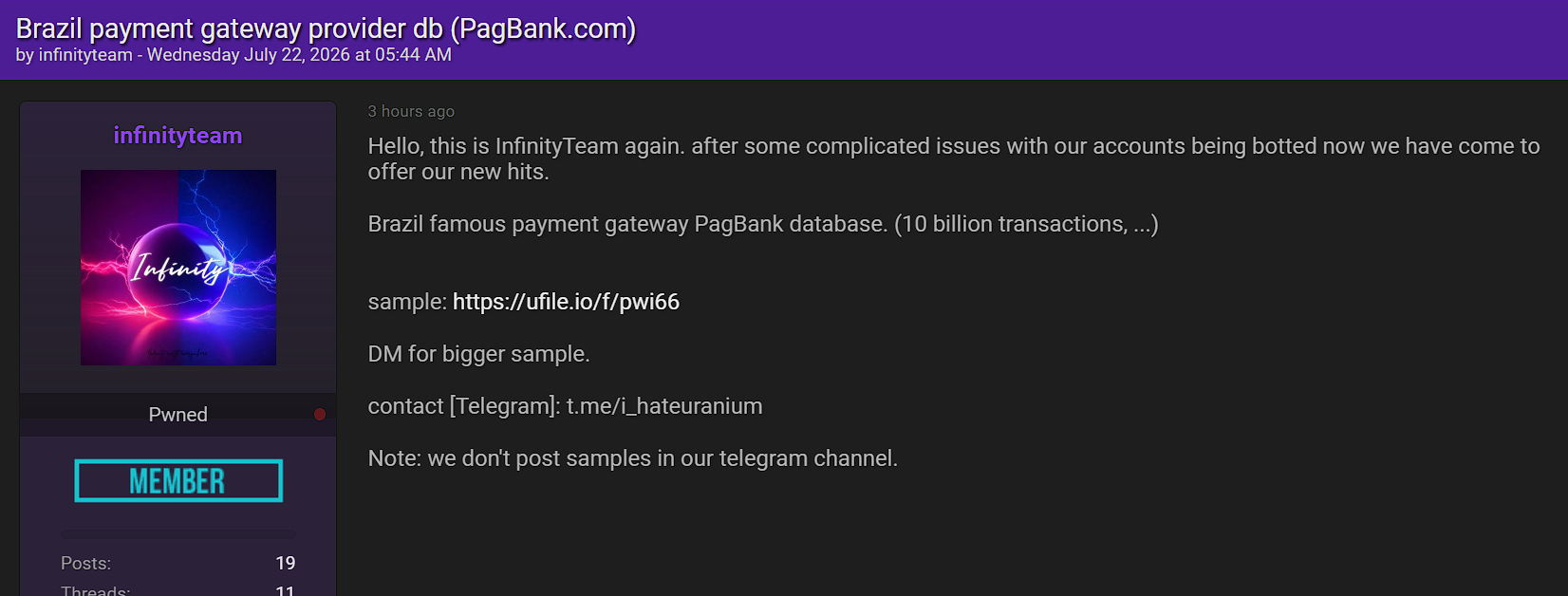
The security incident came to light after threat actors on the underground forum pwnforums.st posted about a successful intrusion into the systems of the Brazilian payment gateway. According to the claims made by the threat actor, the exfiltrated dataset contains details surrounding ten billion distinct transactions processed through the platform. PagBank operates as one of the largest digital banking ecosystems in Latin America, serving millions of active users and facilitating massive financial transaction volumes annually. If validated, this breach would represent one of the largest transactional data leaks recorded in the fintech sector, creating widespread exposure for both individual users and commercial merchants who rely on the platform to process daily payments.
At this stage, neither the target organization nor local regulatory bodies, such as the Central Bank of Brazil, have released a forensic analysis confirming a breach of this magnitude. However, threat intelligence groups are actively monitoring underground communication channels to verify the legitimacy of the database samples provided by the seller. For organizations globally, including those in the GCC region, understanding the mechanics of such database compromises is essential to preventing similar exposures within their own infrastructures.
Deep Technical Analysis: Attack Vectors and Exfiltration Mechanics
To comprehend how an enterprise database containing billions of transactional records can be compromised, security teams must evaluate the realistic pathways that lead to mass exfiltration. In the neobanking and payment gateway ecosystem, data exposure typically occurs through a defined multi-stage attack chain, running from initial perimeter compromise to database discovery and final exfiltration.