Unauthenticated RCE Zero-Day Exploit in Dolibarr ERP
Underground forum advertisements show an unauthenticated remote code execution zero-day exploit targeting Dolibarr version 24.0.2. Security teams must restrict exposed enterprise endpoints immediately.

Key Takeaways
- A threat actor is advertising an alleged unauthenticated RCE zero-day exploit targeting Dolibarr 24.0.2 on cybercrime forums.
- The claim remains unverified by the vendor or independent analysts, but unauthenticated web RCE represents a critical enterprise risk.
- Successful exploitation could grant attackers shell access to underlying host servers and full control over ERP databases.
- Organizations must restrict public access to business management interfaces using VPNs or ZTNA and disable script execution in upload directories.
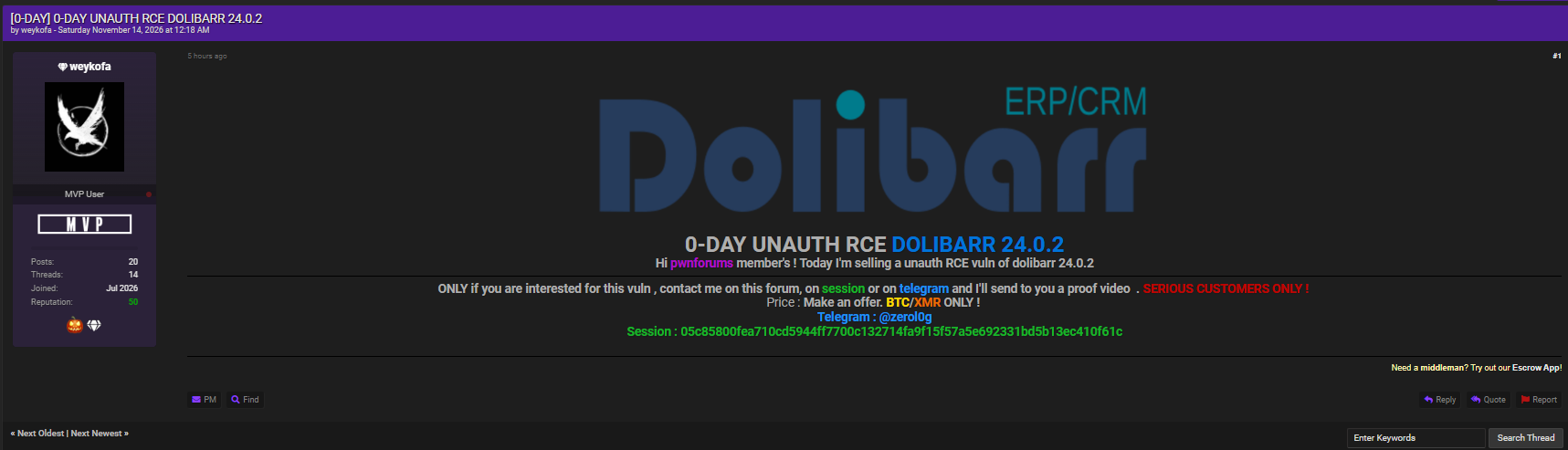
Defenders operating internet-exposed enterprise resource planning software must immediately restrict administrative interface access and audit ingress network traffic for unauthenticated script execution. An underground forum listing from threat actor weykofa offers an alleged unauthenticated Remote Code Execution zero-day exploit targeting Dolibarr version 24.0.2, the open-source ERP and CRM solution maintained by the France-based Dolibarr Association. While commercial underground listings often warrant cautious verification, the potential severity of arbitrary code execution across enterprise databases demands swift perimeter containment.
Affected Versions and Conditions
The dark web listing explicitly identifies Dolibarr version 24.0.2 as the vulnerable target. Because Dolibarr is widely deployed across commercial, manufacturing, and software development sectors to manage customer relations, accounting ledgers, supplier invoicing, and human resource databases, internet-accessible installations represent high-value targets for opportunistic threat actors.
Vulnerability Exposure Prerequisites
For an adversary to execute an unauthenticated exploit against an affected deployment, several environmental and architectural conditions typically align:
Direct Internet Exposure: The application instance is directly reachable from public IP space without upstream network authentication, VPN gateways, or Zero Trust Network Access enforcement.
Unrestricted Public Endpoints: Core public routing pathways, including directories such as
htdocs/public/, unauthenticated API resources, or administrative setup scripts, remain publicly accessible to unvetted client requests.Standard Web Server Execution Context: The web process operates with standard filesystem privileges that permit executing system utilities or writing files to interpreted web roots.
Organizations should leverage continuous Attack Surface Management to discover shadow instances or misconfigured business management deployments before external actors catalog them.
Dolibarr ERP/CRM Vulnerability Status
Affected versions
- Dolibarr ERP/CRM 24.0.2
Patch status
- No fixed release published
Technical Root Cause Analysis and Potential Attack Flaw
Although the underground seller has not publicly disclosed the full exploit payload, the technical flaw is described as an unauthenticated remote code execution vector. In PHP-based enterprise architectures such as Dolibarr, pre-authentication command execution typically stems from one of several architectural failure modes:
Arbitrary File Upload with Script Execution: A public-facing module fails to enforce session authentication or strict file extension validation, permitting a remote attacker to upload a crafted file containing server-side PHP code into a publicly accessible directory.
PHP Object Injection: Unsanitized user input supplied to a native PHP deserialization routine can trigger Property Oriented Programming gadget chains present within application libraries, leading to arbitrary code execution.
Server-Side Command or Template Injection: Unfiltered query parameters passed directly to system execution functions or template rendering engines allow command chaining without requiring administrative credentials.
Step-by-Step Attack Chain
An attack leveraging this pre-authentication flaw would follow a structured intrusion sequence across the target enterprise boundary:
Initial Access: The attacker automates internet-wide scanning against public IP ranges to discover exposed Dolibarr instances running version 24.0.2 by inspecting HTTP headers, favicons, or application login banners (MITRE ATT&CK T1190: Exploit Public-Facing Application).
Exploit Delivery: An unauthenticated HTTP request containing the malicious payload is transmitted to an unprotected endpoint, bypassing session validation routines.
Execution: The server executes injected operating system commands or instantiates malicious PHP instructions under the context of the web daemon, such as
www-dataorapache(MITRE ATT&CK T1059.004: Unix Shell).Persistence and Web Shell Deployment: The adversary writes a persistent backdoor or web shell inside an upload repository or document folder (MITRE ATT&CK T1505.003: Server Software Component: Web Shell).
Credential Access: Using shell access, the threat actor inspects local configuration files, specifically
htdocs/conf/conf.php, extracting plaintext database credentials (MITRE ATT&CK T1552.001: Credentials in Files).
Unauthenticated Web RCE Attack Flow
- 1Reconnaissance
Scan for public Dolibarr v24.0.2 instances
- 2Exploit Delivery
Crafted unauthenticated HTTP GET/POST request
- 3Command Execution
Execute arbitrary code in web daemon context
- 4Web Shell Placement
Drop persistent backdoor in upload directories
- 5Credential Access
Harvest database credentials from conf/conf.php
MITRE ATT&CK Mapping
Exploitation Status and Observed Activity
The current exploitation status centers on an underground forum listing where threat actor weykofa is soliciting sales for the zero-day exploit using cryptocurrency channels, specifically Bitcoin and Monero. The seller claims to possess a working proof-of-concept demonstration video verifying remote code execution on Dolibarr version 24.0.2.
As of this reporting, independent verification from the Dolibarr development community or recognized vulnerability coordinators has not been publicly confirmed. Dark web exploit advertisements frequently fall into one of three classifications: genuine undisclosed zero-day vulnerabilities, weaponized exploits targeting already patched issues presented as new, or outright fraudulent claims designed to collect cryptocurrency deposits from buyers. Regardless of whether the listing represents an authentic zero-day or marketing bravado, the threat vector underscores the risks of running public-facing business software without rigorous Vulnerability Assessments and strict perimeter controls.
Threat Actor Profile
- Motivation
- Financial (Monetization via BTC & XMR)
- Targets
- Dolibarr ERP/CRM DeploymentsAnti-Mafia Investigation Directorate (alleged leak)Swiss Ice Hockey Federation (alleged leak)
- TTPs
- Zero-day exploit listing & brokerageSale of compromised database recordsCyber extortion
Blast Radius and Enterprise Impact Scope
If validated and weaponized, an unauthenticated remote code execution exploit against an enterprise ERP framework carries a catastrophic operational blast radius. Business management platforms act as central repositories for business operations, housing trade secrets, billing pipelines, banking coordinates, and personal data.
Direct Enterprise Ramifications
Full System and Host Compromise: Execution of arbitrary shell commands allows an adversary to pivot from the web server into underlying operating system controls, installing rootkits or secondary persistence mechanisms.
Data Manipulation and Financial Fraud: Direct database manipulation allows attackers to modify pending invoice beneficiary details, create unauthorized administrative accounts, or alter commercial agreements (MITRE ATT&CK T1565: Data Manipulation).
Supply Chain and Lateral Intrusion: Because ERP systems interface with third-party vendors, suppliers, and customer billing networks, a compromised instance serves as a launching pad for lateral movement throughout internal subnets.
Regulatory and Compliance Penalties: Exposure of unencrypted customer records and proprietary contracts triggers mandatory breach disclosure requirements under global and regional data protection regulations.
Potential Enterprise Blast Radius
- Operating System Compromisehigh
- CRM & Accounting Recordshigh
- Direct Financial Fraudhigh
- Internal Network Lateral Movementhigh
- Regulatory & Compliance Breachmedium
Patch, Mitigation, and Verification Guidance
Because no official security advisory or vendor patch specifically resolving this unauthenticated zero-day claim has been issued by upstream maintainers, defensive teams must execute proactive mitigation, strict access restriction, and detection verification immediately.
1. Perimeter Access Restriction and Network Segmentation
The most reliable control against pre-authentication web exploits is removing the asset from the public internet entirely:
Isolate all Dolibarr ERP web services behind a corporate VPN, Zero Trust Network Access gateway, or reverse proxy requiring multi-factor authentication.
Enforce strict IP whitelisting at the perimeter firewall, permitting access only from known corporate subnets or dedicated management IPs.
Disable external access to internal administrative scripts, including any setup directories or development endpoints.
2. Web Server Hardening and Execution Prevention
Harden the web server configuration (such as Apache or Nginx) to disable script execution in media, document, and upload directories where attackers routinely attempt to deposit web shells. For Apache deployments, ensure document storage directories explicitly disable PHP engine execution:
<Directory "/var/www/html/dolibarr/documents">
    php_admin_flag engine off
    Options -ExecCGI
    AddType text/plain .php .php3 .phtml .phps
</Directory>
In addition, restrict file permissions on the primary configuration file htdocs/conf/conf.php to read-only access (e.g., chmod 440) owned by an administrative account rather than the web daemon user, preventing unauthenticated processes from modifying operational settings.
3. Threat Hunting and Detection Verification
Security operations teams should review endpoint detection and response telemetry for anomalous process execution. Security teams can validate logs using detection logic that flags web server daemons spawning interactive command shells:
Monitor process execution where parent processes
apache2,httpd,php-fpm, ornginxspawn child binaries such as/bin/sh,/bin/bash,python,whoami, orid.Audit web server access logs for anomalous HTTP POST requests directed toward
htdocs/public/,htdocs/core/ajax/, or API endpoints resulting in unexpected200 OKor500 Internal Server Errorresponses from unfamiliar foreign IP addresses.Deploy File Integrity Monitoring across the web document root to alert administrators to any newly created
.phpfiles within upload folders or temporary cache directories.
Defenders should maintain vigilant log tracking and perform comprehensive posture evaluations to ensure enterprise assets remain resilient against evolving exploit tradecraft.
Perimeter Containment & Hardening Checklist
- Enforce Network IsolationPlace Dolibarr behind corporate VPN or ZTNA gateway
- Disable Script Execution in UploadsSet php_admin_flag engine off for documents/ directory
- Restrict conf.php PermissionsEnforce read-only permissions (chmod 440) owned by admin
- Implement Process Spawn DetectionAlert on web daemons spawning /bin/sh, /bin/bash, or python
- Activate File Integrity MonitoringQuarantine new or modified PHP files within upload roots
How to Defend Against Similar Threats
- Place all Dolibarr ERP and CRM deployments behind a corporate VPN or Zero Trust access boundary immediately.
- Configure web servers to prevent script execution inside document and attachment storage directories.
- Implement EDR alerting on web server processes spawning system shells such as bash, sh, or python.
- Set restrictive read-only permissions on configuration files including htdocs/conf/conf.php.
Threat Intel FAQ
What is the claimed impact of the Dolibarr 24.0.2 exploit?
Has this zero-day vulnerability been officially confirmed with a CVE?
How can defenders protect their instances without an official patch?
Could a similar threat affect your organization?
If your team may be exposed to a similar threat, FemtoSec can help validate blast radius, prioritize remediation, and connect the issue to a practical security program.
Related Threats

A threat actor is auctioning a zero-day exploit targeting an undisclosed WordPress plugin with over 10,000 active installations. The vulnerability allows low-privileged users with the create_users capability to escalate to Administrator, leading to full site takeover. Discover detection and containment strategies.

An alleged sale of unpatched critical zero-day exploits targeting Floci, Gitea, libssh, and c-ares highlights a growing threat. While the zero-day claims on dark web forums are likely fraudulent, the weaponization of legitimate public research repositories poses an immediate risk to enterprise networks.
June 21, 2026
Libsodium and NaCl Zero-Day Risks: Enterprise Impact
A threat actor is reportedly offering a malware framework exploiting vulnerabilities in libsodium and NaCl. We analyze the risks to enterprise cryptographic integrity and provide mitigation steps.