Malwaremedium
New SS-RAT 0.3 Beta Malware Emerges on Underground Forums
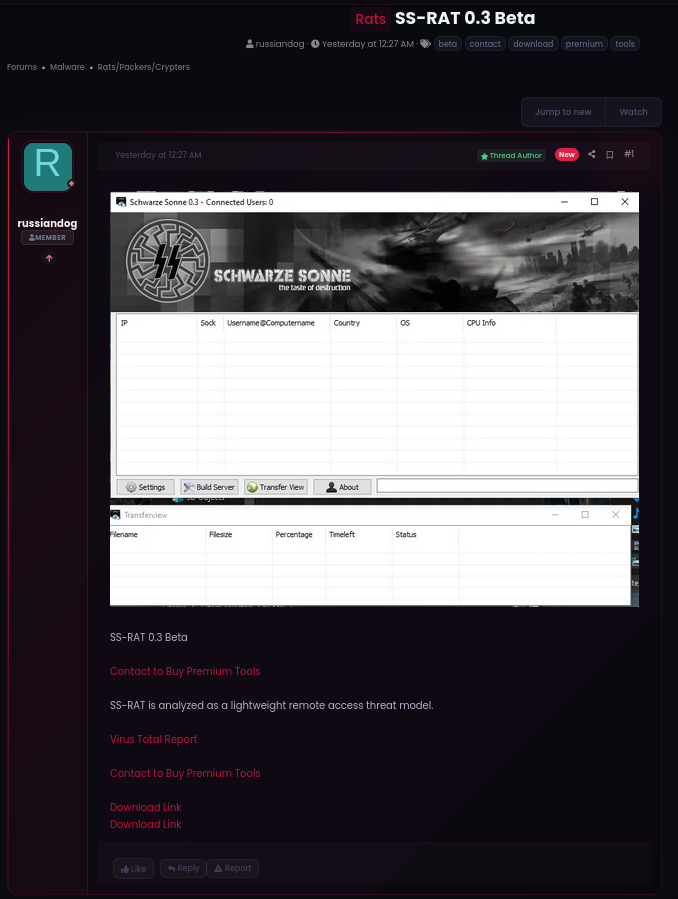
A recently identified Remote Access Trojan, SS-RAT 0.3 Beta, has been spotted in underground forums, offering sophisticated features for system control and data exfiltration.
A recently identified Remote Access Trojan, SS-RAT 0.3 Beta, has been spotted in underground forums, offering sophisticated features for system control and data exfiltration.
The emergence of the SS-RAT 0.3 Beta highlights the persistent and evolving nature of the threat landscape. Marketed as a lightweight remote access tool, this malicious software facilitates unauthorized control over compromised systems. By providing attackers with a centralized control panel, it enables the tracking of victim configurations, management of persistent connections, and the execution of unauthorized file transfers. This development represents a concerning expansion in the availability of offensive tooling for threat actors targeting enterprise environments.
For organizations operating in the GCC region, the proliferation of such specialized malware necessitates a robust defense-in-depth strategy. As threat actors refine their toolkits, the reliance on signature-based detection becomes increasingly insufficient. Enterprises must shift towards proactive, behavioral-based detection models to identify and neutralize these threats at the point of entry.
Remote Access Trojans (RATs) are among the most dangerous tools in a threat actor's arsenal. Their ability to grant full, unauthorized access to a victim's machine allows for long-term espionage, data theft, and the deployment of additional malicious payloads. The SS-RAT 0.3 Beta is designed to be low-footprint, allowing it to evade standard security software while maintaining a high level of functional capability. The inclusion of features specifically tailored for file exfiltration and connection management makes this variant a significant risk to data integrity.
To understand if your enterprise is already exposed to such threats or has been compromised, consider conducting a proactive Penetration Testing engagement to simulate how these tools would interact with your current defensive controls. By identifying weaknesses in your infrastructure before an adversary does, you effectively reduce the window of opportunity for attackers.
Building a resilient security posture requires continuous vigilance. It is no longer enough to rely on periodic assessments; organizations must embrace a continuous monitoring approach. Part of this strategy involves identifying misconfigurations and exposed assets that malware authors often target to gain initial access. Engaging in comprehensive Attack Surface Management ensures that your internet-facing resources are not providing easy pathways for attackers to deploy tools like SS-RAT 0.3 Beta.
Free exposure check
Dark Web Scanner
check dark web mentions, compromised account indicators, malware log signals, public breach exposure, and recent underground market activity for your domain.
As the threat landscape becomes more automated, the response must become more intelligent. The deployment of AI-powered security and regular, expert-led red team operations are essential for maintaining a strong defensive perimeter. FemtoSec provides the specialized expertise necessary for enterprises in the GCC to navigate these complexities, ensuring that compliance and security go hand-in-hand. By prioritizing proactive identification of vulnerabilities, organizations can significantly diminish the impact of emerging malware variants.
Ultimately, the threat from tools like SS-RAT 0.3 Beta is not just the malware itself, but the access it provides to the broader corporate network. Strengthening internal controls, implementing strict least-privilege policies, and ensuring that your incident response team is equipped to handle rapid containment are non-negotiable requirements for modern business continuity.
If your team may be exposed to a similar threat, FemtoSec can help validate blast radius, prioritize remediation, and connect the issue to a practical security program.
October 7, 2026
Underground forums have observed threat actors commercializing AbkoRAT, a commercial Remote Access Trojan engineered for stealthy surveillance, multimedia interception, credential harvesting, and arbitrary command execution across compromised enterprise hosts.
October 1, 2026
A threat actor has advertised a batch of 3,100 FATETRAFFIC stealer logs on underground cybercrime forums. The archive contains harvested browser credentials, active session tokens, and endpoint metadata collected through widespread information-stealer malware operations.
September 18, 2026
A new malware-as-a-service offering named Hermes has surfaced on underground forums, bundling hidden virtual desktop control, browser credential harvesting, crypto wallet theft, and remote command execution.