Data Breachhigh
Genesis College Breach Exposes Extensive Student Data
A significant data breach involving Genesis College has exposed highly sensitive information, including student and staff personal data. We analyze the implications.
A significant data breach involving Genesis College has exposed highly sensitive information, including student and staff personal data. We analyze the implications.
The reported data breach at Genesis College represents a critical exposure of sensitive personal information. Threat actors claim to have exfiltrated a massive cache of institutional data, spanning from student and parent details to internal administrative documentation. In an environment where academic institutions hold high volumes of personally identifiable information (PII), such events are particularly damaging to privacy, trust, and regulatory compliance.
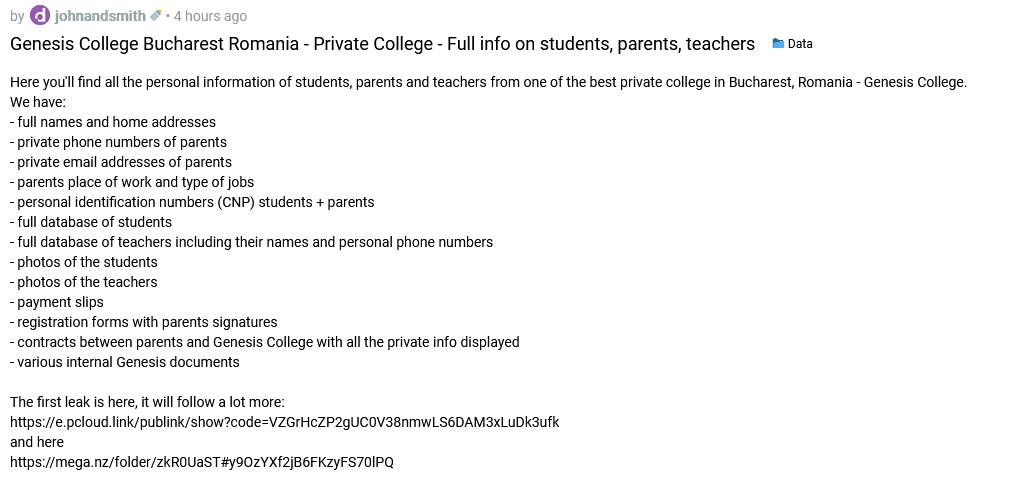
The stolen dataset reportedly includes full names, home addresses, phone numbers, email addresses, and official identification numbers. Beyond basic identity markers, the leak extends to highly sensitive administrative content such as registration forms, signed contracts, employment details, payment slips, and photographs. This breadth of information allows for sophisticated follow-on attacks, including targeted phishing, identity theft, and potential financial fraud.
For institutions in the education sector, managing this data involves stringent requirements. Organizations must maintain a robust Vulnerability Management program to ensure that the infrastructure hosting these sensitive documents remains shielded from unauthorized access. When data of this nature enters the dark web, the risk of credential stuffing and social engineering increases significantly for all affected parties.
Free exposure check
Dark Web Scanner
check dark web mentions, compromised account indicators, malware log signals, public breach exposure, and recent underground market activity for your domain.
The Genesis College incident highlights a common failure in modern security: the inability to detect unauthorized exfiltration before the data surfaces on underground forums. Enterprises must shift their focus toward proactive measures. Relying on perimeter defenses is no longer sufficient; institutions need visibility into their own Attack Surface Management to identify and remediate misconfigurations before they are weaponized by threat actors.
A critical component of this strategy is the acknowledgment that data leakage is often the end product of a long-standing security deficit. Whether it is an unpatched vulnerability in an outward-facing web portal or a compromised set of privileged credentials, the path to the database is often laid out in plain sight. Ensuring that internal documents are segmented and encrypted is essential for minimizing the blast radius of such an occurrence.
For any institution faced with similar exposure, the immediate priority is to invalidate compromised credentials, secure all endpoints, and perform a comprehensive log review to identify the initial point of entry. Once containment is achieved, organizations should conduct a deep-dive Penetration Testing engagement to stress-test their defenses against the techniques utilized in this campaign. This validates whether current security controls are sufficient to stop future attempts.
Ultimately, the educational sector remains a high-value target for actors seeking to capitalize on the vast store of personal information available. Protecting this data requires a commitment to continuous monitoring and a proactive stance toward cybersecurity. By integrating advanced threat intelligence into daily operations, institutions can move from reactive incident response to a resilient, defensive posture.
If your team may be exposed to a similar threat, FemtoSec can help validate blast radius, prioritize remediation, and connect the issue to a practical security program.
An online learning management system belonging to a diplomatic academy was breached via a zero-day authentication bypass exploit. Threat actors maintained persistent access for ten months, compromising the personal data of 10,000 diplomatic personnel, including encrypted passwords and email addresses.
October 16, 2026
A dark web forum breach exposing 200,000 citizen records has highlighted severe identity theft and social engineering risks across public administration databases. FemtoSec provides deep technical analysis of the exfiltration vectors, MITRE ATT&CK mapping, and actionable containment measures for security teams.
October 14, 2026
A threat actor claims to have published approximately 100,000 billing, payment, and customer records from a prominent Cambodian payment gateway on an underground forum, highlighting significant operational and fraud risks for integrated merchants and consumers.
Onion URL
https://dreadytofatroptsdj6io7l3xptbet6onoyno2yv7jicoxknyazubrad.onion/post/66d9b29d3cff71d0df07