A confirmed breach of a major IT consultancy highlights the critical threat of exposed DevOps credentials. Learn how compromised Azure PATs, RSA keys, and private repositories put enterprise supply chains at risk and how to detect and contain these threats.


Actor 888 lists the 35 GB exfiltrated dataset for one-time sale in Monero.
Accenture isolates the source of the leak, rotating affected keys and tokens.
Compromise developer credentials or Azure PATs
Authenticate directly to dev.azure.com endpoints
Execute Git clone for 121123_AtriasTalentAcademy
Extract RSA/SSH keys and Azure Storage keys from code history
If your team may be exposed to a similar threat, FemtoSec can help validate blast radius, prioritize remediation, and connect the issue to a practical security program.
A targeted cyber campaign has exposed credentials and personally identifiable information belonging to prominent digital advocacy leaders. The threat actor is leveraging encrypted peer-to-peer messaging networks to distribute the stolen data, highlighting persistent cognitive warfare threats.

An 8 GB SQL database archive has been leaked online, exposing sensitive student records, institutional identifiers, and emails. The incident highlights critical security gaps in public-facing educational platforms and the immediate danger of secondary credential abuse attacks across enterprise environments.

June 24, 2026
The emerging PEAR Team has leaked 1.8 TB of highly sensitive corporate and client records from Canada-based Exchange Group. Our detailed technical analysis exposes their data-only extortion tactics, RMM persistence methods, and actionable security telemetry to protect enterprise environments.
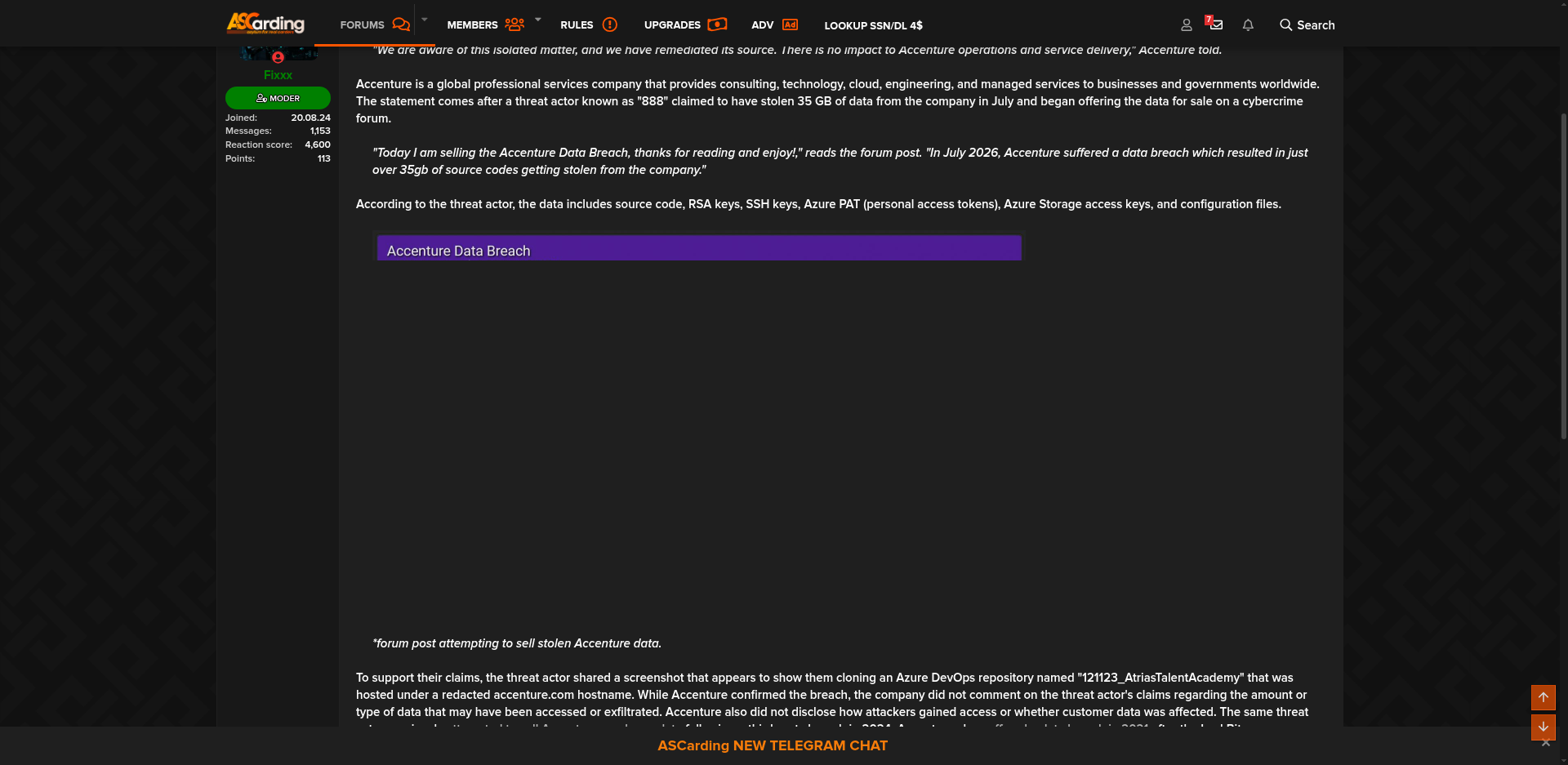
A global IT services enterprise has confirmed a security breach following a threat actor's public attempts to sell 35 gigabytes of proprietary source code and development secrets on a popular cybercrime forum. The incident, which came to light after an actor operating under the alias 888 advertised the data archive, highlights the acute threat that developer credential exposure poses to modern organizations. According to threat intelligence reports, the stolen dataset contains sensitive development assets, including private repositories, cryptographic keys, and cloud environment configuration files. While the target company stated that the issue has been remediated with no operational impact on service delivery, the compromise serves as a stark reminder of how vulnerable cloud-based development environments can be when access credentials are not strictly managed.
Securing enterprise software development pipelines demands continuous verification and advanced offensive security validation. Relying on basic perimeter controls is no longer sufficient when threat actors can easily purchase or steal active developer credentials. Proactive security measures can help organizations identify weaknesses before attackers do.
FemtoSec delivers comprehensive, offensive cybersecurity solutions tailored to the needs of leading enterprises in the GCC region. Our expert-led assessments go beyond simple automated scans, simulating real-world adversaries to uncover exposed credentials, misconfigured access controls, and vulnerabilities in your software supply chain. Whether you require in-depth network and cloud assessment or ongoing monitoring of underground forums, our team of seasoned security professionals provides the actionable insights necessary to fortify your digital perimeter.
To learn more about how FemtoSec can secure your development environments and protect your critical digital assets from credential abuse, contact our threat intelligence team today for a free initial consultation with response within 24 hours.
For large enterprises, particularly those operating across the GCC region, securing the software supply chain has become a paramount priority. When an IT services provider or consulting firm suffers a code repository breach, the risk extends far beyond the immediate organization. Downstream clients, partners, and interconnected public networks may also face heightened exposure, as attackers can analyze proprietary code to identify security weaknesses or leverage stolen cryptographic credentials for secondary intrusions. Continuous tracking of exposed data assets is critical in these scenarios. Through our Dark Web Monitoring service, FemtoSec helps companies identify leaked credentials, proprietary code, and infrastructure blueprints before they can be exploited on underground markets.
The incident surfaced in early July 2026, when the threat actor 888 posted an advertisement on PwnForums seeking a buyer for a one-time purchase of the exfiltrated dataset. To validate their claims, the actor shared a proof-of-concept screenshot depicting the cloning of a private Azure DevOps repository named 121123_AtriasTalentAcademy, hosted under an accenture.com sub-domain. While the victim organization quickly isolated the source of the leak and began remediation, the incident has renewed industry concerns regarding how easily attackers can target modern development pipelines.
The stolen data represents a significant threat because it is not limited to passive documentation or public-facing code. The exfiltrated archive reportedly contains:
Proprietary Source Code: Private repositories that define the business logic of internal applications, talent platforms, and customer-facing interfaces.
Cryptographic Assets: RSA and SSH keys that serve as trust anchors for secure communications, server access, and code signing.
Cloud Access Keys: Azure Storage access keys and Azure Personal Access Tokens (PATs) that permit administrative control over cloud resources.
Configuration Files: Files containing system settings, database connection strings, and network paths that map the internal infrastructure of the target environment.
By capturing these highly sensitive secrets, threat actors bypass the need to discover and exploit traditional software vulnerabilities. Instead, they exploit valid credentials to blend in with authorized developer activity, making early detection exceptionally difficult for standard perimeter defenses.
To defend against similar repository compromises, security teams must understand how threat actors target the development lifecycle. The attack chain in repository harvesting incidents typically follows a systematic progression, moving from initial access to silent exfiltration and monetization.
While the precise entry point for this specific breach has not been disclosed, typical access vectors in DevOps breaches involve the compromise of developer identities. Threat actors frequently exploit weak, unrotated passwords, or harvest active session tokens from the endpoints of software engineers using infostealer malware. In other instances, developers inadvertently expose Personal Access Tokens (PATs) in public repositories, third-party collaboration tools, or testing environments. Once an attacker obtains a valid PAT or a set of active credentials, they can authenticate directly to Azure DevOps endpoints without triggering typical multi-factor authentication prompts, especially if the organization does not enforce phishing-resistant MFA or conditional access policies.
Once authenticated as a legitimate developer or service principal, the threat actor executes Git clone commands to copy private repositories to external, attacker-controlled servers. Because standard Git operations are a routine part of daily development workflows, a single developer account cloning multiple repositories does not always trigger immediate alerts. In this incident, the threat actor targeted the 121123_AtriasTalentAcademy repository, pulling down not only the source code but also any configuration files and secrets embedded directly in the development history.
After cloning the repositories, the attacker conducts offline analysis to extract hardcoded credentials. It is a common, though dangerous, practice for development teams to store API keys, database passwords, and SSH keys in local configuration files or git history for ease of testing. By retrieving these secrets, the attacker gains persistent, secondary access pathways. In this case, the exposure of Azure Storage access keys and RSA/SSH keys represents a critical escalation vector. Armed with these credentials, the actor can access sensitive cloud storage buckets, establish persistent SSH backdoors on internal servers, or potentially move laterally into other parts of the corporate network.
Security teams can map the threat behaviors observed in this incident to the MITRE ATT&CK framework to establish robust defensive coverage:
T1078 - Valid Accounts: The threat actor leverages compromised developer credentials or Personal Access Tokens to authenticate directly to the Azure DevOps environment.
T1552.001 - Credentials in Files: The attacker harvests RSA keys, SSH keys, and cloud storage secrets embedded directly within repository configuration files and code history.
T1530 - Data from Cloud Storage Object: The threat actor gains unauthorized access to private cloud resources, downloading proprietary intellectual property and code files.
T1048 - Exfiltration Over Alternative Protocol: Proprietary repository contents are transferred out of the network via standard Git over HTTPS protocols, masquerading as routine development activities.
T1587.002 - Develop Capabilities (Code Repositories): Attackers target development environments to gather intelligence and find potential supply-chain vulnerabilities that can be exploited in downstream target environments.
The compromise of code repositories poses several severe downstream risks for global organizations and their enterprise clients. When source code is exposed, competitors or malicious actors can review the logic to identify structural flaws, unpatched vulnerabilities, or architectural weaknesses. This allows attackers to craft highly targeted exploits that would be difficult to discover through black-box testing alone.
Furthermore, the theft of cryptographic keys and cloud access tokens creates a profound trust crisis. If an attacker possesses valid RSA/SSH keys or Azure Storage access keys, they can potentially authenticate to production systems or access sensitive databases. For organizations in the GCC region, where digital transformation and cloud adoption are accelerating rapidly, protecting these trust assets is crucial for regulatory compliance, including alignment with national cybersecurity frameworks and international standards like SOC 2 and PCI-DSS.
If the domain already looks exposed, use Dark Web Scanner before requesting a full report. By mapping development subdomains and public endpoints with Attack Surface Management, organizations can proactively block unauthorized access before credentials can be abused.
Free exposure check
Dark Web Scanner
check dark web mentions, compromised account indicators, malware log signals, public breach exposure, and recent underground market activity for your domain.
Defending against DevOps repository breaches requires a combination of automated monitoring, proactive log analysis, and rigorous secrets management. Organizations should establish concrete detection mechanisms to identify compromised developer accounts before data exfiltration occurs.
To detect anomalous activities within development platforms, security operation centers should implement the following monitoring rules:
Monitor Bulk Cloning Events: Configure SIEM alerts to trigger when a single user account or IP address clones an unusually high number of repositories within a short timeframe. Analyze Azure DevOps AuditLogs for operations such as Git.RepositoryCloned.
Geographic and IP Anomalies: Flag any Git or API connections originating from unexpected geographic locations, residential VPNs, or IP addresses not associated with the corporate network.
Token Creation and Lifespan Alerts: Monitor the creation of Azure Personal Access Tokens (PATs) with long lifespans or excessive permissions. Ensure alerts are generated whenever a PAT is generated with broad administrative scopes.
Continuous Secret Scanning: Deploy automated scanning engines to continuously scan active code commits, pull requests, and historical branches for hardcoded API keys, private cryptographic keys, and database passwords.
If an organization suspects that its development repositories have been compromised, incident responders must act quickly to isolate the breach and prevent further lateral movement:
Revoke Affected Credentials: Immediately deactivate and rotate all potentially compromised Personal Access Tokens, SSH keys, RSA keys, and cloud storage access secrets. Treat all secrets within the exposed repositories as fully compromised.
Audit DevOps Access Logs: Query Azure DevOps access logs to identify the exact scope of the compromise. Determine which user account was utilized, what IP addresses accessed the systems, and exactly which repositories were cloned or modified.
Enforce Phishing-Resistant MFA: Mandate the use of hardware-based multi-factor authentication, such as FIDO2 tokens, for all developer accounts. This prevents session hijacking and token theft from bypassing authentication screens.
Implement IP-Based Access Restrictions: Enforce Azure AD Conditional Access policies to restrict repository access to corporate-managed devices and verified, corporate-owned IP blocks.