Data Breachhigh
Data Breach Risks: Analyzing the BT Group Exposure
A recent claim of a massive data breach affecting 1.5 million records at BT Group highlights the urgent need for robust data governance and proactive security.
A recent claim of a massive data breach affecting 1.5 million records at BT Group highlights the urgent need for robust data governance and proactive security.
In an era where data is the lifeblood of enterprise, the reported breach involving BT Group serves as a stark reminder of the persistent threats facing the telecommunications sector. A threat actor has claimed access to over 1.5 million records, allegedly containing full names, residential addresses, phone numbers, and other granular customer information. While the incident is currently under assessment, the potential impact on customer trust and regulatory standing is significant.
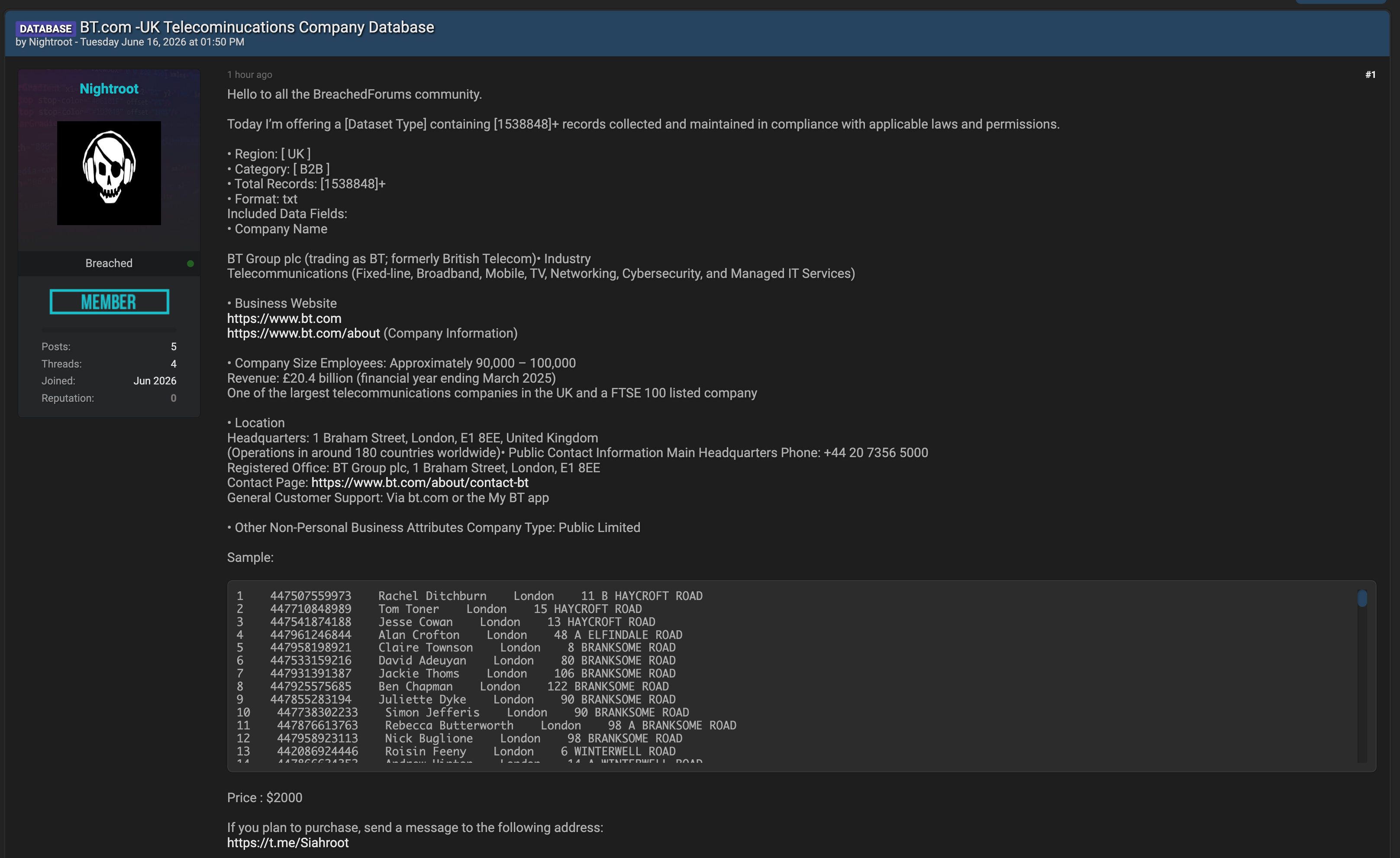
For enterprise leaders, a breach of this magnitude is not merely a technical failure; it is an organizational risk that necessitates a shift toward a compliance-first, proactive security model. When sensitive customer data reaches underground forums, the likelihood of secondary attacks, such as targeted phishing or social engineering campaigns, increases exponentially. Organizations operating in the GCC must recognize that such breaches often indicate failures in the protection of PII and critical infrastructure assets.
Free exposure check
Dark Web Scanner
check dark web mentions, compromised account indicators, malware log signals, public breach exposure, and recent underground market activity for your domain.
When customer databases are leaked, the risk vector shifts from initial access to identity-based exploitation. Attackers leverage these datasets to conduct high-fidelity credential stuffing or to craft convincing, context-aware phishing messages that bypass standard filters. The exposure of residential and contact data creates a multi-layered threat: individuals are at higher risk of identity fraud, while the organization faces potential reputational damage and regulatory inquiries.
Enterprises should utilize Dark Web Monitoring to ensure that internal data is not appearing in illicit markets before it results in a public incident. By identifying leaks at the earliest possible stage, security teams can initiate password resets, invalidate session tokens, and deploy enhanced monitoring on targeted accounts to stop lateral movement before it matures.
Many organizations rely on traditional perimeter defenses, but modern threats demand a more rigorous approach. Through Penetration Testing, security teams can identify the vulnerabilities that allow unauthorized access to database environments. A compliance-first operating model ensures that security controls are not only active but also aligned with sector-specific standards, reducing the overall attack surface and minimizing the impact of potential future breaches.
Furthermore, managing your digital footprint is essential. By implementing continuous Attack Surface Management, firms can maintain visibility into their internet-facing assets and ensure that misconfigurations or exposed APIs do not provide a back door for threat actors. A resilient enterprise architecture is built on the principle of least privilege and continuous validation, ensuring that even if one component is compromised, the broader business infrastructure remains resilient.
Automated Monitoring: Implement continuous scanning to detect leaked credentials or internal data in unauthorized locations.
Strengthen Access Controls: Enforce multi-factor authentication across all customer-facing and internal database environments.
Incident Response Readiness: Develop clear procedures for notifying stakeholders and regulatory bodies in the event of a confirmed data leak.
Regular Validation: Utilize third-party testing to simulate how an adversary would target your specific data infrastructure.
The incident at BT Group highlights that no organization is immune. Security is a continuous process of hardening, monitoring, and adapting to a landscape where threat actors are constantly evolving their tactics. By prioritizing proactive defenses and maintaining strict visibility over critical assets, organizations can significantly reduce the window of opportunity for attackers.
If your team may be exposed to a similar threat, FemtoSec can help validate blast radius, prioritize remediation, and connect the issue to a practical security program.
October 16, 2026
A dark web forum breach exposing 200,000 citizen records has highlighted severe identity theft and social engineering risks across public administration databases. FemtoSec provides deep technical analysis of the exfiltration vectors, MITRE ATT&CK mapping, and actionable containment measures for security teams.
October 14, 2026
A threat actor claims to have published approximately 100,000 billing, payment, and customer records from a prominent Cambodian payment gateway on an underground forum, highlighting significant operational and fraud risks for integrated merchants and consumers.
September 20, 2026
A threat actor claims to have leaked more than 100,000 records from a public water management entity, exposing Peruvian national identity document numbers, citizen names, emails, and internal complaint registries.
Onion URL
http://breached4wtyw5fb45zj7sggnoazgv3aohme2zftkrndhvo76d5q5uad.onion/Thread-DATABASE-BT-com-UK-Telecominucations-Company-Database