Data Breach Analysis: Homers.fr Security Exposure
A significant data breach involving Homers.fr has exposed customer records including personal and financial preferences. FemtoSec provides an in-depth security perspective on protecting sensitive enterprise assets against unauthorized exposure.

Key Takeaways
- A major database leak at Homers.fr has exposed personal, financial, and behavioral customer data.
- The scope of the breach highlights critical vulnerabilities in customer data management systems.
- Proactive security measures like regular penetration testing are essential to preventing unauthorized database access.
- Enterprises must prioritize visibility over their entire attack surface to mitigate future risks.
Overview of the Homers.fr Data Incident
Recent threat intelligence reports highlight a concerning data breach involving Homers.fr, a real estate organization based in France. Reports indicate that unauthorized actors have obtained and leaked an internal database containing sensitive customer information. The exposure includes a wide range of fields, such as full names, email addresses, phone numbers, and highly specific customer profiles including rental preferences, income details, and invoice-related records.
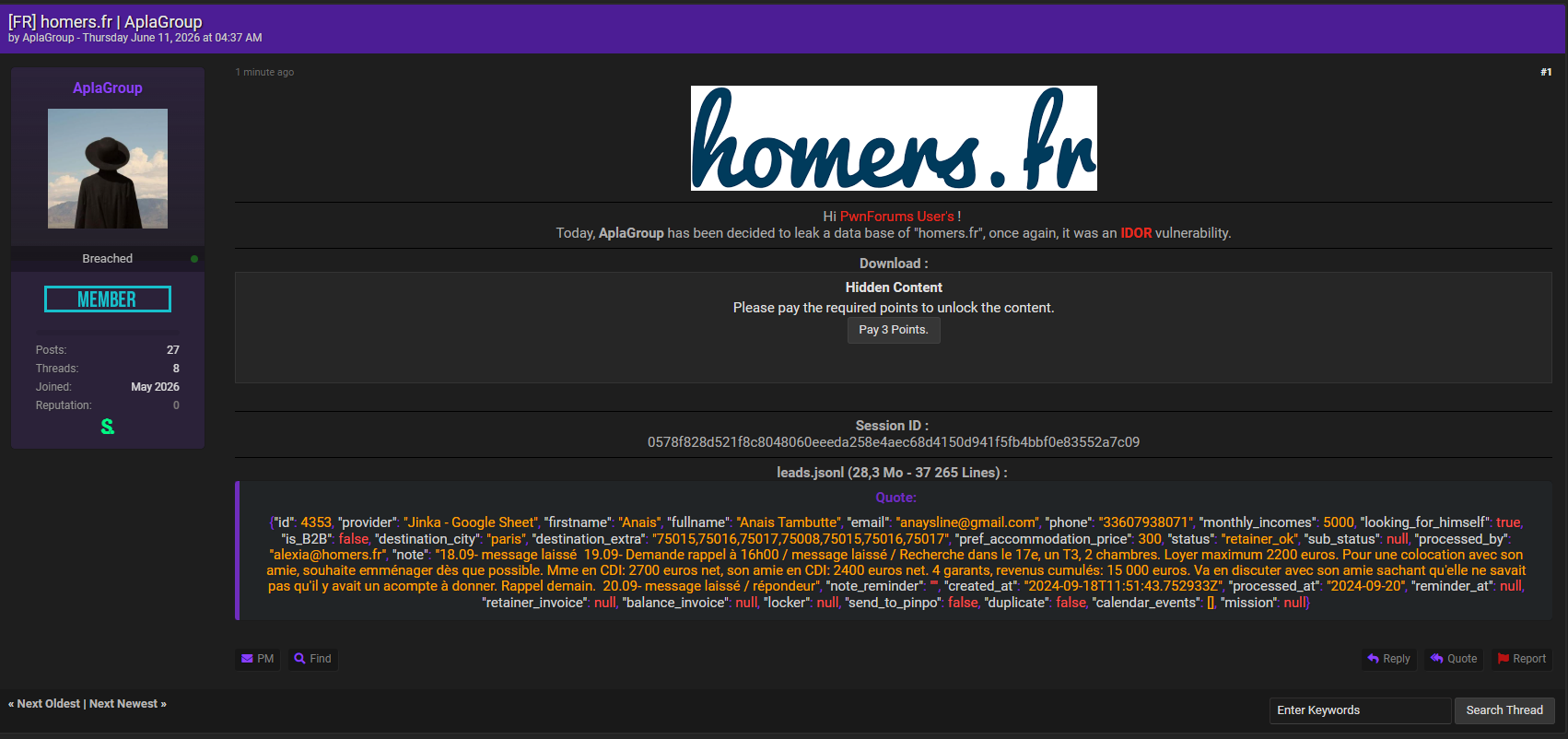
For any enterprise, the loss of customer management data is not merely a breach of privacy but a significant business risk. Beyond the immediate impact of exposed personal identifiers, the depth of the data leaked—such as accommodation budgets and financial status—presents a high risk for targeted social engineering and phishing campaigns against the affected user base. Organizations must view this incident as a reminder that their databases are high-value targets that require continuous, proactive validation.
Implications for Enterprise Security
When customer data is leaked in the public domain, the fallout often extends beyond the victimized organization to the customers themselves. The inclusion of internal customer management notes and calendar events suggests that the security flaw may have resided in the application layer, potentially involving an insecure API or an insufficiently protected database instance. To prevent such incidents, businesses need a robust approach to Attack Surface Management to ensure that no part of their infrastructure remains exposed to the public internet without proper security controls.
Furthermore, this breach highlights the danger of static defenses. Many organizations focus on perimeter security while neglecting the internal validation of their applications. A professional Penetration Testing engagement would identify the vulnerabilities that typically lead to such database compromises, such as broken object-level authorization or SQL injection flaws, long before an adversary can weaponize them.
The Importance of Proactive Threat Intelligence
In the aftermath of such events, remediation is complex. Companies must perform thorough forensic investigations to understand exactly what was exposed and to what extent. However, waiting for an incident to occur is a failing strategy. By integrating threat intelligence with a compliance-first operating model, enterprises can identify weaknesses and close them within days, avoiding the catastrophic loss of consumer trust.
Free exposure check
Dark Web Scanner
check dark web mentions, compromised account indicators, malware log signals, public breach exposure, and recent underground market activity for your domain.
Strategic Recommendations
To mitigate the risks associated with data leaks, organizations should consider the following:
Regularly audit all internet-facing assets for unauthorized exposure or misconfigurations.
Implement stringent access controls and encryption for all customer-facing databases.
Conduct frequent source code reviews to identify flaws that could permit unauthorized database access.
Develop a comprehensive incident response plan that includes monitoring for leaked credentials.
The complexity of modern cyber threats requires a specialized approach. At FemtoSec, we help GCC-based enterprises fortify their defenses through rigorous offensive security testing and AI-powered intelligence. Whether it is a web application vulnerability or a wider network issue, our platform ensures your business stays ahead of adversaries.
How to Defend Against Similar Threats
- Perform an immediate audit of internet-facing database instances and API security.
- Initiate an enterprise-wide dark web monitoring program to detect further leaks of internal data.
- Conduct a comprehensive penetration test to identify and patch vulnerabilities before exploitation.
- Review internal data handling procedures to ensure compliance with privacy regulations.
Threat Intel FAQ
What kind of data was exposed in the Homers.fr breach?
How can businesses prevent similar database breaches?
Could a similar threat affect your organization?
If your team may be exposed to a similar threat, FemtoSec can help validate blast radius, prioritize remediation, and connect the issue to a practical security program.
Related Threats
September 20, 2026
Water Infrastructure Authority Database Leaked Online
A threat actor claims to have leaked more than 100,000 records from a public water management entity, exposing Peruvian national identity document numbers, citizen names, emails, and internal complaint registries.
An online learning management system belonging to a diplomatic academy was breached via a zero-day authentication bypass exploit. Threat actors maintained persistent access for ten months, compromising the personal data of 10,000 diplomatic personnel, including encrypted passwords and email addresses.
An alleged data breach targeting Brazilian payment gateway and digital banking platform PagBank has surfaced on underground forums. A threat actor claims to possess a database containing information related to 10 billion transactions, highlighting the growing cybersecurity risks facing the fintech sector.