Academic Data Breach Hits Australian College
Recent reports highlight a major data breach at the Australian College of Management and Innovation. This analysis explores the implications for higher education security.

Key Takeaways
- Exposure of 25,000 records including PII and financial transaction data.
- Higher education institutions are high-value targets due to the volume of sensitive data they store.
- Proactive monitoring of the dark web and attack surface is essential to preventing data exfiltration.
- Financial data exposure increases the risk of downstream fraud and identity theft for users.
Incident Overview
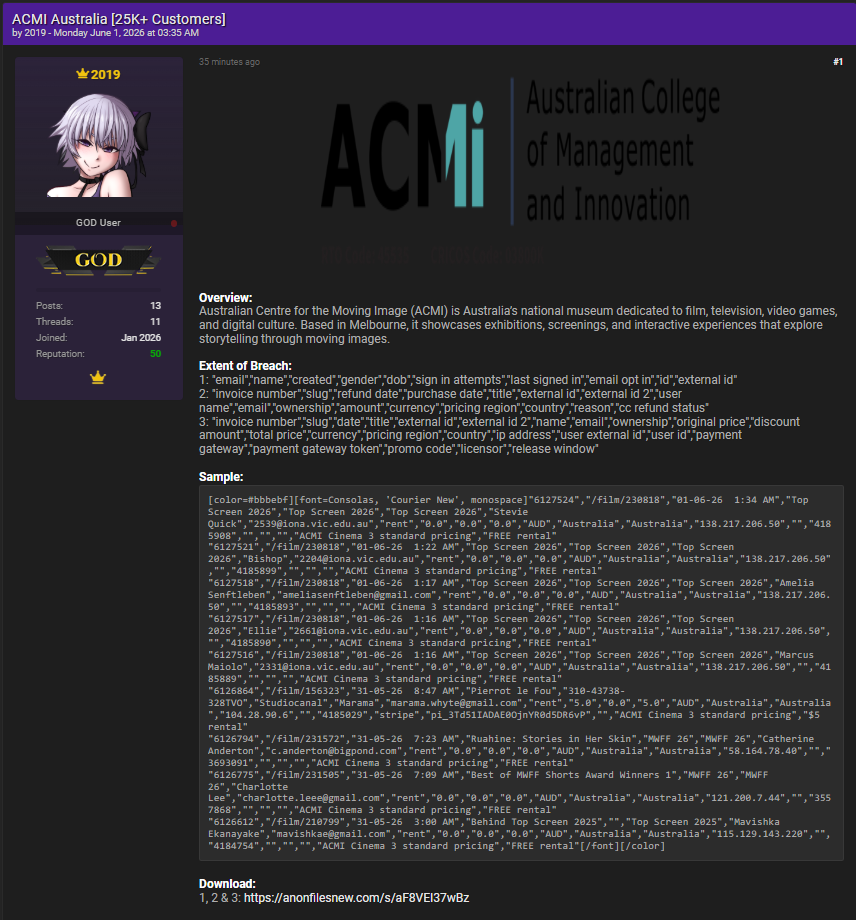
A recent data breach impacting the Australian College of Management and Innovation (ACMI) has brought significant attention to the vulnerabilities within the higher education sector. Reports indicate that a threat actor has claimed to leak a database containing approximately 25,000 records. The exposed data includes sensitive personally identifiable information (PII) such as emails, full names, gender, job titles, and sign-in metadata, as well as financial details like invoice numbers, purchase dates, discount amounts, and pricing structures. For academic institutions, this breach serves as a stark reminder of the necessity for robust vulnerability assessments to identify and mitigate risks before they result in unauthorized data exfiltration.
Implications for Academic Institutions
Educational institutions like ACMI often maintain massive datasets of student, faculty, and administrative information. The theft of financial records alongside personal credentials creates a high-risk environment where threat actors can engage in identity fraud or targeted phishing campaigns. When attackers gain access to such granular data, the potential for downstream attacks against individuals increases significantly. Organizations must proactively manage their digital footprint and monitor external exposure through comprehensive dark web monitoring to stay ahead of potential leaks.
Strategic Cybersecurity Lessons
The nature of this breach underscores that no sector is immune to data exfiltration. The inclusion of invoice data and pricing structures suggests that the attackers gained deep access to the college's internal systems, possibly through neglected subdomains or misconfigured cloud storage, which highlights the critical need for mature attack surface management. Academic entities are frequently targeted due to the perceived softness of their cybersecurity posture compared to private corporations. By integrating offensive security measures such as red teaming, colleges can pressure-test their defenses against modern adversary techniques.
Moving Beyond Passive Defense
In the aftermath of such incidents, reactive measures are insufficient. Leading enterprises in the GCC region and globally rely on continuous security validation. At FemtoSec, we advocate for a compliance-first, proactive operating model. By regularly testing applications, infrastructure, and API security, organizations can identify the weaknesses that often lead to these catastrophic leaks. Whether it is addressing unpatched software or securing sensitive database access, technical resilience is built through consistent validation and strategic governance.
Protecting Institutional Integrity
The academic sector holds a unique trust with its students. A loss of data not only results in regulatory scrutiny and financial damage but also erodes the reputation of the institution. Maintaining the confidentiality, integrity, and availability of student data should be a board-level priority. Through the adoption of advanced security practices, institutions can ensure that they are not merely checking boxes for compliance, but actively hardening their environment against sophisticated digital threats.
How to Defend Against Similar Threats
- Conduct a comprehensive vulnerability assessment to identify system entry points.
- Implement continuous dark web monitoring to identify potential credential leaks early.
- Review internal access controls and database security policies to minimize the blast radius of a breach.
- Engage in periodic red teaming exercises to simulate and defend against real-world adversary tactics.
Threat Intel FAQ
What kind of data was involved in the Australian College of Management and Innovation breach?
Why are academic institutions frequent targets for cyberattacks?
Could a similar threat affect your organization?
If your team may be exposed to a similar threat, FemtoSec can help validate blast radius, prioritize remediation, and connect the issue to a practical security program.
Related Threats
An online learning management system belonging to a diplomatic academy was breached via a zero-day authentication bypass exploit. Threat actors maintained persistent access for ten months, compromising the personal data of 10,000 diplomatic personnel, including encrypted passwords and email addresses.
October 16, 2026
Returnero Leaks 200,000 Government Records
A dark web forum breach exposing 200,000 citizen records has highlighted severe identity theft and social engineering risks across public administration databases. FemtoSec provides deep technical analysis of the exfiltration vectors, MITRE ATT&CK mapping, and actionable containment measures for security teams.
October 14, 2026
Fintech Payment Gateway Leaks 100,000 Billing Records
A threat actor claims to have published approximately 100,000 billing, payment, and customer records from a prominent Cambodian payment gateway on an underground forum, highlighting significant operational and fraud risks for integrated merchants and consumers.