
Source Code Review: Complete Guide to Improve Code Quality and Security
Most organizations that get breached weren't missing a firewall. They had monitoring tools. They had a WAF. Some of them had done penetration tests. What they didn't have was a serious look at the code itself, the actual lines that handled user input, validated credentials, enforced access control, and processed payments.
That's what source code review is for. And in 2026, with application layer attacks driving the majority of confirmed breach vectors, it has moved from a nice-to-have in an enterprise security checklist to a foundational control that serious programs treat as non negotiable.
This guide breaks down what source code review actually is, what it finds that nothing else will, which tools are worth using, and what separates a real review engagement from a scanner report with a consulting firm's logo.
What Source Code Review Actually Means
Source code review, also called secure code review, static security analysis, or simply code security review, is the process of systematically examining application source code to identify security vulnerabilities, logic errors, insecure design patterns, and compliance gaps before the software ships.
Unlike black-box penetration testing services in dubai, which attacks a deployed application from the outside with no visibility into its architecture, source code review works from the inside. Reviewers read the actual code, trace how data flows through the application, and look for the decisions that create exploitable conditions.
This gives reviewers access to an entirely different class of vulnerability one that external testing cannot surface at all:
Hardcoded credentials are buried in configuration utilities
Cryptographic implementations that look correct but use weak or deprecated algorithms
Authorization logic that works in 99% of cases but fails silently under edge conditions, an attacker can engineer
Race conditions that only appear under specific timing sequences
Input validation that's applied in the UI layer but bypassed entirely in the API
These aren't exotic. They appear in production codebases at every scale, from early-stage startups to Fortune 500 applications. And they can sit undetected for years because nothing in the deployment pipeline was designed to catch them.
Why 2026 Is the Wrong Year to Skip This
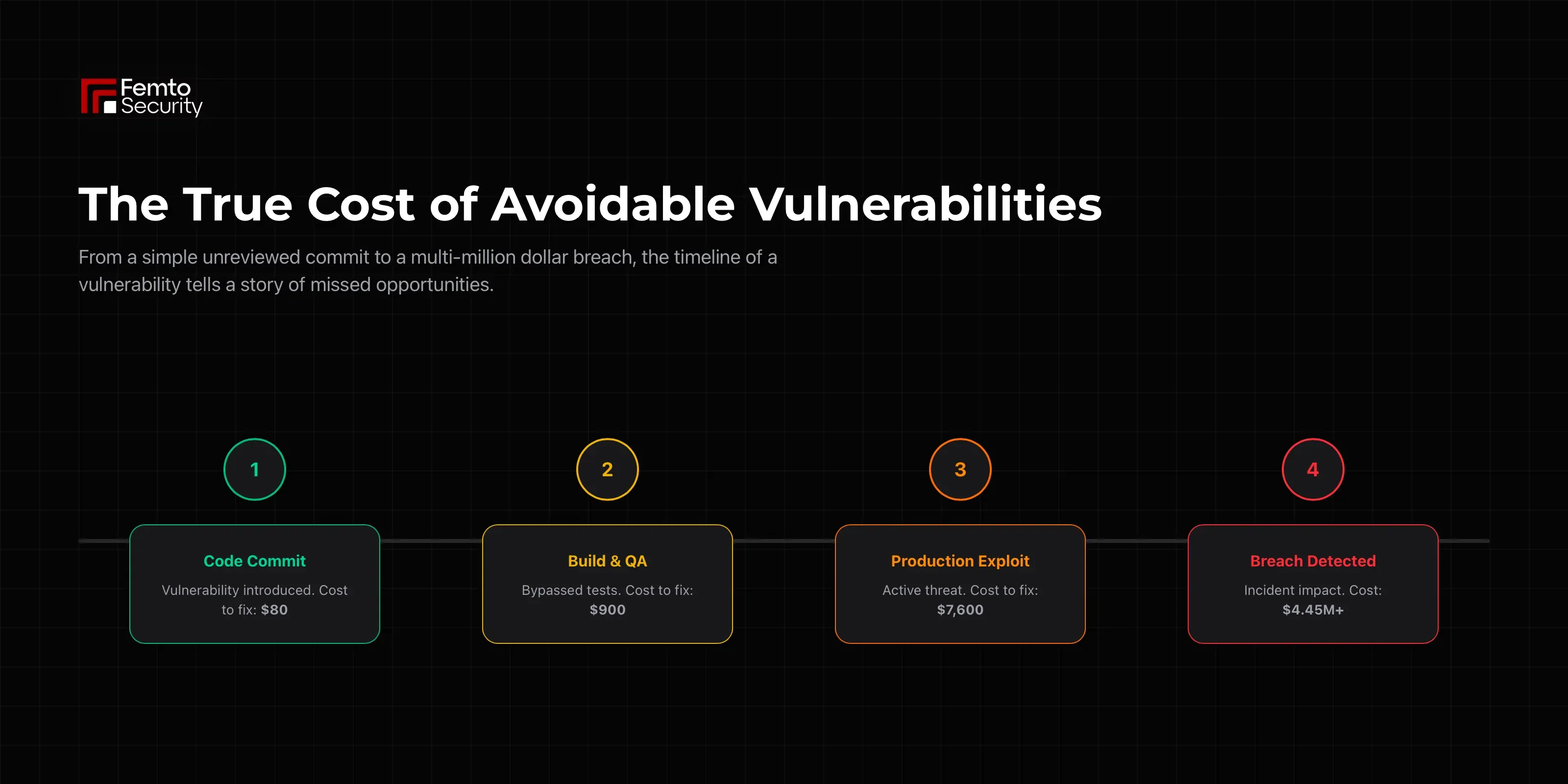
The IBM Cost of a Data Breach Report has tracked the relationship between security controls and breach costs for years. The trend in its most recent editions is unmistakable: the earlier a vulnerability is found, the cheaper it is to fix by orders of magnitude.
Here's what that looks like in practice:
Stage Vulnerability Is Found | Average Remediation Cost |
|---|---|
During code review (pre-merge) | $80 – $240 |
During QA and functional testing | $960 – $7,600 |
Post-deployment, pre-breach | $7,600 – $29,000 |
Post-breach, during incident response | $4.45M average total breach cost |
That isn't a linear increase. It's exponential. A SQL injection vulnerability that a developer fixes in 20 minutes during a code review becomes a multi-week incident response engagement if it reaches production and gets exploited.
The math makes the argument. Source code review is not a cost center, it's the highest-ROI security control most organizations aren't doing consistently.
Three other 2026 realities making this more urgent:
AI-assisted exploit development is lowering the bar. Attackers increasingly use LLMs to automate the discovery of vulnerable patterns in leaked or publicly exposed codebases. The window between "vulnerability exists" and "vulnerability is exploited" is shrinking.
Supply chain attacks have become an industry. The 2020 SolarWinds attack was a turning point. Since then, software supply chain compromises have grown year over year. Source code review including dependency analysis is the primary control that addresses this at the code level.
Regulators are catching up. From the Femto Security cybersecurity disclosure rules to VARA Compliance, regulatory frameworks increasingly require organizations to demonstrate that software is developed and assessed securely. A scan report from a free tool does not satisfy that requirement.
What Source Code Review Actually Finds
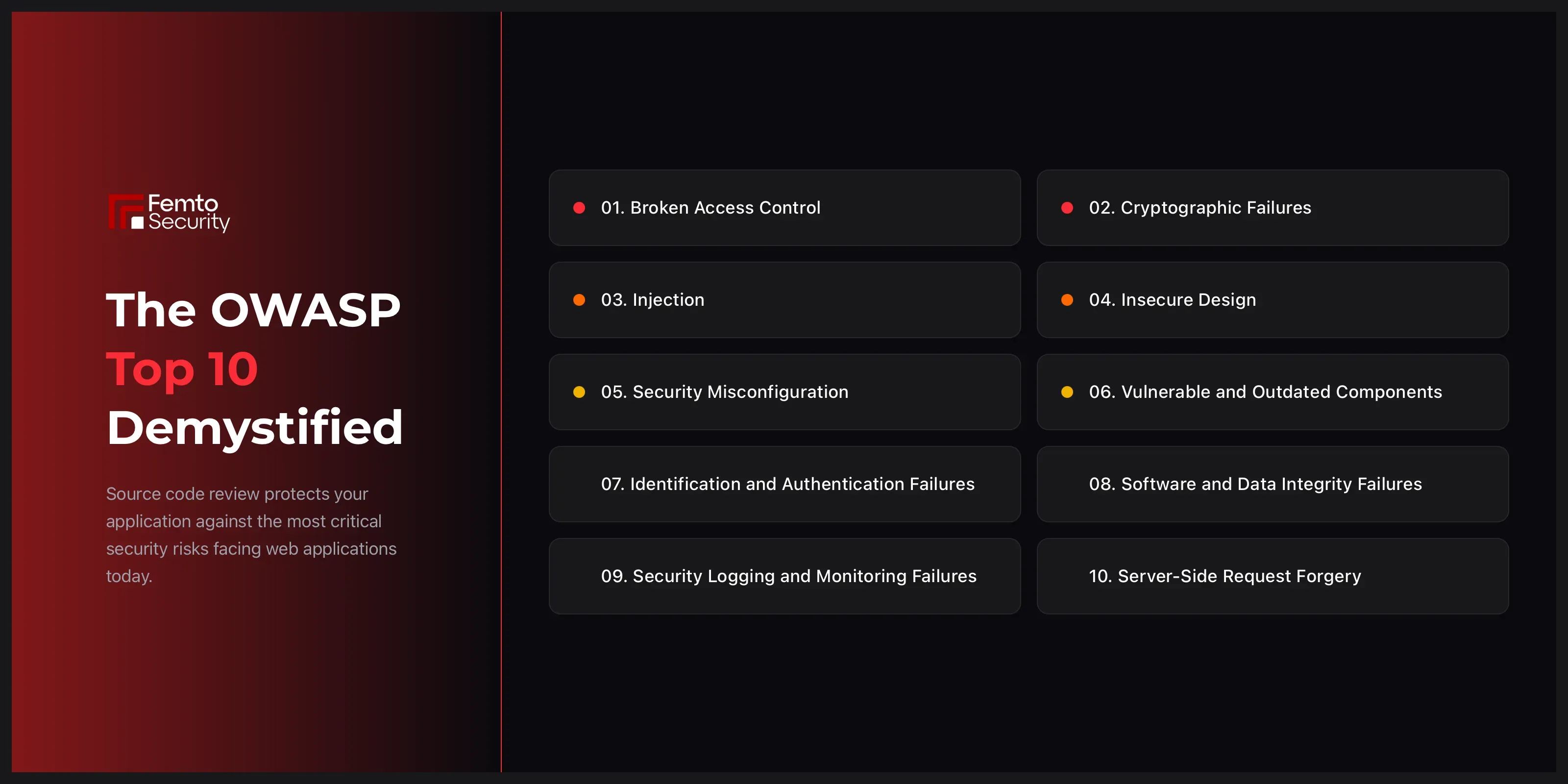
The most useful way to understand the scope of source code review is to map it to the OWASP Top 10 the most widely referenced framework for web application security risks. Most of the OWASP Top 10 categories are primarily detectable through source code analysis.
Broken Access Control — The #1 Risk, Caught Almost Exclusively Through Code
Broken access control has held the top spot on the OWASP list for years because it's both extremely common and extremely hard to detect from the outside. The vulnerability lies in the logic: a function that should check whether a user is authorized to view a resource doesn't do so under certain conditions.
External penetration testing services may find some access control failures, an endpoint that returns data it shouldn't, a parameter that can be incremented to access another user's records. But the full picture only appears when you read the code. That's where you see the missing isAuthorized() check, the access control logic that was bypassed when a developer added a new endpoint in a hurry, or the admin function that validates the role in the UI but not in the API handler.
Cryptographic Failures - Invisible to External Testing
An external attacker can observe that traffic is encrypted. They cannot observe that the key is stored in a config file. They cannot observe that the encryption algorithm is DES deprecated for two decades or that the initialization vector is hardcoded and reused across all encrypted records.
These decisions are made in code. They're visible in code. And they represent a category of finding that is entirely opaque to any form of testing that doesn't involve reading the implementation.
Injection - Classic, Still Everywhere
SQL injection, LDAP injection, OS command injection, and template injection these are old vulnerability classes that still appear in production applications in 2026. Tracing how user-controlled input flows into query construction is one of the most fundamental techniques of code review, and it's one of the areas where skilled reviewers consistently find high-severity findings that automated tools miss because they can't fully reason about data flow across functions and modules.
Authentication Failures - The Logic Is in the Code
Weak session management. Broken "remember me" implementations. Password reset flows that can be manipulated to reset another user's password. Missing multi factor authentication enforcement on privileged endpoints. All of these are code-level decisions that are only visible by reading the logic.
Software and Data Integrity Failures
Insecure deserialization. Dependency confusion attacks. Unsigned software update mechanisms. These vulnerabilities stem directly from decisions made during development, which is exactly why code review, not runtime testing, is the right control.
Source Code Review Tools: What's Actually Worth Using
There is no shortage of tooling in this space. But tooling without understanding is noise. Here's an honest breakdown of what the tool categories actually offer and where each one falls short.
Automated SAST (Static Application Security Testing)
Automated source code review tools scan codebases at machine speed, looking for patterns that match known vulnerability signatures. They're fast, consistent, and excellent at finding well-known patterns. They also generate false-positive rates of 40-70% in most deployments and are completely blind to business-logic vulnerabilities.
The major commercial platforms:
Tool | Strength | Best For |
|---|---|---|
Checkmarx SAST | Broad language coverage, deep enterprise workflow integration | Large enterprises with complex multi-language codebases |
Veracode Static Analysis | SaaS delivery, strong compliance reporting | Organizations without internal security tooling |
Fortify SCA (OpenText) | Deep Java/.NET support, mature platform | Regulated industries, legacy enterprise environments |
Snyk Code | Developer-first UX, fast IDE feedback, real-time scanning | DevSecOps teams focused on shifting left |
These are real tools that provide real value. They are also not a substitute for human review. The findings they generate still require a skilled analyst to validate, prioritize, and contextualize.
Open Source Code Review Tools
For teams with security engineering capacity, open-source code review tools offer significant capabilities at no licensing cost. These are not "good enough" alternatives; several of them are best-in-class for specific use cases.
Semgrep has become the community standard for writing custom rules. Its pattern-matching syntax is clean enough that developers can write their own rules targeting company-specific insecure patterns, a significant advantage over any black-box commercial platform. The community-maintained rule registry covers hundreds of vulnerability patterns across dozens of languages.
SonarQube Community Edition covers security, code quality, and technical debt across a wide range of languages. For teams already running SonarQube for code quality (the majority of large engineering organizations), enabling its security ruleset adds immediate coverage with minimal additional infrastructure.
CodeQL, available free via GitHub Advanced Security for public repositories, performs semantic code analysis and understands code structure and data flow, not just text patterns. This enables it to catch subtle vulnerability chains that simpler pattern-matching tools miss entirely.
Gitleaks and TruffleHog deserve special mention as specialized open-source code-review tools focused entirely on secret detection. Finding API keys, tokens, passwords, and credentials committed to source repositories. These should run on every commit in every organization's pipeline, full stop. Hardcoded credentials appear in approximately 1 in 4 enterprise repositories being scanned for the first time; it's not an edge case.
Bandit (Python), Brakeman (Ruby on Rails), and FindSecBugs (Java) round out the landscape with language-specific security analysis that catches patterns unique to each ecosystem.
What Automated Tools Will Never Catch
This is important enough to say clearly: no automated tool open source or commercial will catch business logic vulnerabilities. They require human understanding of what the application is supposed to do to identify where the code can be manipulated to do something else.
An attacker who discovers that your checkout flow can be manipulated to apply a discount code multiple times exploits a business logic flaw that no scanner would have flagged.
A privilege escalation path exists because a developer assumed that certain API parameters would never be sent together, making it invisible to pattern-matching tools.
An authentication bypass that works only when two specific conditions are met simultaneously requires a human analyst to identify and validate them.
This is the gap that professional source code review services close the gap between what tools find and what skilled human analysts find when they actually read and reason about the code.
How a Real Source Code Review Engagement Works
Understanding what a rigorous engagement looks like helps organizations set accurate expectations when evaluating vendors and recognize when they're being sold a scanner report dressed up as a review.
Step 1: Scoping and Threat Modeling
Before anything is read, reviewers need context: What does this application do? Who are its users? What assets does it protect? Where is the most sensitive logic?
A payment processing module deserves more scrutiny than a static content renderer. An API endpoint that accepts unauthenticated input is higher risk than a backend job that runs on a fixed schedule. Good scoping focuses human review time on the areas with the highest risk.
Step 2: Automated Scanning
Every professional engagement starts with automated scanning to establish a baseline. Running the codebase through multiple source code review tools quickly surfaces the low-hanging fruit hardcoded secrets, use of deprecated functions, and obvious injection sinks and lets reviewers focus their manual time on higher-complexity findings.
Step 3: Manual Deep Dive
A skilled security engineer reads the code. Not skims reads. They trace how user input moves through the application. They follow authentication decisions from the entry point through every function they touch. They look for what should be there and isn't: missing authorization checks, absent rate limiting, and no output encoding. And they look for what shouldn't be there: eval() on user input, disabled security headers, and trust assumptions about data that shouldn't be trusted.
This is where the high-severity findings live. Broken access control. Authentication bypass. Privilege escalation paths. Insecure direct object references. These are found by human analysts who understand both the vulnerability pattern and the application context not by tools running a ruleset.
Step 4: Reporting That Developers Can Act On
The output of a source code review is only as valuable as the remediation it drives. Quality reports include:
Exact file and line references for every finding
A clear explanation of how the vulnerability could be exploited
Business impact in terms that a non-technical stakeholder can understand
Specific remediation guidance with code examples
Mapping to OWASP Top 10 / CWE identifiers for compliance purposes
A prioritized remediation roadmap based on severity and exploitability
Organizations evaluating professional source code review services should ask for a sample report before committing. The difference between a genuine deep-dive report and a reformatted scanner output is immediately visible.
Source Code Review vs. Everything Else: Understanding the Stack
A question that comes up constantly: "We already do penetration testing. Do we still need code review?"
Yes. And the reason is that these two controls find entirely different things.
Testing Approach | Unique Strengths | Inherent Limitations |
|---|---|---|
Source Code Review | Cryptographic issues, logic flaws, hardcoded secrets, all code paths including untested ones | Cannot observe runtime behavior or configuration-level issues |
Black-Box Pentest | Attacker perspective, real exploitability validation, configuration findings | Blind to code-level root cause, misses untested paths entirely |
DAST (Dynamic Analysis) | Runtime injection, authentication bypass in running app | Cannot identify code-level root cause or coverage gaps |
Vulnerability Assessment | Known CVEs in dependencies and infrastructure | No coverage of custom application code |
The relationship between these controls is additive, not competitive. Penetration testing validates whether vulnerabilities are exploitable in production. Vulnerability assessments maintain a continuous inventory of known weaknesses across the deployed environment. Source code review shows you why vulnerabilities exist and how to prevent them from recurring.
Red teaming engagements bring these together in a realistic adversarial simulation testing whether the combination of controls actually holds under targeted attack conditions. Organizations running mature security programs use all of these as a layered defense, with each control informing the others.
10 Facts About Source Code Review Worth Knowing
Fact 1: IBM's Cost of a Data Breach Report consistently shows that organizations with a DevSecOps program which centers on code review save an average of $1.68M per breach compared to those without one.
Fact 2: 70% of vulnerabilities in enterprise applications are introduced during the development phase, before any security testing begins.
Fact 3: The average enterprise codebase contains 30+ direct and transitive dependencies for every line of first-party code. Comprehensive source code review must cover dependencies, not just the application itself.
Fact 4: SAST tools generate false positives at rates of 40–70% in most deployments. Without human validation, high false positive rates cause teams to ignore scanner output entirely, a failure mode worse than not scanning at all.
Fact 5: Hardcoded credentials are found in approximately 1 in 4 enterprise repositories scanned for the first time. After years of secure coding guidance, this number has barely moved.
Fact 6: Smart contract exploits caused over $3.8B in losses in 2022 alone. The majority exploited vulnerabilities reentrancy, integer overflow, access control failures that are detectable through code review before deployment.
Fact 7: The Equifax breach (2017), the Capital One breach (2019), and the Log4Shell crisis (2021) all had code-level root causes that a comprehensive source code review program would have surfaced.
Fact 8: Organizations that implement continuous code scanning in CI/CD pipelines reduce their mean time to remediate critical vulnerabilities by an average of 58%.
Fact 9: Developers who complete secure coding training produce up to 50% fewer vulnerabilities in subsequent work. Training changes behavior; tooling catches what training doesn't prevent.
Fact 10: The Sonatype State of the Software Supply Chain report documented a 742% increase in supply chain attacks between 2019 and 2022. The primary defense is source code review, including analysis of dependencies and third-party components.
Building a Continuous Source Code Review Program
Running a one-time review before a major release is better than nothing. Building a continuous program is what actually improves security posture over time. Here is what that looks like when it's working.
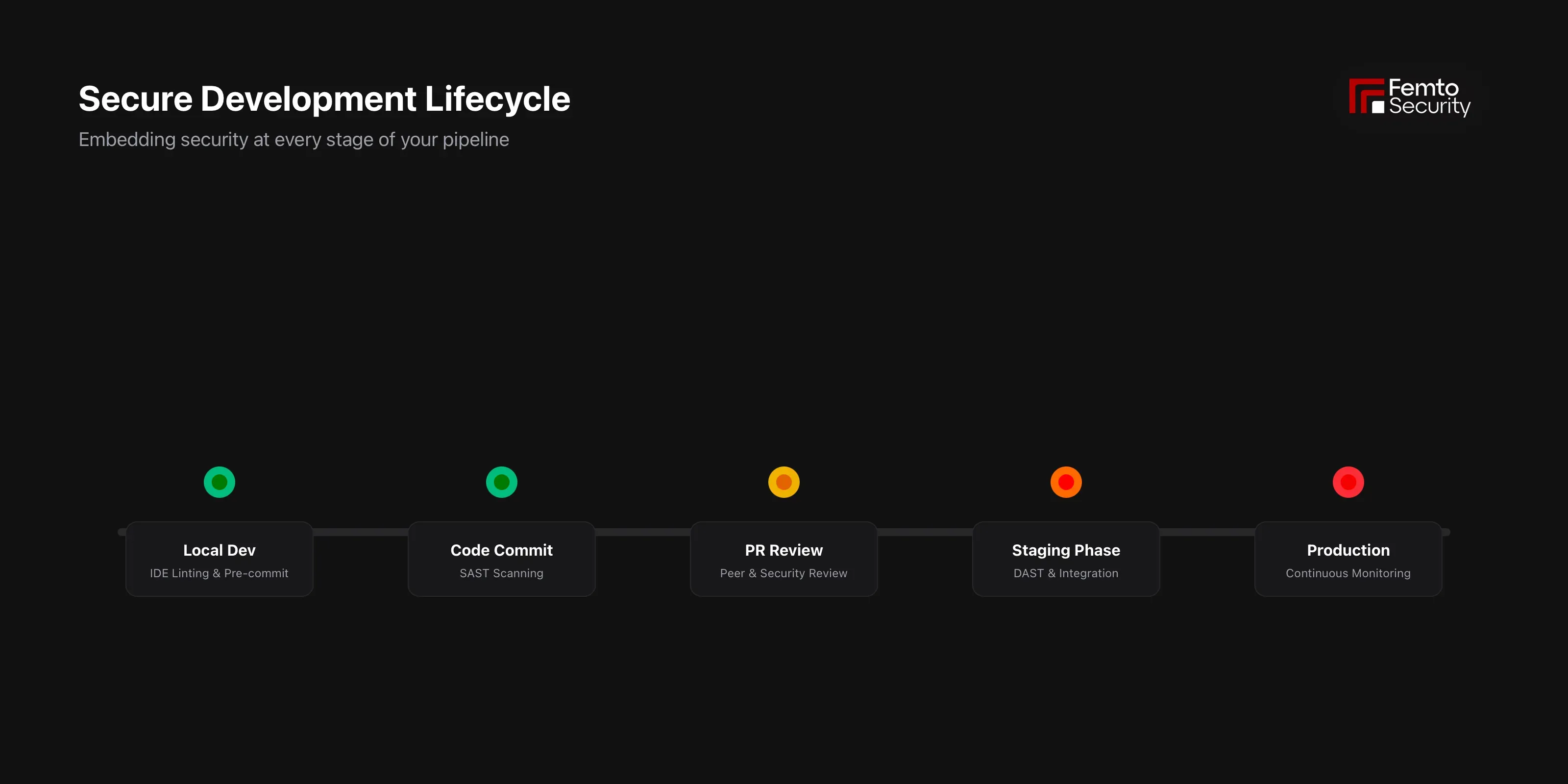
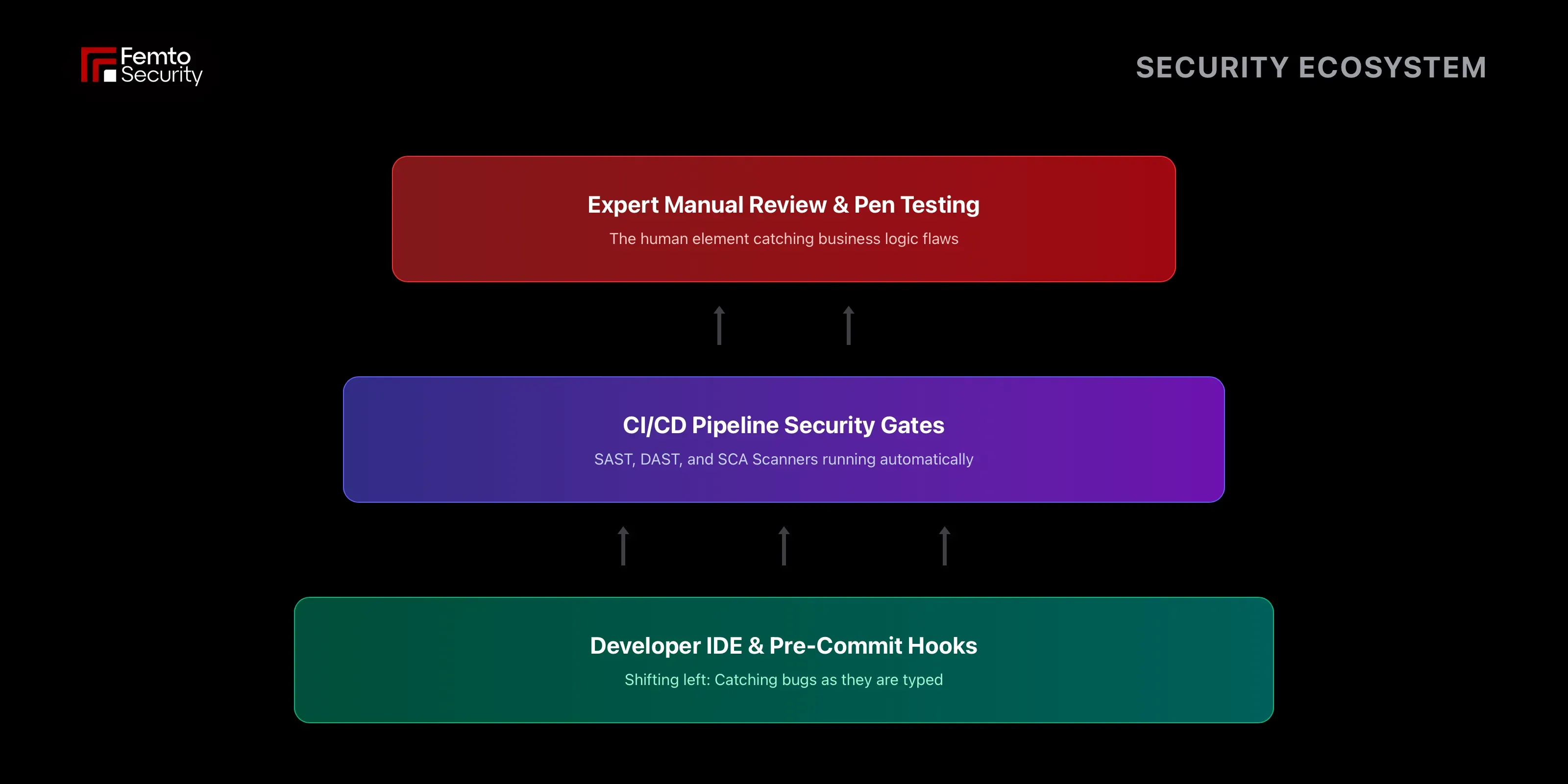
Shift Left: Catch It Where It's Cheapest
The concept of "shifting left" means moving security earlier in the development lifecycle closer to where code is written, not to where it's deployed.
In practice, this means:
IDE security plugins that surface vulnerability patterns as code is being written. Snyk, SonarLint, and the Semgrep VS Code extension give developers real-time feedback without context-switching to a separate tool.
Pre-commit secret scanning using Gitleaks or TruffleHog to prevent credentials from ever reaching the repository.
CI/CD pipeline gates that run full SAST scans on every pull request and block merges with a severity above a defined threshold.
Pull request checklists that include security review criteria alongside functional review criteria, making security a normal part of the code review conversation.
Developer Security Education
Tools catch patterns. Education changes behavior. When developers understand why certain patterns are dangerous not just that a tool flagged them they stop introducing those patterns in the first place.
Femto Security security awareness training programs give development teams the secure coding foundation to write defensible code from the start. Teams that have undergone structured, secure coding training consistently show a measurable reduction in the volume and severity of findings in subsequent reviews. It's one of the highest-leverage investments a security program can make.
Periodic Manual Reviews
Automated scanning in the pipeline catches new vulnerabilities as they're introduced, but it doesn't retroactively audit the existing codebase. Legacy code accumulates vulnerabilities over time patterns that were acceptable five years ago may be exploitable today.
Periodic manual reviews at minimum once annually, and whenever significant new functionality is shipped surface the accumulated technical debt that automation misses. For enterprise organizations, these reviews are typically scoped to the highest-risk modules: authentication systems, payment processing logic, API endpoints, and any code path that handles personally identifiable information or privileged operations.
Source Code Review in Specialized Contexts
Smart Contract Auditing
Smart contracts present the most demanding code review challenge in existence. Code deployed on a blockchain is immutable. There is no patch deployment, no emergency hotfix, no rollback once a vulnerability is in a live contract, it stays there until the contract is deprecated or exploited.
The most common smart contract vulnerability classes reentrancy, integer overflow/underflow, access control failures, flash loan attack vectors are all detectable through code review before deployment. The cost of finding them in review is measured in hours of analyst time-the cost of finding them after deployment is measured in permanent, unrecoverable asset loss.
Femto Security smart contract auditing services apply specialized review methodology for Solidity, Rust, and Move-based contracts, including economic attack modeling that goes beyond static analysis to reason about adversarial manipulation of contract logic.
For organizations operating in the UAE's digital asset space, smart contract security intersects directly with VARA regulatory requirements. Femto Security vCISO for VARA compliance program helps organizations build the governance structure to make code review a compliance function, not just a security practice. Our VARA-focused content explores the regulatory framework in detail for organizations navigating that landscape.
Government and Defense Applications
Source code review requirements for Government cybersecurity are governed by specific frameworks: NIST SP 800-53, FedRAMP, DISA STIGs, CMMC, and agency-specific secure development standards. Reviews in these contexts require not just technical depth but documentation rigor audit trails, chain-of-custody for findings, and alignment to specific control identifiers.
Government contractors handling sensitive or classified data face heightened scrutiny of their software supply chains. The requirement to verify not just first-party code but every third-party dependency makes comprehensive source code review a procurement and compliance requirement, not just a security best practice.
Compliance-Driven Reviews
For organizations pursuing or maintaining certifications ISO 27001, SOC 2 Type II, PCI DSS, HIPAA source code review provides the documented evidence that software was developed with security controls in place. Femto Security compliance services tie review activities directly to control frameworks, producing documentation that meets auditor requirements without requiring teams to map findings to standards after the fact manually.
The intersection of ISO 27001 and emerging regulations like VARA is explored in depth in our post on why ISO 27001 certification is essential for VARA compliance relevant to any organization operating in the UAE financial services or digital asset sectors.
What to Demand from a Source Code Review Provider
The market for source code review services suffers from noise. Many engagements sold as "comprehensive code reviews" are actually scanner runs with a consulting firm's cover page attached. Here is how to tell the difference.
Ask how they handle false positives. Every scanner generates false positives. A real review involves a human analyst validating each finding, dismissing the false positives, and escalating findings that require deeper investigation. If a vendor can't explain this process, the report will be noise.
Ask about business logic coverage. Any engagement that relies purely on automated tools cannot find business logic vulnerabilities. Ask specifically: how do your engineers identify authorization flaws and logic errors that automated tools don't flag? If the answer is vague, the engagement won't find what matters most.
Ask for a sample report. Quality source code review reports include exact file and line references, exploitation narratives, business impact statements, and remediation guidance with code examples. A quality report is immediately distinguishable from a formatted list of scanner findings.
Ask about remediation support. The report is not the end of the engagement. Organizations need support validating that fixes actually address the root cause, not just the specific finding. Vendors who disappear after report delivery leave organizations with incomplete remediation.
Ask about language and framework expertise. A reviewer who is deeply knowledgeable in Java security patterns may miss Rails-specific vulnerabilities entirely. Confirm that the team has demonstrated verifiable expertise in the specific stack you're asking them to review.
How Source Code Review Connects to the Wider Security Picture
Source code review doesn't operate in a vacuum. The strongest security programs connect it to external intelligence and ongoing validation.
Threat intelligence feeds the review priority. Knowing which vulnerability classes threat actors are actively targeting helps reviewers focus attention on the patterns most likely to be exploited. Femto Security dark web monitoring services surface intelligence about active exploitation campaigns including when specific CVEs or vulnerability patterns are being weaponized against organizations in your industry. Our complete guide to dark web monitoring explains how this intelligence connects to proactive defense.
Penetration testing validates exploitability. Code review identifies vulnerabilities. Penetration testing determines which of those vulnerabilities are exploitable in the actual deployed environment, given real-world configuration and network conditions.
Attack surface management tracks what's exposed.Attack surface management maintains continuous visibility into what assets are exposed externally giving code reviewers context about which components face the internet and which face internal users, helping prioritize review depth accordingly.
VAPT programs close the loop.Vulnerability assessment and penetration testing programs run continuously against the deployed environment, catching what code review doesn't configuration weaknesses, newly disclosed CVEs in dependencies, and runtime behavior that diverges from what the code suggests.
Together, these disciplines create a security program in which code-level decisions are validated through operational testing, and operational findings feed back into development practices.
Conclusion:
The majority of serious application vulnerabilities don't arise from zero-day exploits or sophisticated nation-state techniques. They exist because a line of code made a bad assumption about user input, skipped an authorization check, or used a cryptographic function that was deprecated before the developer who wrote it had finished college.
Source code review finds those decisions before attackers do. It's the control that addresses root cause rather than symptoms and in an environment where AI-assisted exploitation is lowering the attack barrier and regulatory requirements are tightening, it's no longer something organizations can defer.
A successful approach to identifying vulnerabilities in source code involves a combination of the right tools for code review, skilled human analysis, developer education, and professional review services for critical projects. Organizations often partner with specialized security providers such as Femto Security, whose expertise in application security and secure code assessment helps teams detect vulnerabilities early and strengthen their development lifecycle. This proactive strategy sets organizations apart from those that only uncover vulnerabilities during late-night incident response calls.
Frequently Asked Questions (FAQs)
1. What is a source code review?
Source code review is the process where developers examine each other's code to identify bugs, improve code quality, enhance security, and ensure coding standards are followed.
2. Why is source code review important?
Source code review helps detect errors early, improve software security, increase maintainability, and promote knowledge sharing among development teams.
3. What are the different types of source code reviews?
Common types include manual code review, automated code review using tools, peer review, and formal inspections.
4. What tools are used for source code review?
Popular tools include GitHub Pull Requests, GitLab, Bitbucket, SonarQube, and Crucible.
5. How do you perform an effective code review?
An effective code review involves checking logic, security vulnerabilities, code readability, performance issues, and adherence to coding standards.
Continue Reading
October 19, 2026
MCP Security | Risks, Attacks, and Best Practices
What is MCP security explained: the top risks, tool poisoning & prompt injection attacks, OAuth 2.1 authorization, pass/fail checklist to secure MCP servers.
October 15, 2026
Agentic AI Security | Protect Agents Before They Act
Prompt injection, over-permissioned agents, leaked credentials: learn the top AI agent security risks and the controls that stop them before launch.
October 12, 2026
AI Incident Response | A Practical Guide for Security Teams
A practical AI incident response guide: how to detect, contain, and recover from prompt injection, data leaks, and rogue agents, plus a readiness checklist.