

Insider Threat Detection | Signs, Techniques, and Programs
Insider threat detection is the process of identifying risky or malicious activity by people who already have legitimate access, such as employees, contractors, and partners. It works by combining behavioral, access, and data-movement signals because no single log entry reliably separates a normal workday from an insider incident.
Insiders fall into three groups: malicious insiders who act deliberately, negligent insiders who make costly mistakes, and compromised insiders whose credentials an outsider is using. Each group leaves different traces, which is why detection has to look beyond intent. IBM's 2025 Cost of a Data Breach Report found that malicious insider attacks averaged $4.92 million per breach, the highest of any initial attack vector. This guide covers the signs of insider activity, how the main detection techniques (including UEBA) compare, and how to build a program that security, HR, and legal can run together without turning monitoring into surveillance.
What Is Insider Threat Detection?
Insider threat detection is the capability to spot misuse of legitimate access, whether deliberate, careless, or the result of stolen credentials, before it becomes a data loss, fraud, or sabotage event. It relies on correlating who accessed what, how that differs from their normal behavior, and what data moved as a result.
Insider threat vs insider threat detection vs insider risk management
An insider threat is the potential for someone with authorized access, such as an employee, contractor, or vendor, to harm the organization by misusing that access. The harm can be intentional (theft, fraud, sabotage) or unintentional (a misdirected file, a phished login).
Insider threat detection is narrower. It is the monitoring and analysis layer that surfaces suspicious activity so someone can investigate it.
Insider risk management is the broadest of the three. It covers the whole program: governance, policy, access design, training, detection, investigation, and the HR and legal processes around them. Detection is one component of it. A team can have detection tooling without a risk management program, but the tooling then produces alerts nobody is authorized or equipped to act on.
Why insiders are harder to detect than external attackers
Insiders are harder to detect because their activity looks like legitimate work. They log in with valid credentials, use approved systems, and touch data they are allowed to touch. Perimeter defenses and signature-based tools are built to flag what doesn't belong, and an insider usually belongs.
The numbers reflect this. IBM's 2025 data showed that malicious insider breaches took an average of 260 days to identify and contain, second only to third-party and supply chain compromises at 267 days.
Three factors drive the delay. First, intent can't be read from logs, only behavior can, and the same download can be routine for one person and a red flag for another. Second, insiders know where sensitive data lives and which controls are watched. Third, compromised insiders add a twist: the account is valid and the person is trusted, but the actor is not who the system thinks it is. This is why detection depends on baselines and context for each user and role, not a universal rule.
Where detection sits in the security stack
Detection sits between prevention and response. Prevention controls, such as least-privilege access, strong authentication, and segmentation, reduce what an insider can reach. Detection assumes some misuse will still occur and looks for it in identity, endpoint, cloud, email, and data activity. Response takes over once an alert is confirmed: investigating, containing access, preserving evidence, and involving HR and legal where needed.
This maps directly to the Detect function in the NIST Cybersecurity Framework. The practical consequence is that detection quality depends on both neighbors. Weak prevention floods analysts with legitimate-but-excessive access to review, and weak response means a correct alert still ends in a slow or inconsistent outcome. Detection works best when its output feeds a defined investigation workflow rather than a general security queue.
Types of Insider Threats You Need to Detect
The insider threats worth detecting fall into four groups: malicious insiders who act on purpose, negligent insiders who make mistakes, compromised insiders whose accounts an outsider controls, and third parties with delegated access. Each needs different detection logic because the motive, and therefore the telltale behavior, is different.
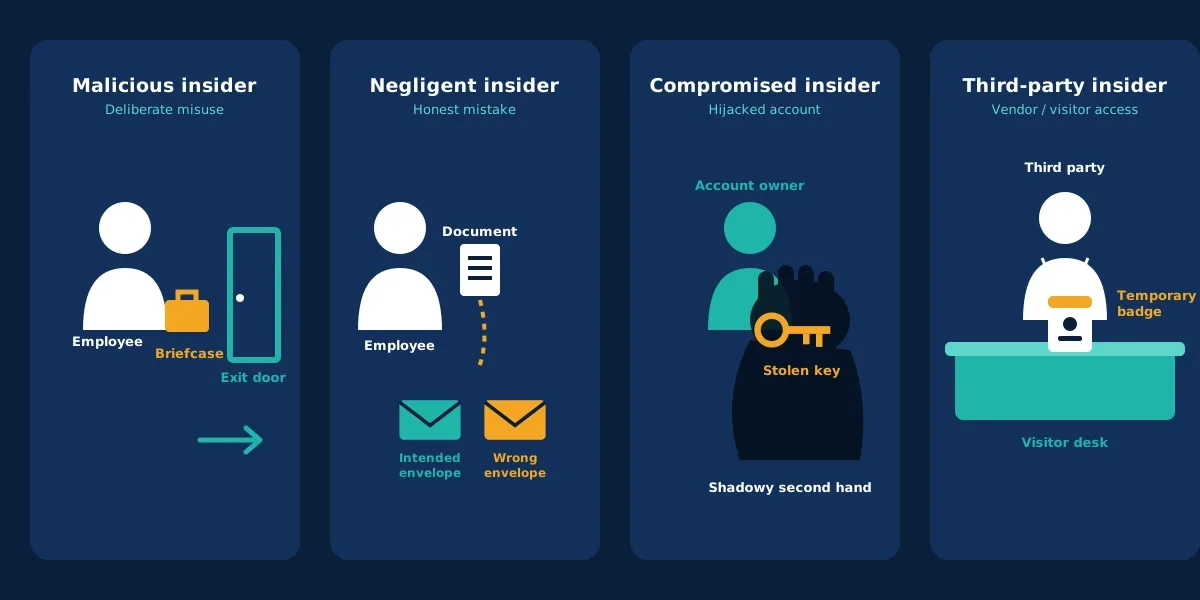
Malicious insiders (fraud, sabotage, IP theft)
A malicious insider deliberately uses authorized access to steal data, commit fraud, or damage systems. Common patterns include an engineer copying source code before leaving for a competitor, a finance employee manipulating payment records, and an administrator planting a backdoor account or disabling logging after a dispute.
These cases rarely show up as one dramatic event. They show up as a sequence: access to repositories or records outside the person's normal role, data staged in one location, then moved out through a personal cloud account, email, or removable media. Detection works best when it tracks that sequence over time and weighs it against context such as a resignation, a role change, or a recent disciplinary action.
Negligent insiders (misdirected data, shadow IT, policy bypass)
A negligent insider causes exposure without intending harm. Examples include sending a spreadsheet to the wrong recipient, storing customer data in an unapproved file-sharing app, pasting sensitive text into a public AI tool, or bypassing a control to meet a deadline.
This is the most common category. Ponemon's 2025 Cost of Insider Risks research attributed 55 percent of the insider incidents it studied to employee negligence, with malicious insiders at 25 percent and credential theft at 20 percent. The hard part is that these behaviors look like ordinary productivity. A workaround rarely feels like a violation to the person doing it. Detection here means flagging policy-violating data handling and repeated patterns, and the response is usually coaching and a control fix rather than discipline.
Compromised insiders (stolen credentials, session hijacking)
A compromised insider is a legitimate user whose account, device, or session an external attacker has taken over. The credentials are valid and the person is trusted, but the actor is not who the system believes.
Typical entry routes are phishing, infostealer malware, MFA fatigue attacks, and stolen session tokens. The signals are identity-level mismatches: logins from implausible locations, a new device, access at unusual times, or API activity that doesn't match how that person works. The response differs from the other two types. The employee is a victim, so the priority is containing the account and revoking sessions, not opening an HR case.
Third-party and contractor access
Third-party insiders are vendors, contractors, consultants, and managed service providers who hold credentials or integrations inside your environment. They count as insiders because they bypass the perimeter the same way employees do, yet they are often governed less tightly.
Warning signs include access outside the contract scope or working hours, dormant accounts that suddenly reactivate, shared logins, and data pulls larger than the engagement requires. You usually can't monitor a contractor's own devices, so detection leans on identity, session, and data-access logs. Offboarding gaps are a frequent weak spot, because a finished engagement can leave live credentials behind.
Comparison: types of insider threats
Type | Typical Motive | Typical Signal | Hardest-to-Spot Behavior |
|---|---|---|---|
Malicious | Financial gain, grievance, competitive advantage | Out-of-role access, data staging, disabled logging | Slow, low-volume data collection by a trusted, high-performing employee |
Negligent | Convenience, speed, lack of awareness | Data sent to wrong recipients, unapproved apps, repeated policy bypass | Well-intentioned workarounds that look like normal work |
Compromised | Attacker's gain (the user has none) | Impossible travel, new device, unusual API or session activity | Attacker activity that mimics the user's normal hours and tools |
Third-party | Varies, from none to financial gain | Access beyond scope, dormant account reactivation, shared credentials | Legitimate-looking access that persists after the engagement ends |
Behavioral and Technical Indicators of an Insider Threat
The clearest indicators of an insider threat are deviations from a person's normal pattern in four areas: what they access, what data they move, how they authenticate, and what is changing in their employment. Any one of these can be innocent, so they carry weight mainly in combination.
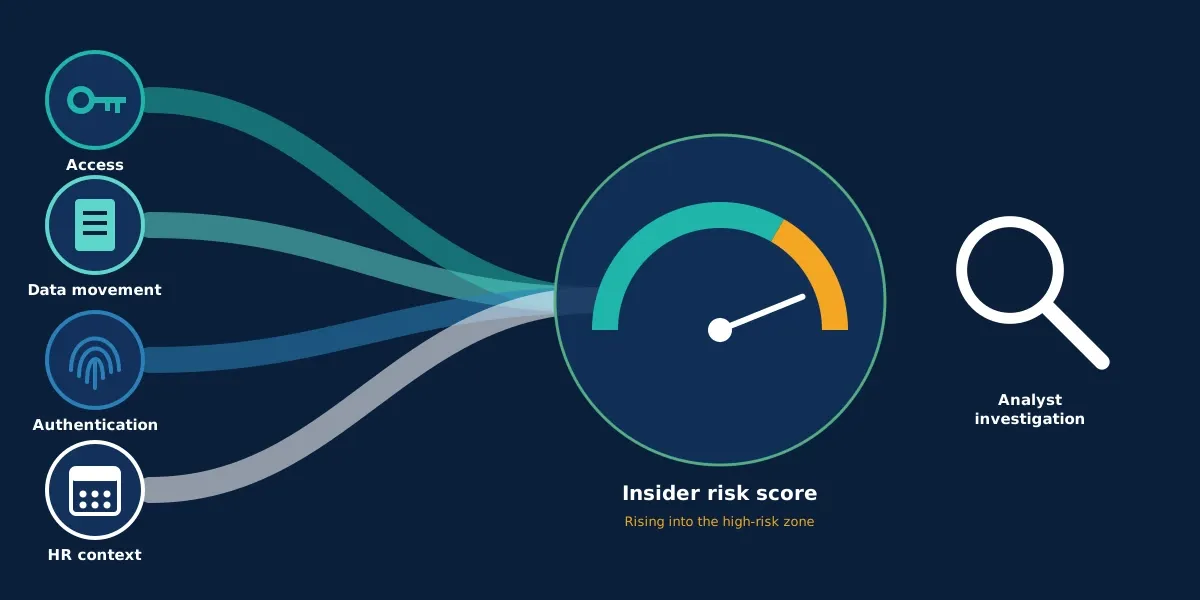
Access anomalies (off-hours, unusual systems, privilege escalation)
An access anomaly is activity that doesn't fit the user's role, history, or peer group. Off-hours logins are only meaningful against that person's baseline, since a night-shift engineer logging in at 2 a.m. is routine and an accountant doing it is not. Stronger signals include first-time access to sensitive systems such as source code repositories, HR records, or financial platforms, and rapid browsing across many records or accounts that the person has no obvious reason to open.
Privilege changes deserve particular attention. Watch for self-granted rights, new administrator accounts, unexpected group membership changes, and sudden use of a dormant privileged account. Attempts to disable logging or endpoint protection are another strong signal, because they suggest the person expects to be watched.
Data movement signals (bulk downloads, cloud sync, personal email, USB)
Data movement signals show information leaving its normal home. Common forms include bulk downloads or exports, large archives created and compressed, files synced to personal cloud storage, messages forwarded to personal email, writes to removable media, and sensitive text pasted into unapproved AI tools.
Volume matters, but so does comparison. A download that is ordinary for an analyst can be extraordinary for a developer. Many incidents unfold in two steps: data is collected into one place, then moved out, sometimes days apart. Slow, low-volume collection is the hardest pattern, because each action alone stays below any alert threshold. Compressing or encrypting files right before a transfer is a useful tell that the person wants the contents hidden.
Authentication signals (impossible travel, MFA fatigue, new device)
Authentication signals show whether the right person is really behind a valid login. The main ones are impossible travel (two logins from distant locations within minutes), a new device or browser, logins from anonymizing services, concurrent sessions, and a run of failed attempts followed by a success. MFA fatigue is a distinct pattern: repeated push approvals the user didn't initiate, ending in one accepted prompt.
These signals matter because stolen credentials are the most common way attackers get in. Verizon's 2025 Data Breach Investigations Report found that credential abuse was the leading initial access vector, involved in 22 percent of breaches. Expect false positives from VPNs and mobile networks, so impossible-travel alerts need context, such as known corporate egress addresses, before they trigger action.
Human and HR context signals (resignation, role change, disciplinary action)
HR context signals describe changes in a person's situation that raise the odds that they might act against the organization. Examples include a resignation or termination notice, a demotion or role change, a performance improvement plan, a disciplinary action, or a denied promotion. The notice period before a departure is a commonly cited high-risk window for data collection.
These signals are modifiers, not evidence. A resignation proves nothing about intent, and treating it as an accusation creates legal and morale problems. The sound approach is to use HR events to raise or lower the risk weight of technical activity already seen, to limit access to this data to a small, authorized group, and to involve legal and privacy teams in deciding how it's used.
Why a single indicator is rarely enough (correlation over alerts)
A single indicator is rarely enough because each one has a harmless explanation, and alerting on each produces more noise than a team can review. Correlation solves this by scoring combinations of signals over a time window against the user's own baseline and peer group.
Consider a sales representative who exports a customer list. At quarter-end, that is routine. Now add a resignation notice, access to accounts outside the rep's territory, and an upload to a personal cloud account within the same week. The same export has become a high-priority case. No single event crossed a line, but the pattern did. This is the practical case for risk scoring over standalone alerts: it keeps analysts focused on the small number of users whose signals stack up, and it gives investigators a timeline to start from.
How to Detect Insider Threats: Step by Step
To detect insider threats, identify your most sensitive assets, collect logs showing who touches them, learn what normal looks like for each user and role, write a small set of detection rules that combine signals, and give analysts a defined path for investigating and escalating what surfaces. The order matters, because each step supplies what the next one needs.
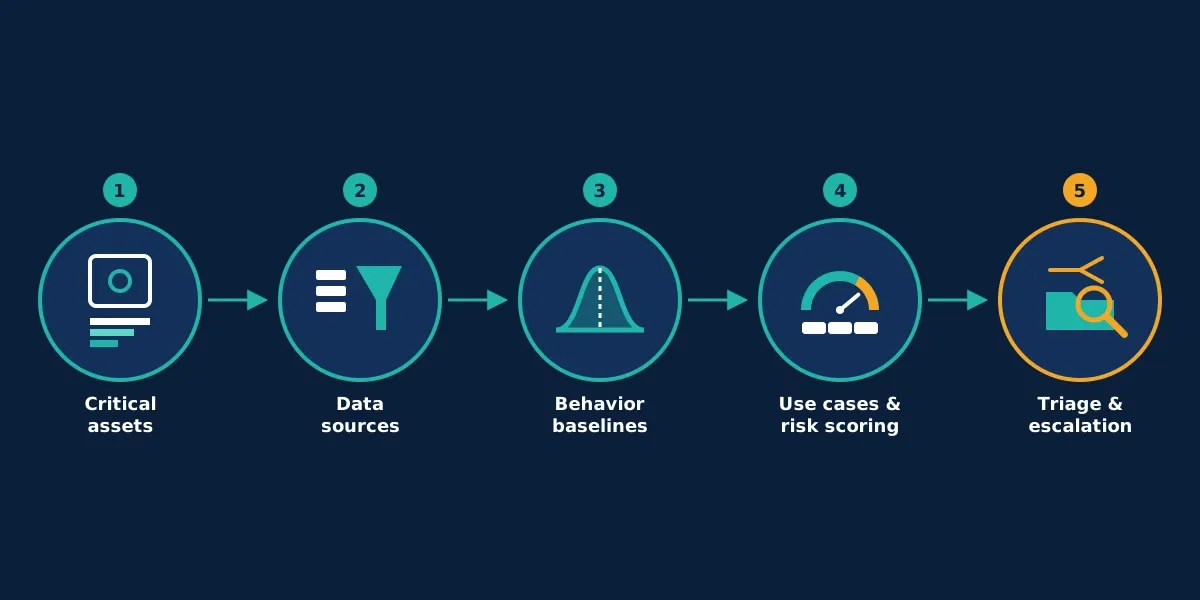
Step 1: Define critical assets and who can touch them
Start with the few assets whose loss would hurt most: source code, customer or patient records, financial systems, product designs, and administrative consoles. Ten well-chosen assets beat a hundred poorly watched ones. For each, record an owner and a list of everyone with access, including contractors, vendors, and service accounts.
Then compare that list to who actually needs the access. The gap between the two is usually the first useful finding, because excess access widens what any insider, malicious or compromised, can reach. The output of this step is a ranked asset list that tells you where detection effort should go first.
Step 2: Map data sources (identity, endpoint, cloud, email, HR)
Detection can only find what the logs record. The core sources are the identity provider or directory (logins, group changes), endpoint tools (file activity, USB, process data), cloud and SaaS audit logs (downloads, sharing), email and web gateways (attachments, uploads), and an HR feed (hire, role change, resignation, termination dates).
Check three things for each source: whether the logs are actually collected, how long they are kept, and whether one person's many usernames resolve to a single identity. That last point trips up many programs, because activity split across five accounts looks like five unremarkable users. Retention should cover enough history to build a baseline.
Step 3: Establish behavioral baselines
A baseline describes normal activity for a user, a role, and a peer group: usual hours, systems, data volumes, and destinations. It turns "this download is large" into "this download is ten times larger than anyone in this role has done."
Allow enough history to cover a full business cycle; otherwise, month-end or quarterly close, or seasonal work will trigger false alerts. Handle new hires and role changes separately, since they have no stable history yet. Also remember that a baseline built while an insider is already active can treat their behavior as normal, so compare people to peers as well as to themselves.
Step 4: Build detection use cases and risk scoring
A detection use case is a specific scenario tied to an asset, such as a bulk export of customer records, creation of a new administrator account, a large archive followed by an upload to personal storage, or logging disabled on a sensitive system. Start with a handful and expand. MITRE's Insider Threat TTP Knowledge Base is a useful reference for checking which behaviors your use cases cover.
Instead of alerting on each event, assign weights to signals and add them up over a time window. Raise the score when HR context applies, such as a resignation, and set a threshold that sends a case to an analyst. Review the results regularly: use cases that produce only false positives should be tightened or retired.
Step 5: Triage, investigate, and escalate
Triage answers one question first: is this a malicious, negligent, or compromised insider? The answer sets the path. A compromised account goes to the security team for immediate containment. A negligent case goes to the employee's manager for coaching and a control fix. A suspected malicious case moves to a restricted investigation involving HR and legal.
Speed matters. Ponemon's 2026 Cost of Insider Risks research found that organizations containing incidents within 30 days averaged $14.2 million in annual insider-risk cost, versus $21.9 million where containment took more than 90 days. Preserve evidence early, keep the circle of people who know small, and avoid confronting the employee before legal and HR agree on the approach.
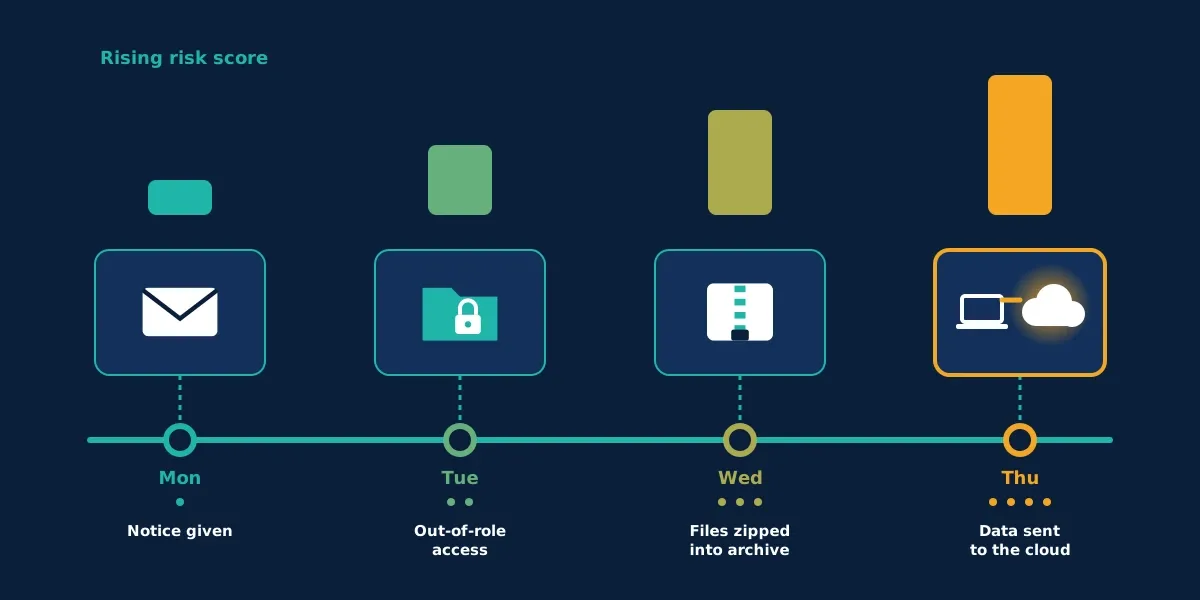
Example scenario: tracing a departing employee's data collection from logs to decision
The following is an illustrative scenario, not a real case. A product manager gives notice on a Monday, and the HR feed raises that user's risk weighting. On Tuesday, identity logs show access to pricing and roadmap folders outside the manager's own product line. On Wednesday, endpoint logs record a large compressed archive of those files. On Thursday, proxy logs show the archive uploading to a personal cloud storage account.
Individually, each event might pass as routine handover work. Together, with the resignation, they push the score over the threshold. An analyst builds a timeline, confirms that the files have no link to the person's role, and discreetly checks with the manager. The case goes to legal and HR, access is restricted, and the laptop is imaged. The final decision, whether to interview, demand recovery, or pursue legal action, is a human judgment about intent and proportionality, which no detection rule can make.
Insider Threat Detection Techniques Compared
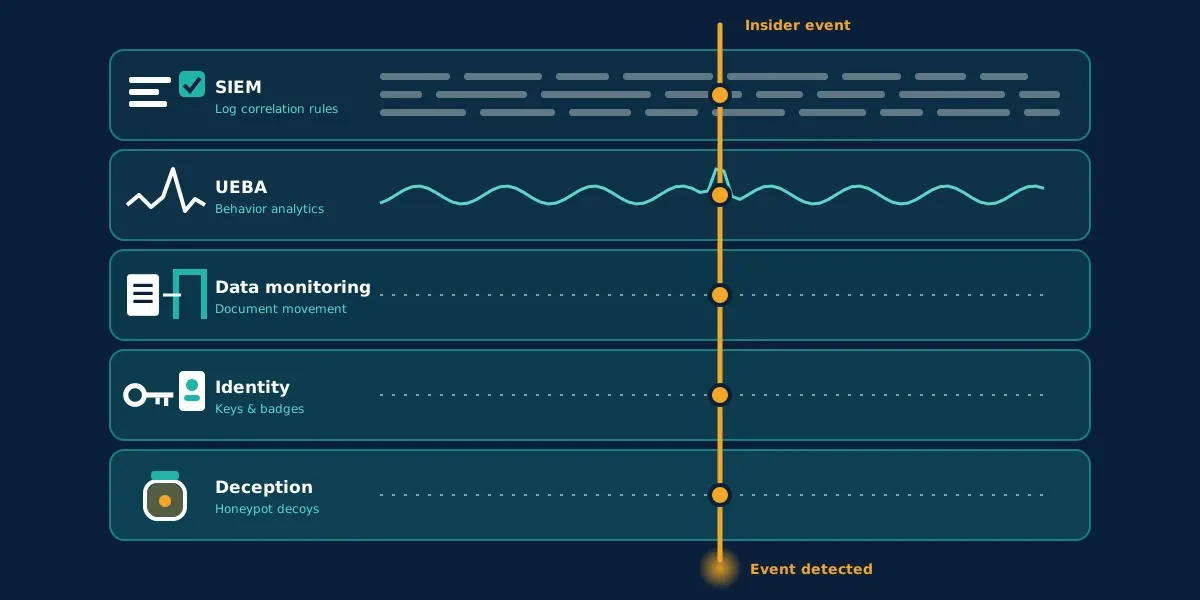
No single technique detects every kind of insider threat, so most programs layer two or three. SIEM correlation catches known patterns, UEBA catches deviations from normal behavior, data-centric monitoring catches sensitive data in transit, identity monitoring catches access abuse, and deception catches snooping with very few false alerts.
Rule-based and log correlation (SIEM)
A security information and event management (SIEM) platform collects logs from many systems and applies rules that link events together. A typical rule fires when a new administrator account is created and logging is disabled shortly afterward, or when a user downloads more than a set number of files from a sensitive repository.
SIEM rules are transparent and easy to explain to an auditor or investigator. Their weakness is rigidity. A fixed threshold misses behavior that stays just under it, and it can't recognize a pattern nobody wrote a rule for. Quality also depends on log coverage and on resolving each person's many usernames into one identity. Expect to spend continuing effort on tuning as the business changes.
User and entity behavior analytics
User and entity behavior analytics (UEBA) builds a baseline for each user, device, and peer group, then scores activity that deviates from it. It is strongest where rules are weakest: a compromised account behaving unlike its owner, or a slow accumulation of small actions that no single threshold would catch.
Its limits are real. It needs weeks of clean data to establish baselines, performs poorly for roles with erratic activity, and can miss an insider whose behavior stays within normal range. Scores can also be hard to explain, which complicates an HR or legal conversation. UEBA works best as a prioritization layer on top of good data, not a replacement for it.
Data-centric monitoring (DLP, file activity)
Data-centric monitoring watches the information itself: where sensitive files go, who opens them, and which channels they leave through. Data loss prevention (DLP) tools and file activity monitoring can catch customer records attached to an outbound email, copied to a USB drive, or uploaded to an unapproved cloud service.
This technique answers the question the others can't: did sensitive data actually leave? It misses data that has been encrypted, photographed from a screen, or sent through an approved channel. It also depends on data classification, the heaviest part of the effort, and it produces many false positives until policies are tuned. For policy design and channel controls, see the dedicated DLP guide; here DLP matters as one signal source among several.
Identity and privileged access monitoring
Identity monitoring analyzes authentication and authorization activity: logins, session patterns, group changes, and privileged account use. It catches privilege escalation, account takeover, dormant accounts coming back to life, and administrators acting outside their normal scope.
It is relatively cheap to start, because the identity provider already holds the data. What it cannot see is misuse within granted rights. An authorized employee who logs in normally and quietly copies files they are entitled to open will look unremarkable to identity logs alone. Respondents in Ponemon's 2026 Cost of Insider Risks research reported the largest cost savings from identity management (6.1million),followedbybehavioralintelligence(5.1 million), which suggests these two layers deserve early attention.
Deception techniques (honeytokens, honey files)
Deception places decoys where only someone snooping would find them: a fake credential in a configuration file, a decoy folder named like a sensitive project, a fake customer record in a database, or a canary document that alerts when opened. Because no legitimate task requires touching a decoy, almost any interaction is worth investigating.
That gives deception a very low false-positive rate and a low cost. The trade-offs are coverage and realism. It only catches insiders who touch the decoys, a careful or informed insider may avoid them, and poorly placed decoys can be found by accident. It works best as a tripwire alongside the other techniques, not a standalone control. Involve legal and HR before deploying so the decoys fit the organization's monitoring policy.
Comparison table: techniques at a glance
The ratings below are general guidance based on how these tools typically behave, not measured benchmarks. Your results will depend on data quality and tuning.
Technique | What It Catches | What It Misses | Effort | False-Positive Profile |
|---|---|---|---|---|
SIEM and log correlation | Known patterns, such as new admin plus logging disabled | Novel and slow, low-volume behavior | Medium to high (rules, log coverage, tuning) | Moderate to high with static thresholds |
UEBA | Deviations from baseline, compromised accounts, slow accumulation | Insiders who stay within normal range; new hires and erratic roles | High (data quality, baseline period, tuning) | Moderate, improves with tuning |
Data-centric monitoring (DLP, file activity) | Sensitive data leaving through email, USB, or cloud uploads | Encrypted or photographed data; misuse through approved channels | High (data classification, policy design) | High until policies are tuned |
Identity and privileged access monitoring | Privilege escalation, account takeover, dormant account reuse | Misuse within legitimately granted access | Low to medium | Low to moderate |
Deception (honeytokens, honey files) | Snooping and unauthorized exploration | Insiders who never touch the decoys | Low | Very low |
UEBA for Insider Threat Detection
User and entity behavior analytics (UEBA) detects insider threats by learning what normal activity looks like for each user, device, and peer group, then scoring departures from it. It is most useful for compromised accounts and slow, low-volume misuse that fixed rules miss, and it depends heavily on clean data and ongoing tuning.
How UEBA builds baselines and flags deviations
UEBA ingests logs from identity systems, endpoints, cloud and SaaS applications, and network or proxy tools. From these, it extracts behavioral features such as login times and locations, systems accessed, data volumes, devices used, and typical transfer destinations. Statistical or machine learning models turn those features into a profile for each user, and a second profile for the user's peer group, such as everyone in the same department or job role.
Each new event is compared against both profiles. A developer who normally pulls 40 MB a day from a repository and suddenly pulls 4 GB is unusual compared to their own history and to their peers. Individual anomalies are then combined into a risk score per user, which usually decays over time if no further unusual activity appears. The entities in "UEBA" include service accounts, servers, and other devices, which matters because compromised machines and service credentials can be misused in the same way as human accounts.
What UEBA does well and where it fails (cold start, noisy roles, tuning burden)
UEBA is strongest in three situations: an account acting unlike its owner, a gradual build-up of small actions that would stay under any fixed threshold, and behavior no one thought to write a rule for. It also helps prioritize, ranking which users deserve an analyst's attention.
Its failures are predictable. The cold start problem means new deployments, new hires, and people who change roles have no reliable baseline for the first weeks. Noisy roles, such as incident responders, system administrators, or a sales team at quarter-end, show legitimate spikes that look suspicious. The tuning burden is continuous: analysts must feed back which alerts were real, suppress known-good patterns, and revisit models as the business changes. UEBA can also miss an insider whose activity stays within normal range, or one who shifts behavior slowly enough that the baseline moves with them. Finally, risk scores can be hard to explain, which complicates conversations with HR or legal.
UEBA vs DLP vs SIEM: how they work together
These three tools do different jobs. A SIEM collects and stores logs, correlates events with rules, and provides the platform for investigation and case management. UEBA is an analytics layer that studies the same data for behavioral deviations. DLP is content-aware: it recognizes sensitive data and monitors or blocks the channels it leaves through.
They complement each other. UEBA might flag a user whose access pattern changed sharply, DLP can then show that classified files were uploaded to a personal account, and the SIEM ties both to a single timeline with identity and HR context. Many SIEM products now include UEBA modules, so the practical question is usually whether the built-in analytics are strong enough, not whether to run a separate product.
Questions to ask before relying on UEBA
Start with data: which log sources does the tool need, and do you already collect them with enough retention to build baselines? Ask how it handles new hires, role changes, and departing employees, since those are exactly the cases insider programs care about. Ask whether every score can be explained in plain terms an investigator can use, and whether your own team can tune and suppress alerts without vendor help.
Test before committing. Run a pilot on your own data and measure the alert volume and false-positive rate in your environment, because vendor demos rarely reflect your noise. Check where behavioral data is stored and processed, since monitoring employees can trigger privacy obligations such as the UAE's PDPL or GDPR, depending on where your workforce sits. Finally, confirm that you have the analyst capacity to review what the tool produces. More than 40 percent of organizations in DTEX's 2026 Ponemon-based research said they now use AI to detect or prevent insider risks, but a tool nobody reviews only produces unread alerts.
Insider Threat Detection Tools: What Categories Cover
Insider threat detection tools fall into a few capability categories: data collection, behavioral analytics, data movement visibility, identity monitoring, and case management. Most organizations cover these with several tools rather than one, so the useful question is whether your set covers your critical assets and fits your data, not whether a single product claims to do everything.
Capability categories to look for (without vendor names)
The first category is data collection and normalization: gathering logs from identity, endpoint, cloud, and email systems and tying them to a single person across accounts. Everything else depends on it. Next is behavioral analytics, which builds baselines and scores deviations, as covered in the UEBA section above.
Data movement visibility shows what leaves, through which channel, and how sensitive it is. It typically combines endpoint agents, cloud and SaaS audit logs, and email and web gateway signals. Identity and access monitoring watches logins, privilege changes, and the use of administrator accounts. Deception tools, such as honeytokens, are an optional low-cost addition.
The category buyers most often neglect is investigation and case management: timelines of user activity, evidence preservation, restricted access to sensitive cases, and an audit trail of who looked at what. This is where the money goes. Ponemon's 2026 Cost of Insider Risks research found that containment averaged $247,587 per incident, far more than the $39,728 spent on escalation. Tools that shorten investigation and support response actions, such as revoking sessions or isolating a device, address the most expensive phase.
Privacy controls belong on the list too. Look for role-based access to monitoring data, masking of personal details until a case is opened, and configurable retention. These features matter for employee trust and for regulatory exposure.
Build vs buy considerations
Building means assembling detection from platforms you already own: a SIEM or data lake, your identity provider's logs, endpoint detection, and cloud audit logs, with custom rules on top. It works well for a short list of high-value use cases and keeps data under your control. The costs are engineering time, ongoing maintenance, and the lack of packaged behavioral models and case workflows.
Buying a dedicated platform brings faster deployment, ready-made use cases, and built-in case management. In return, you take on license costs, integration work, and a new system that holds sensitive employee data. A hybrid approach is common and usually sensible: start with what your current stack can already do, then add a specialized tool only where you can name a gap. Team size matters as much as budget, since a tool needs analysts to review what it produces.
Data and integration prerequisites
Tools can't compensate for missing data, so check these foundations before evaluating any of them:
Unified identity. Every person needs one identifier that links their accounts across systems.
Reliable HR feed. Hire, role change, and departure dates should arrive promptly and from an authoritative source.
Log coverage and retention. Confirm that audit logging is switched on for key cloud and SaaS applications, since some are off by default or limited by license tier, and that retention covers your baseline period.
Consistent timestamps. Time synchronization across systems keeps timelines trustworthy in an investigation.
Asset classification. At minimum, label the critical assets from your list so alerts reflect what matters.
Integration access. Plan for API access and service accounts that follow least-privilege rules.
Governance. Decide where monitoring data is stored, who can see it, how long it is kept, and how employees are notified, with legal and privacy review before activation.
Building an Insider Threat Detection Program
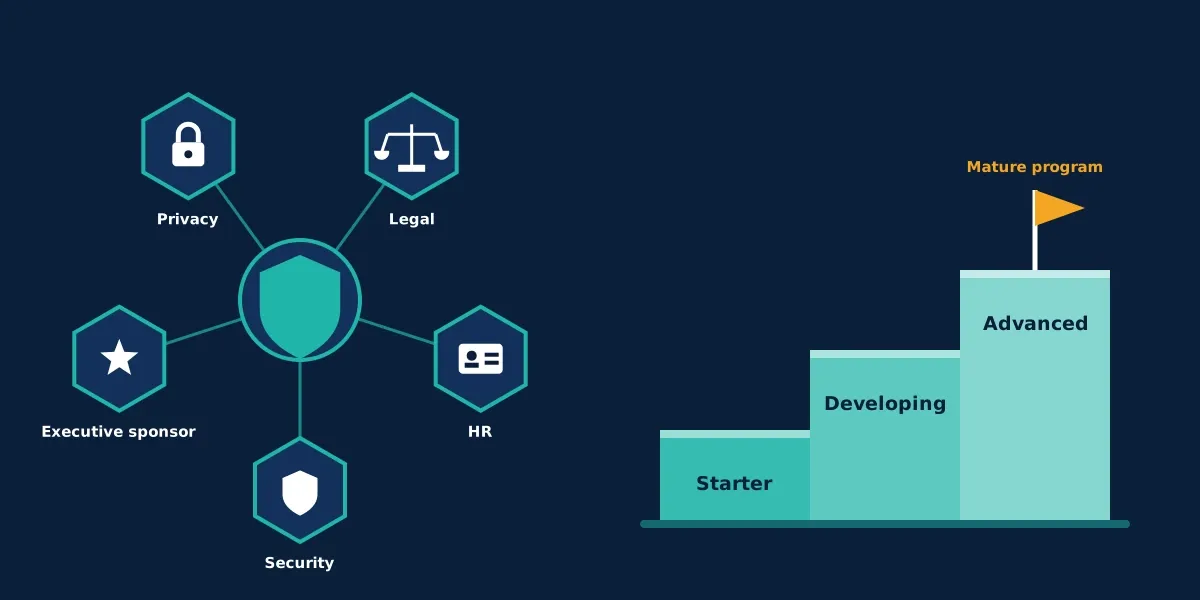
A durable insider threat detection program is a governed, cross-functional effort, not a tool purchase. It needs an executive sponsor, a team that spans security, HR, legal, and privacy, clear policies, defined escalation paths, and metrics that show whether detection is working.
Governance: executive sponsor, HR, legal, security, privacy
An executive sponsor gives the program authority, funding, and a way to settle disputes between departments. Day to day, the program needs a standing team with representation from each function that touches an insider case. Security runs detection and technical investigation. HR supplies employment context and handles personnel actions. Legal decides what monitoring is lawful and how evidence must be handled. Privacy sets limits on data collection and retention. Owners of critical assets, such as engineering or finance leads, help judge what activity is normal.
Both CISA and NIST point to this structure. CISA describes a multi-disciplinary threat management team as the backbone of a mitigation program. NIST SP 800-53 Rev. 5 control PM-12 likewise requires a formal insider threat program with a cross-discipline incident handling team. Put the program's authority, scope, and roles in a written charter, so that when a case involves a senior employee, nobody is guessing who may act.
Policy and acceptable-use foundations
Policies tell employees what is expected and tell investigators what was violated. At minimum, you need an acceptable-use policy that explains what is monitored and why, a data classification and handling standard, rules for personal devices and unapproved apps (including AI tools), and a clear channel for reporting concerns with protection against retaliation. Contractor and vendor agreements should cover monitoring rights, data handling, and credential removal at the end of an engagement.
Consistency matters as much as content. If similar violations lead to different outcomes depending on seniority, the policy loses credibility and creates legal risk. Have counsel review employee notices and monitoring terms for each jurisdiction where staff work.
Program components aligned to CISA, CERT, and NIST guidance
The three main reference sources fit together well. CISA's Insider Threat Mitigation Guide lays out four phases: define the threat, detect and identify it, assess it, and manage it. That sequence works as the backbone of the program. CISA also stresses that the program should help people rather than operate as an aggressive enforcement or "gotcha" effort.
CERT's Common Sense Guide provides the practical details. Its seventh edition, released in September 2022, draws on analysis of 3,000 insider threat cases and opens with two foundations: know and protect your critical assets, and develop a formalized insider risk management program. NIST contributes the control language auditors expect: PM-12 for the program itself, with related controls such as AT-2 (security awareness training) and AU-6 (audit record review) covering the training and monitoring pieces.
Roles and escalation workflow
Name the roles before the first alert arrives: a program manager, analysts who triage, investigators for substantiated cases, HR and legal partners, a privacy officer, asset owners, and the incident response team for containment. Then define decision rights, meaning who can approve restricting access, imaging a device, interviewing an employee, or referring a matter to law enforcement.
The workflow follows the triage logic from the detection steps. An analyst reviews the alert and classifies it. Compromised accounts go straight to incident response. Negligent cases go to the employee's manager for coaching and a control fix. Suspected malicious activity moves into a restricted case, shared only with those who need to know, where HR and legal guide the response. Set time targets for each stage, and document every decision so the process can be reviewed later.
Maturity model: starter, developing, advanced
At the starter level, the program uses tools already in place. It covers a short list of critical assets, ingests identity and HR data, runs five to ten detection use cases, and reviews alerts manually under a written policy. CISA's own guidance advises starting small and building on existing capabilities.
At the developing level, the program adds correlation and risk scoring, baselines for users and peer groups, a case management process, a standing cross-functional team, and regular tuning based on analyst feedback. At the advanced level, behavioral analytics are tuned to your environment, third-party and service-account coverage is in place, response actions such as session revocation are partly automated, tabletop exercises test the workflow, and metrics drive investment decisions. Most organizations move between levels unevenly, so treat the model as a way to find the next gap, not a score.
Metrics that matter (time to detect, false-positive rate, investigation closure)
Good metrics show whether detection improves outcomes, and counting alerts doesn't. Track time to detect (from first suspicious activity to a triaged alert), time to contain, the false-positive rate or the share of alerts that become real cases, investigation closure time, and the proportion of critical assets with working coverage. Also watch repeat negligent incidents, which show whether coaching and control fixes are working.
The case for measuring is practical. In Ponemon's 2026 research for DTEX, organizations with an insider risk management program reported avoiding an average of seven incidents in 12 months, worth about $8.2 million in avoided breach-related costs. Benchmark against your own history first. Avoid metrics that reward the wrong behavior, such as the number of employees disciplined, which pushes the program toward enforcement over prevention.
Privacy, Legal, and Ethical Considerations
Insider threat monitoring is generally defensible only when it is transparent to employees, necessary for a defined security purpose, proportionate to the risk, and compliant with the data protection and employment laws of every country where staff work. Those rules differ by jurisdiction, so counsel should review the program before monitoring starts.
Monitoring transparency and employee notice
Employees should know, before monitoring begins, what is collected, why, who can see it, how long it is kept, and what rights they have. Put this in the acceptable-use policy, repeat it in onboarding, and reinforce it with login banners on corporate systems. Notice protects the organization as well as the employee: evidence gathered under a clear, documented policy is far easier to defend in a dispute.
The leading European precedent illustrates the point. In Bărbulescu v. Romania, the European Court of Human Rights examined an employer's monitoring of an employee's messages. It focused on whether the employee had been told in advance, including the nature and extent of the monitoring. Covert monitoring is a separate matter. It belongs only to narrow situations, such as a specific suspicion of serious wrongdoing, with legal approval, and it is restricted or unavailable in some jurisdictions.
Proportionality and data minimization
Proportionality means the monitoring should go no further than the risk requires. Collect the data needed to detect the behaviors you defined, and no more. In practice, that means preferring metadata over content: log that a user copied 4,000 files to external storage rather than reading the files, and look at message content only when a case justifies it.
Several design choices keep monitoring proportionate:
Pseudonymize or mask identities in routine analytics, and unmask them only when a score crosses a threshold and an authorized person approves.
Keep private channels, personal devices, and sensitive categories such as health, union activity, or political views out of scope.
Set retention limits and delete data that no longer serves the purpose.
Log who views monitoring data, since the monitoring system is itself a sensitive asset.
Use the data only for security purposes, not for performance reviews or unrelated management decisions.
Regulators expect this analysis in writing. The European Data Protection Board has said national lists should require a data protection impact assessment when an employer systematically monitors employees, so document the necessity and proportionality reasoning before deployment.
Cross-border and regional considerations (GDPR, UAE PDPL, DIFC/ADGM, other jurisdictions)
The stakes under the GDPR are high. Infringing its basic processing principles can bring fines of up to €20 million or 4 percent of worldwide annual turnover, whichever is higher, under Article 83(5). For employee monitoring, the key requirements are a lawful basis (regulators generally treat employee consent as unreliable because of the power imbalance, so organizations typically rely on legitimate interests), transparency under Articles 13 and 14, data minimization, and a DPIA under Article 35. Transfers of monitoring data to a vendor or security operations center outside the EEA need a valid transfer mechanism. Some EU countries also require works council consultation or employee-representative involvement before monitoring starts, so check national law.
The UAE has three regimes. The federal Personal Data Protection Law (Federal Decree-Law No. 45 of 2021) has been in force since January 2022 and applies onshore and in free zones that lack their own data protection law. The DIFC and ADGM sit outside the federal law and run their own regimes: DIFC Data Protection Law No. 5 of 2020 and the ADGM Data Protection Regulations 2021. A group with entities on the mainland and in a financial free zone may need to satisfy both. Several legal trackers reported in 2026 that the federal law's executive regulations, which would set operational details such as breach timelines and penalties, had not yet been published, so build to the statute's principles and document your judgment calls.
Beyond the UAE and EU, other countries have their own rules. Saudi Arabia, for example, has its own personal data law, and some U.S. states, such as New York, require written notice of electronic monitoring. For a global workforce, map each location's requirements and design to the strictest standard you can reasonably apply everywhere.
Avoiding a surveillance culture
A technically lawful program can still damage trust. CISA frames an insider threat program as a way to help people, not an aggressive enforcement or "gotcha" effort. Practical steps include: explaining the program's purpose plainly, focusing detection on behaviors around critical assets rather than opinions or personal traits, and keeping most outcomes supportive, such as coaching and control fixes for negligent cases.
Guard against bias and overreach. Don't use protected characteristics as inputs, review models for uneven false-positive rates across groups, and require human review before any adverse action. Under the GDPR, decisions with significant effects based solely on automated processing are restricted, so a risk score should start an inquiry rather than conclude one. Report program results to leadership in aggregate, and give employees a way to raise concerns about the program itself.
Insider Threat Detection in Regulated Environments
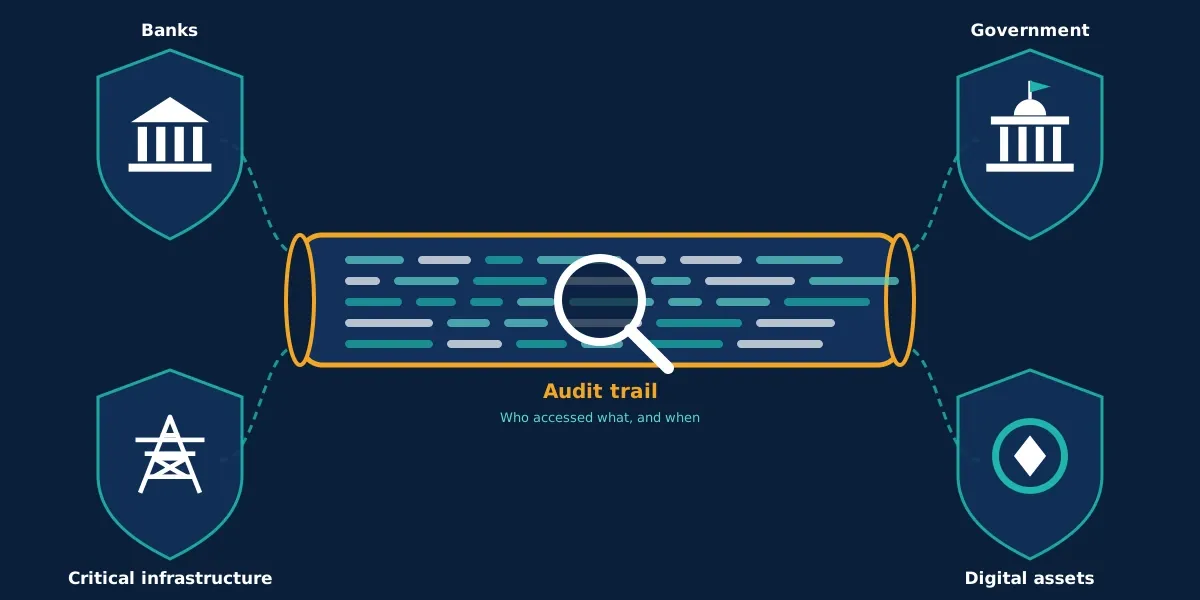
Regulated organizations are generally expected to show least-privilege access, logging of privileged and user activity, monitoring reviewed by someone independent, and evidence that can survive an audit. Few rules use the phrase "insider threat," but these controls are the foundation of insider threat detection, and regulators increasingly name it directly.
Financial services and crypto/VASP expectations (access control, monitoring, auditability)
Financial regulators tend to ask the same three questions: who can reach sensitive systems, who is watching what they do, and can you prove it. Dubai's VARA is unusually explicit. Its Technology and Information Rulebook includes an internal user activity monitoring standard, stating that it helps identify compromised accounts or insider threats early. VASPs are expected to monitor internal user activity, including access to sensitive systems and administrative actions, and to keep monitoring separate from the operational teams being monitored.
The rulebook also ties access to auditable evidence. Access to systems and data is limited to people with a demonstrable business need, with an access log maintained. Key access changes require an audit log, a VASP must assess whether to generate a new key when staff with key access leave, and internal audits of access removal must run quarterly.
New York's financial regulation covers similar ground for U.S. firms. Section 500.14 of 23 NYCRR requires risk-based controls to monitor authorized users' activity and detect unauthorized access to, use of, or tampering with nonpublic information by those users. Detection use cases built around leavers' access, privileged changes, and bulk data access produce exactly the evidence examiners ask for.
Government and critical infrastructure
In the United States, federal insider threat requirements trace to Executive Order 13587 (2011), which created the National Insider Threat Task Force and required agencies with classified networks to establish insider threat programs. Cleared defense contractors face a parallel obligation under 32 CFR 117.7(d), which requires a program and a written appointment of an Insider Threat Program Senior Official. Program policies must cover user activity monitoring, and employees must be told that their activity on classified systems is monitored, usually through login banners and user agreements.
For critical infrastructure, CISA's insider threat guidance is written for these operators, and NIST SP 800-53 control PM-12 requires a formal program. In the electric sector, NERC CIP-004 covers personnel risk assessments and access revocation, and CIP-007 covers security event monitoring. A regional reliability organization has noted that these controls offer limited protection against a trusted insider with authorized access, which is why internal network security monitoring standards are being developed. The gap matters for any regulated operator: compliance with access rules does not by itself detect misuse of legitimate access.
Regional frameworks (SIA, SAMA, NCA, VARA), mapped to monitoring obligations
The table maps each GCC framework to its scope and the obligations that matter most for insider threat detection. It is a starting point for planning, not a compliance determination.
Framework | Who It Applies To | Relevant Monitoring and Access Obligations | Detection Implication |
|---|---|---|---|
VARA Technology and Information Rulebook | VASPs licensed in Dubai | Internal user activity monitoring, audit logging, need-based access with logs, quarterly access-removal audits, key access logging | Monitor privileged and key activity; keep evidence of leaver access removal |
UAE Information Assurance Regulation (SIA, formerly NESA) | UAE government entities and critical infrastructure operators | Personnel security controls (screening, termination, transfer) and system logging and monitoring | Link HR events to access changes; log all systems where feasible |
SAMA Cyber Security Framework | SAMA-regulated financial institutions in Saudi Arabia | Periodic review of privileged and remote accounts, individual accountability, limits and monitoring on shared privileged accounts, security event monitoring | Eliminate shared-account blind spots; tie every privileged action to a person |
NCA Essential Cybersecurity Controls (ECC) | Saudi government entities and critical infrastructure operators | Identity and access management, security logging and monitoring | Central logging with defined review and alerting |
A few cautions apply. These regimes change, so confirm the current version and the issuing body before building evidence against them. Local personal data law still governs how the monitoring itself is done, as covered in the privacy section above. And a control that exists on paper does not satisfy an assessor: they will ask for logs, review records, and examples of alerts handled.
Common Mistakes and Limitations
Insider threat detection programs usually fail for operational reasons rather than technical ones: they buy tools without building a program, monitor without HR and legal alignment, watch only for malicious insiders, bury analysts in unreviewed alerts, or expect detection to do what only prevention can. Knowing these failure modes up front is the cheapest way to avoid them.
Treating it as a tool purchase
A tool produces signals, not outcomes. Organizations that buy a platform first often end up with a dashboard nobody reviews, because the surrounding pieces were never built: a ranked list of critical assets, clean identity and HR data, owners for each alert type, and an investigation workflow. The result is expensive coverage that can't answer the question leadership asks after an incident: whether anyone would have noticed.
The fix is to work backward from the assets and use cases you defined, then confirm the tool can ingest the data those use cases need. Pilot it on your own logs, measure the noise, and verify you have analysts to review what it produces before signing a multi-year contract.
Monitoring without HR and legal alignment
Detection that runs without HR and legal creates problems at the worst moment. When an alert becomes a real case, investigators need to know what evidence they can use, who may interview the employee, and whether the action fits employment and privacy law. Without prior agreement, teams hesitate, act too early and tip off the person, or collect data in ways that can't later be used.
Settle these questions before the first alert. Agree on a charter, a notice to employees, a playbook that says who decides what at each stage, and a rule that sensitive cases stay confidential. Consistent handling also protects the organization from claims of unfair treatment.
Ignoring negligent and compromised insiders
A program built around the spy-and-saboteur story misses most of the problem. In Ponemon's 2025 Cost of Insider Risks research, negligent employees caused 55 percent of incidents and credential theft caused another 20 percent, so three in four incidents involved non-malicious insiders.
These two groups need their own detection and response paths. Compromised accounts need strong identity signals and fast containment, with no HR case. Negligent behavior needs policy-violation detection, coaching, and a control fix, such as blocking an unapproved upload route. Track repeat negligent incidents to see whether the fixes work. A program that only hunts bad actors will find few of them and miss most of its real exposure.
Alert overload and unreviewed risk scores
Alert overload is the most common way a working detection program quietly stops working. Static thresholds that fire on routine activity, risk scores nobody has time to review, and alerts that arrive without context all teach analysts to ignore the queue. Once that happens, a genuine case can sit unread behind hundreds of harmless ones.
Several habits keep volume manageable:
Start with a small number of high-value use cases rather than every possible rule.
Set a review time target for each risk tier, and report how often it is missed.
Track the share of alerts that become real cases, and retire or retune rules that never do.
Route low-risk, negligent-type events to automated nudges or manager coaching instead of analysts.
Compare users to peer groups so that normal role behavior doesn't trigger alerts.
What detection cannot do (intent, prevention)
Detection has hard limits, and a program that overpromises loses credibility. First, it can't read intent. It sees behavior, such as a bulk download, and a human investigation has to decide whether that behavior was malicious, careless, or business as usual. Second, it can't prevent anything on its own, because it acts after access is granted. Prevention comes from least-privilege access, prompt offboarding, segmentation, and a culture where people report concerns.
Third, it can only see what is logged. Photographing a screen, memorizing information, or a conversation outside monitored channels leaves no trace. Fourth, a determined insider who understands the monitoring may avoid it. Treat detection as one layer that shortens the window between misuse and response, and pair it with preventive controls, so that no single layer carries the whole risk.
Conclusion
Effective insider threat detection starts small and builds in a clear order. Identify the few assets whose loss would hurt most, then collect identity and data-movement signals around them. Correlate those signals across sources so that a single harmless event doesn't trigger an alert while a pattern does. Bring HR, legal, and privacy teams in before monitoring begins, so that every alert has an agreed path to a fair and defensible outcome.
Speed is the practical measure of success. Ponemon's 2026 research found that organizations containing insider incidents within 30 days averaged $14.2 million in annual insider-risk cost, compared with $21.9 million when containment took more than 90 days. Detection that shortens that window pays for itself, and it works best alongside least-privilege access and prompt offboarding.
If you want an outside view of where your critical assets, access controls, and logging stand today, a security assessment is a sensible first step.
Frequently Asked Questions (FAQs)
What are the first signs of an insider threat?
The earliest signs are usually deviations from a person's normal pattern: access to systems outside their role, unusual data downloads or transfers, logins from new devices or locations, and attempts to bypass or disable logging. HR context, such as a resignation, raises concern when combined with these. No single sign is conclusive by itself.
Can UEBA detect insider threats on its own?
Not reliably. UEBA is good at spotting deviations from baseline behavior, including compromised accounts and slow data collection, but it needs clean logs, time to learn normal activity, and ongoing tuning. It can miss insiders who stay within normal patterns, so most programs pair it with SIEM correlation, data monitoring, and human investigation.
How is insider threat detection different from DLP?
DLP watches sensitive data and the channels it leaves through, blocking or flagging transfers based on content and policy. Insider threat detection is broader: it looks at behavior across access, identity, and data movement to find risky people or compromised accounts. DLP is one signal source feeding the larger detection program.
How long does it take to detect an insider incident?
Published figures usually measure containment, not detection alone. Ponemon's 2026 research found insider incidents took an average of 67 days to contain, and only 13 percent were contained within 30 days. Faster is cheaper: incidents contained within 30 days carried lower annual costs than those lasting over 90 days.
Do small companies need an insider threat program?
Yes, in a scaled-down form. Small companies face the same insider risks, including mistakes and stolen credentials, with fewer safeguards. A practical start is a short list of critical assets, least-privilege access, prompt offboarding, audit logging on key systems, and a written policy, using tools already owned rather than a dedicated platform.
Is employee monitoring legal?
Often yes, within limits. Many jurisdictions allow workplace security monitoring if it is disclosed to employees, has a legitimate purpose, and is proportionate to the risk. Rules vary by country and by state, and some require impact assessments or employee consultation, so have legal counsel review your program before monitoring begins.
Continue Reading
November 17, 2026
Data Loss Prevention (DLP) | What It Is and How It Works
What is data loss prevention? See how DLP finds, monitors, and blocks risky data movement, plus types, policy rules, and a four-phase rollout plan.

November 12, 2026
Software Bill of Materials (SBOM) | The Complete Guide
Learn what a software bill of materials (SBOM) is, what it must include under CISA’s 2026 elements, which formats to use, and how to create one step by step.

November 10, 2026
Cyber Insurance Requirements | What Insurers Demand
Cyber insurance requirements: is it required? Learn the controls insurers demand, how underwriting works, and what voids a claim, plus a readiness checklist.