Vulnerabilitycritical
Windows 11 Kernel Framework Leak Analysis
An alleged zero-day exploitation framework targeting Windows 11 has emerged on underground forums. We analyze the technical implications and defense strategies.
An alleged zero-day exploitation framework targeting Windows 11 has emerged on underground forums. We analyze the technical implications and defense strategies.
A threat actor has published the Orcahunter Framework v1.0, a toolkit claiming to facilitate automated vulnerability research against the Microsoft Windows 11 24H2 kernel. This release specifically includes a purported pre-authentication exploit targeting the Windows network stack via the tcpip.sys driver. The potential impact of such a vulnerability is significant, as it could lead to system-wide denial-of-service conditions or unauthorized remote code execution on target machines.
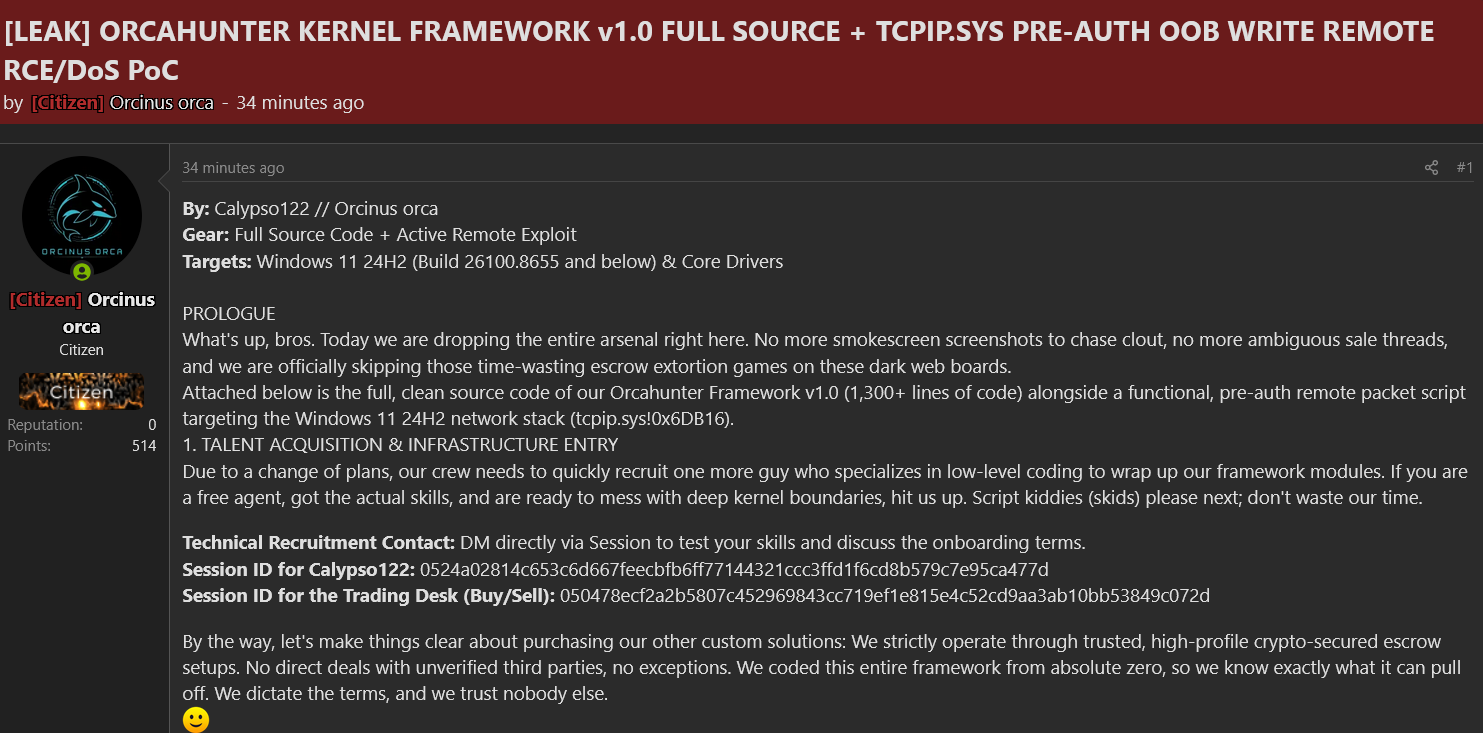
The emergence of such tooling poses an immediate risk to enterprises relying on the latest Windows 11 iterations. Even in the absence of a confirmed CVE, the existence of a functional exploit framework lowers the bar for adversaries looking to weaponize kernel-level flaws. When critical infrastructure relies on unpatched or legacy configurations, the window for exploitation narrows significantly. It is essential to understand that kernel-level vulnerabilities bypass standard application-layer defenses, making deep-system visibility mandatory.
Free exposure check
Dark Web Scanner
check dark web mentions, compromised account indicators, malware log signals, public breach exposure, and recent underground market activity for your domain.
The core of this risk lies in the manipulation of the tcpip.sys driver, a critical component for network communication. If an attacker successfully gains remote code execution through the network stack, they can establish persistence or move laterally within a network without needing valid user credentials. This represents a substantial breach of the perimeter. To mitigate this risk, security teams should prioritize Vulnerability Assessments to track patch status across all endpoints, ensuring that kernel-level patches are prioritized over standard application updates.
Furthermore, attackers often utilize such leaked frameworks in conjunction with credential harvesting. The ability to trigger a blue screen of death (BSOD) remotely may be used as a smokescreen for other malicious activities, including data exfiltration or the deployment of secondary payloads. Organizations should leverage Attack Surface Management to ensure that internet-facing Windows 11 assets are limited, hardened, and monitored for anomalous traffic patterns, especially those targeting known driver-level protocols.
Defenders must transition from a reactive patching model to a proactive, validation-based posture. Relying solely on official patch notes is insufficient when custom frameworks exist that leverage unpatched, undocumented, or zero-day vulnerabilities. Continuous offensive validation is necessary to confirm that your existing security controls effectively block attempts at memory corruption or unauthorized kernel access. Furthermore, verifying your internal visibility through robust log monitoring allows teams to identify signs of automated exploitation attempts, which are often characterized by repeated, abnormal network stack interaction patterns.
For GCC-based enterprises, where regulatory compliance and operational uptime are critical, a compromise at the kernel level can cause extended service disruption. Femto Security advocates for a security-first operating model that integrates deep technical audits with compliance-focused controls to ensure that your environment remains resilient against emerging exploit weaponization. Our approach helps enterprises bridge the gap between theoretical risk and actual environmental security, identifying potential entry points before an attacker has the chance to leverage them in an incident.
If your team may be exposed to a similar threat, FemtoSec can help validate blast radius, prioritize remediation, and connect the issue to a practical security program.
August 9, 2026
An underground threat actor is actively selling two unauthenticated SQL injection zero-day vulnerabilities affecting widely used MyBB plugins with over 20,000 downloads. Learn the technical mechanics of the threat, the attack chain, and actionable detection strategies to secure your forum infrastructure.
June 20, 2026
A reported zero-day exploit targeting Local Privilege Escalation (LPE) in Windows presents a significant risk to enterprise security, potentially allowing attackers to elevate permissions and compromise system integrity.
June 21, 2026
A threat actor is reportedly offering a malware framework exploiting vulnerabilities in libsodium and NaCl. We analyze the risks to enterprise cryptographic integrity and provide mitigation steps.