Data Breachhigh
Vietnam Ministry Data Breach: Analysis and Response
A reported data breach impacting the Ministry of Education of Vietnam highlights critical risks to public sector infrastructure and the need for proactive defensive measures.
A reported data breach impacting the Ministry of Education of Vietnam highlights critical risks to public sector infrastructure and the need for proactive defensive measures.
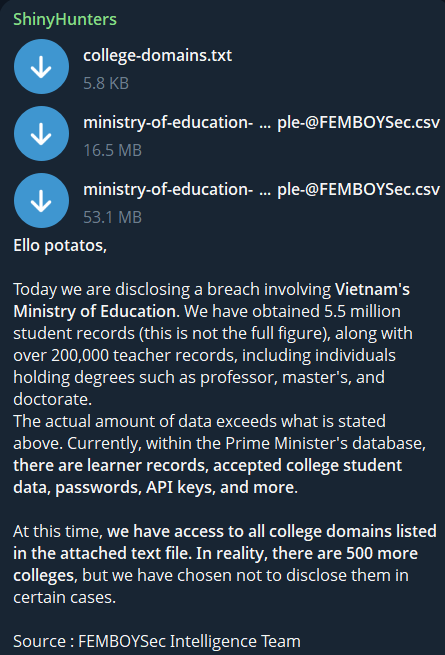
Recent threat intelligence reports indicate an alleged data breach targeting the Ministry of Education of Vietnam, specifically impacting the domain en.moet.gov.vn. This incident, associated with adversarial activity, underscores the persistent threat posed to government administrative infrastructure in the ASEAN region. As attackers move to compromise high-value public sector targets, the risks of data exfiltration and long-term operational disruption grow significantly.
Public sector entities like ministries often house vast repositories of sensitive citizen and internal policy data. When an internet-facing asset like a ministry portal suffers a security event, the impact extends beyond the immediate database. Attackers frequently seek to establish persistence, move laterally through internal networks, and leverage stolen credentials to access privileged systems. For organizations managing critical infrastructure, identifying how such breaches occur, whether through vulnerable web applications or credential harvesting, is the first step toward effective mitigation.
Free exposure check
Dark Web Scanner
check dark web mentions, compromised account indicators, malware log signals, public breach exposure, and recent underground market activity for your domain.
The breach of an government domain typically signals that the organization's Attack Surface Management must be prioritized. If an external-facing system is compromised, there is a high probability that the entry vector was either a known, unpatched vulnerability or stolen administrative credentials. In a landscape where threat actors utilize automated tooling to identify misconfigurations, constant vigilance and Penetration Testing are no longer optional for large-scale enterprises or government agencies.
The potential for credential reuse is a primary concern in incidents involving government portals. Employees may use corporate or personal credentials on external systems that have been subjected to data leaks. This creates a bridge for attackers to pivot into more sensitive internal environments. Continuous Dark Web Monitoring is essential to detect when employee credentials, session tokens, or internal documents appear on underground forums.
To defend against similar incursions, organizations must transition from a reactive posture to a compliance-first, proactive operating model. This involves conducting regular, deep-dive Vulnerability Assessments to catch flaws before they are weaponized. Furthermore, implementing strong identity and access management policies, combined with rigorous Source Code Review for web applications, significantly reduces the probability of a successful exploit chain. Security is an ongoing cycle of discovery, validation, and hardening.
If your team may be exposed to a similar threat, FemtoSec can help validate blast radius, prioritize remediation, and connect the issue to a practical security program.
October 16, 2026
A dark web forum breach exposing 200,000 citizen records has highlighted severe identity theft and social engineering risks across public administration databases. FemtoSec provides deep technical analysis of the exfiltration vectors, MITRE ATT&CK mapping, and actionable containment measures for security teams.
October 14, 2026
A threat actor claims to have published approximately 100,000 billing, payment, and customer records from a prominent Cambodian payment gateway on an underground forum, highlighting significant operational and fraud risks for integrated merchants and consumers.
September 20, 2026
A threat actor claims to have leaked more than 100,000 records from a public water management entity, exposing Peruvian national identity document numbers, citizen names, emails, and internal complaint registries.