Transit Ticketing Breach Exposes 305k Records
A reported breach of an Egyptian public transit booking platform has exposed over 305,000 customer records, including national identification numbers, transaction identifiers, and travel histories. Security teams must prioritize credential resets, API auditing, and identity impersonation monitoring.

Key Takeaways
- Over 305,000 passenger records from Blue Bus Egypt were advertised for sale on cybercrime forums.
- Exposed fields include national identification numbers, full names, dates of birth, travel schedules, and payment transaction IDs.
- The breach highlights severe risks of targeted smishing, secondary identity theft, and corporate executive tracking.
- Egyptian Personal Data Protection Law (Law No. 151 of 2020) mandates strict breach reporting and potential liabilities.
- Defenders must immediately audit booking APIs for authorization flaws and verify database connection boundaries.
Security defenders must immediately prioritize the audit of public-facing booking application programming interfaces (APIs) and database authentication credentials following reports that over 305,000 customer records from an Egyptian transit platform have surfaced on illicit forums. When booking platforms suffer data compromise, malicious operators quickly operationalize exposed national identification numbers, phone records, and booking references to stage targeted social engineering and identity fraud across regional consumer networks.
Incident Exposure & Compliance Requirements
What Was Exposed
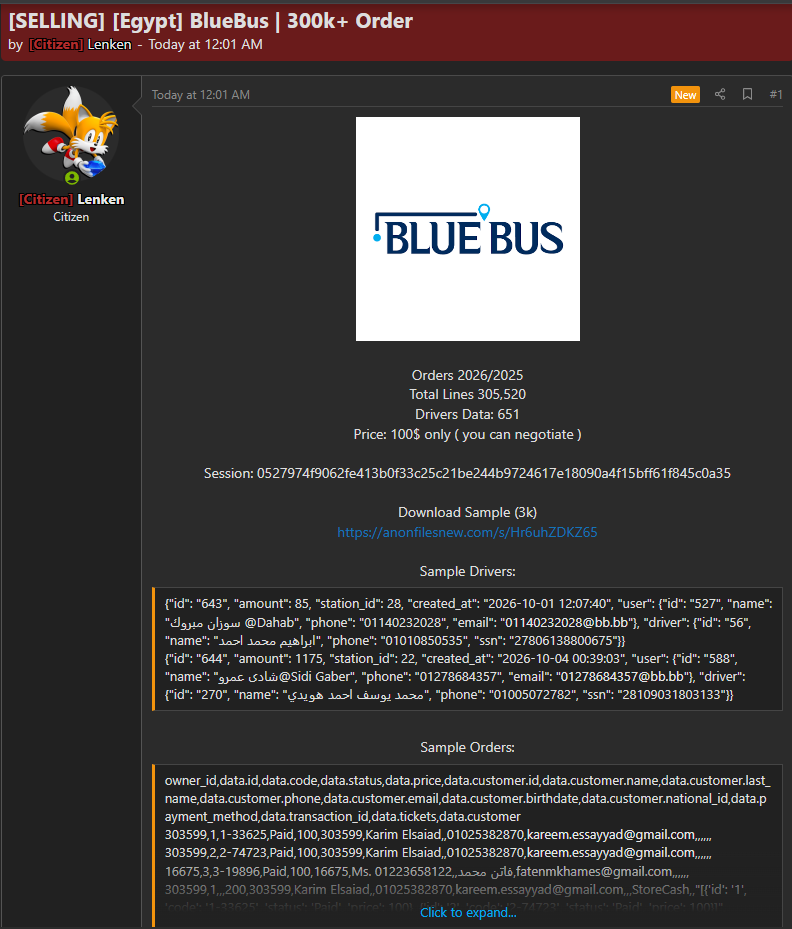
The compromised dataset allegedly originates from Egyptian transportation operator Blue Bus Egypt (operating the domain bluebus.com.eg). Threat actors on underground forums claim to hold 305,520 distinct customer and transaction records. A review of the listing reveals that the compromised records contain high-value personal data paired directly with transactional and mobility telemetry.
The exposed data fields cataloged in the breach repository include:
Full Customer Names: Primary contact names tied directly to passenger ticketing profiles.
Contact Telemetry: Verified customer phone numbers and email addresses used for booking confirmation and digital receipts.
Demographic Records: Customer dates of birth and government-issued Egyptian National Identification numbers.
Reservation and Travel Data: Granular booking records, travel itineraries, origin and destination points, ticket pricing, seat reservations, and departure timestamps.
Financial Transaction References: Associated payment method indicators, payment gateway transaction IDs, and ticketing fulfillment status flags.
The combination of national identification numbers with exact travel schedules and transactional metadata makes this incident particularly severe. While full credit card numbers or card verification values were not explicitly cataloged in the listing, payment gateway references and transaction status fields provide cybercriminals with credible material to orchestrate targeted financial impersonation campaigns.
Organizations concerned about secondary domain compromise or exposed corporate credentials stemming from employee travel bookings can leverage FemtoSec's Dark Web Scanner to rapidly identify whether organizational domains appear in recent underground marketplace distributions.
Regional Threat Broker Context
- Motivation
- Financial (Database & Initial Access Brokerage)
- Targets
- Egyptian transport operators (BlueBus, GoBus)Regional commercial & government portals
- TTPs
- Bulk SQL database extractionPublic API endpoint scrapingCompromised credential abuseUnderground forum database sales
How the Data Got Out
While the threat actor has not published an exploit technical post-mortem, initial analysis of the data schema and typical threat broker tactics points toward unauthorized database querying or public API extraction. Underground access brokers operating across the Middle East frequently target transport and logistics reservation portals due to their widespread use of external customer portals and mobile application interfaces.
Attack Vector Analysis: Initial Access to Exfiltration
Threat actors targeting regional transit portals commonly follow a multi-stage attack lifecycle mapped across the MITRE ATT&CK framework:
T1190 (Exploit Public-Facing Application): Attackers frequently identify web application flaws within reservation engines, including SQL Injection (SQLi) in search parameters or unauthenticated Representational State Transfer (REST) endpoints. If booking lookups lack parameterized database queries, attackers can extract full customer tables directly from the relational database management system.
T1078 (Valid Accounts): Broker networks often acquire compromised administrative credentials harvested through infostealer malware infections on employee endpoints. Attackers then authenticate directly to backend reservation consoles, dispatch software, or content management interfaces.
T1087.002 (Account Discovery: Domain and Application Accounts): Once internal application access is achieved, adversaries enumerate backend database schemas, locating customer master tables and payment reconciliation ledgers.
T1005 (Data from Local System) and T1048 (Exfiltration Over Alternative Protocol): Attackers run bulk queries to extract passenger data into flat-file dumps (such as CSV or SQL archives) before exfiltrating the payload to external command-and-control staging infrastructure.
Application vulnerabilities such as Broken Object Level Authorization (BOLA) and Broken Object Property Level Authorization (BOPLA) also represent pervasive vectors in mobile ticketing APIs. When an API endpoint fails to validate whether the authenticated user owns the requested booking record, automated tools can iterate through ticket sequence IDs to dump hundreds of thousands of customer profiles without triggering traditional web application firewall blocks.
Proactive assessment through systematic Penetration Testing helps enterprises uncover authorization gaps, parameter tampering weaknesses, and database injection risks across customer-facing portals before threat actors can exploit them.
Threat Actor ATT&CK Matrix
Downstream Risk
Data breaches involving transportation platforms present severe downstream repercussions for both the compromised organization and the individual passengers whose data is traded. Unlike static marketing lists, transit databases combine sensitive national identity data with detailed behavioral and location patterns.
Identity Theft and Fraudulent Impersonation
The presence of government-issued National Identification numbers paired with full names and dates of birth provides threat actors with the core elements required for identity theft. In the regional banking and telecommunications ecosystem, these identifiers are frequently used as secondary verification factors. Attackers can leverage these details to attempt SIM swap fraud, bypass automated customer service verification prompts, or submit fraudulent loan applications.
Targeted Smishing and Social Engineering
With precise knowledge of ticket pricing, travel dates, payment gateways, and phone numbers, cybercriminals can construct highly convincing social engineering lures. Passengers may receive fraudulent SMS or WhatsApp messages referencing legitimate travel dates or transaction reference numbers, claiming that an upcoming departure has been rescheduled or that a payment discrepancy requires immediate settlement via a malicious link.
Corporate Exposure and Executive Tracking
When enterprise personnel use company email addresses or corporate phone numbers to secure transit tickets, threat actors can map employee movement, regional operational hubs, and travel schedules. For high-profile personnel or critical infrastructure operators, the exposure of physical travel patterns introduces operational security risks that extend well beyond digital fraud.
Breach Impact Radius
- Identity Theft & SIM Swap Fraudhigh
- Targeted Smishing Campaignshigh
- Executive Travel Surveillancemedium
- Payment Gateway Impersonationhigh
Regulatory and Notification Exposure
Organizations operating in Egypt and processing personal citizen data are subject to rigorous statutory requirements under the Egyptian Personal Data Protection Law (Law No. 151 of 2020). The legal framework enforces explicit operational mandates regarding data protection, breach handling, and cross-border data exposure.
Under Law No. 151 of 2020, key compliance requirements include:
Mandatory Breach Notification: Data controllers must formally notify the Personal Data Protection Center within 72 hours of discovering any data breach or security incident that affects personal data.
Data Subject Notification: If the breach poses a risk to the rights, freedoms, or financial security of individuals, the data controller must notify the affected individuals without undue delay, detailing the nature of the compromised data and recommended defensive measures.
Security Control Enforcement: Entities handling customer records must demonstrate that technical and organizational safeguards, including role-based access control, data encryption at rest, and transport layer security, were actively enforced.
Sanctions and Penalties: Failure to safeguard protected consumer data or report breaches within statutory deadlines can result in substantial monetary fines and potential criminal liability for responsible executive custodians.
Enterprises operating in transport and logistics must evaluate whether customer data storage architectures fulfill encryption mandates and whether incident response playbooks include established procedures for regional regulatory disclosure.
Ticketing Infrastructure Defense in Depth
- L1Perimeter & API SecurityEnforce strict object-level authorization (BOLA/BOPLA)Inspect WAF logs for automated SQL injection syntaxImplement aggressive rate limiting on booking lookups
- L2Database HardeningRotate master credentials and API tokensRestrict database ports (3306, 5432, 1433) to internal subnetsAudit and alert on unparameterized bulk SELECT queries
- L3Regulatory & IntelligenceEstablish 72-hour regulatory incident reporting workflowsMonitor dark web markets for domain credential leaks
What to Check Now
Defenders managing consumer-facing reservation systems, logistics portals, or enterprise web assets should immediately carry out the following validation and containment procedures to secure their infrastructure against similar intrusion vectors.
1. API and Web Perimeter Validation
Audit Object-Level Authorization: Verify that every API endpoint handling user profiles, ticket lookups, or transaction receipts explicitly validates that the requesting session matches the subject identifier. Reject any request attempting to query arbitrary booking sequence IDs.
Inspect Web Application Firewall Logs: Review HTTP traffic logs for high-volume automated requests, SQL syntax patterns (such as
UNION SELECTor boolean injection markers), and automated scraping tool user-agents across customer lookup paths.Implement Aggressive Rate Limiting: Enforce strict rate limits and progressive delays on sensitive query routes, including passenger search, ticket status lookups, and account login portals.
2. Database Hardening and Access Controls
Rotate Master Credentials: Immediately rotate all database administrative passwords, connection strings stored in web configuration files, and API gateway access tokens.
Restrict Network Surface: Ensure database listening ports (such as TCP 3306, 5432, or 1433) are strictly isolated from the public internet and accessible only via middle-tier application servers over dedicated internal subnets.
Audit Sensitive Database Queries: Establish alerts for non-parameterized bulk
SELECTqueries executed against customer and transaction tables, especially those returning unusually high row counts during non-operational hours.
3. Continuous Threat Monitoring
Because stolen identity and booking dumps frequently circulate across cybercrime marketplaces for months, organizations should deploy persistent Dark Web Monitoring to track underground trading chatter, illicit forum mentions, and compromised credential sales tied to enterprise domains and sensitive operational infrastructure.
How to Defend Against Similar Threats
- Audit all external-facing ticketing and booking APIs for Broken Object Level Authorization (BOLA) and parameter tampering.
- Rotate all database service credentials and ensure database ports are completely inaccessible from the public internet.
- Implement rate limiting, bot protection, and anomaly detection on user lookup and transaction verification endpoints.
- Deploy continuous dark web monitoring to track potential exposure of corporate domains and employee credentials.
- Alert affected customers to watch for targeted phishing or smishing messages referencing past travel dates or booking numbers.
Threat Intel FAQ
What specific customer data was compromised in the Blue Bus Egypt incident?
How do threat actors typically exfiltrate large databases from transit portals?
What should organizations do if their employees used corporate emails on the compromised platform?
Could a similar threat affect your organization?
If your team may be exposed to a similar threat, FemtoSec can help validate blast radius, prioritize remediation, and connect the issue to a practical security program.
Related Threats
September 20, 2026
Water Infrastructure Authority Database Leaked Online
A threat actor claims to have leaked more than 100,000 records from a public water management entity, exposing Peruvian national identity document numbers, citizen names, emails, and internal complaint registries.
October 16, 2026
Returnero Leaks 200,000 Government Records
A dark web forum breach exposing 200,000 citizen records has highlighted severe identity theft and social engineering risks across public administration databases. FemtoSec provides deep technical analysis of the exfiltration vectors, MITRE ATT&CK mapping, and actionable containment measures for security teams.
October 14, 2026
Fintech Payment Gateway Leaks 100,000 Billing Records
A threat actor claims to have published approximately 100,000 billing, payment, and customer records from a prominent Cambodian payment gateway on an underground forum, highlighting significant operational and fraud risks for integrated merchants and consumers.