Data Breachhigh
Tenda Technology Data Breach Analysis
A significant data breach involving 742k records from Tenda Technology has emerged. This incident highlights the critical need for proactive attack surface management and credential monitoring.
A significant data breach involving 742k records from Tenda Technology has emerged. This incident highlights the critical need for proactive attack surface management and credential monitoring.
Recent reports indicate a substantial security incident involving Tenda Technology, with a threat actor claiming to have exfiltrated a dataset containing 742,000 records. The exposed metadata is comprehensive, including personally identifiable information (PII) such as full names, email addresses, phone numbers, and physical location data including province and city IDs. Furthermore, the dump allegedly contains technical metadata such as last login IP addresses, registration timelines, and account status indicators, which present a high risk for downstream exploitation.
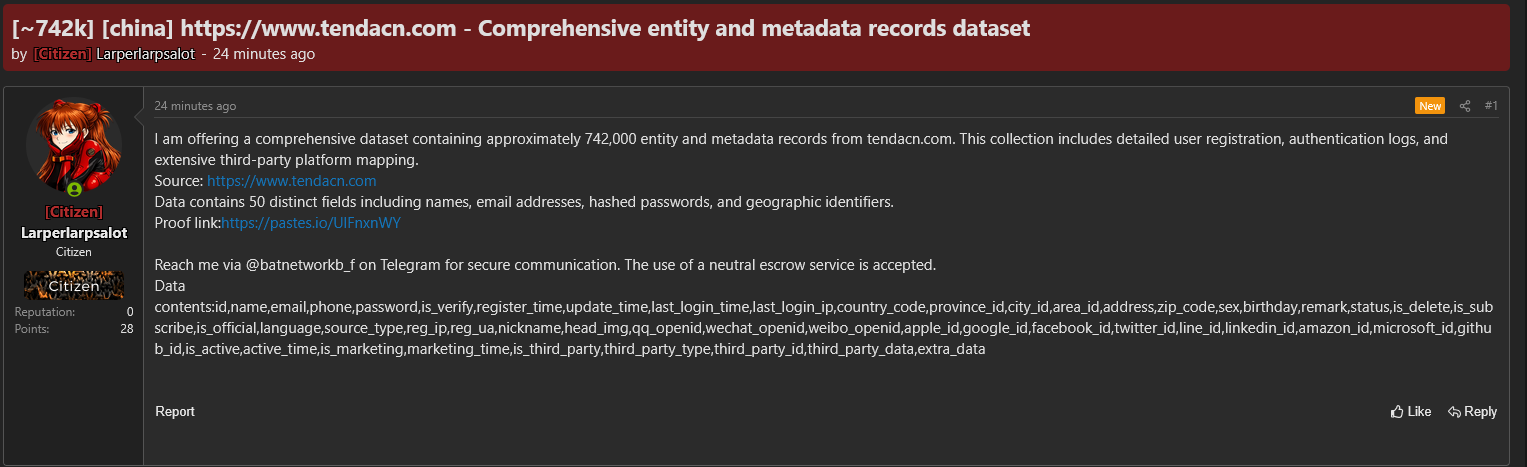
The exposure of such a granular dataset poses significant risks beyond simple identity theft. For enterprise stakeholders and users alike, the presence of account status, password hashes, and login IP telemetry allows malicious actors to conduct highly targeted social engineering campaigns. When attackers possess knowledge of an individual's registration date, subscription status, and last known login IP, they can craft sophisticated phishing attacks that appear legitimate. The inclusion of address, zip code, and birthday data further facilitates identity fraud and potential financial compromise.
Organizations relying on Tenda infrastructure must prioritize security audits. If you believe your domain or corporate credentials could be compromised in this or similar incidents, use FemtoSec's Dark Web Scanner to check dark web mentions, compromised account indicators, malware log signals, public breach exposure, and recent underground market activity for your domain.
This incident underscores the necessity of a robust Attack Surface Management strategy. In the modern threat landscape, visibility is the first line of defense. Enterprises often fail to recognize that leaked employee or user credentials from third-party services can be the initial access vector for broader network infiltration. By maintaining continuous visibility into your exposed assets and external footprint, organizations can preemptively identify potential vulnerabilities.
Furthermore, standardizing on secure development and robust authentication protocols is critical. The presence of 'password' and 'last login' metadata in the leaked set serves as a reminder to enforce multi-factor authentication (MFA) across all enterprise portals and to rotate credentials immediately upon evidence of a breach. Organizations must treat such leaks as potential triggers for account takeover (ATO) attempts against their internal staff.
For organizations, the remediation process should start with rigorous Vulnerability Assessments to ensure that any underlying infrastructure weaknesses which might have facilitated data exfiltration are addressed. Following an incident of this scale, it is vital to perform a comprehensive log review to detect anomalous access patterns or unauthorized lateral movement that might have occurred following the potential data acquisition. Security teams should prioritize mapping the blast radius of this breach and initiating password resets for any accounts where reuse is suspected.
If your team may be exposed to a similar threat, FemtoSec can help validate blast radius, prioritize remediation, and connect the issue to a practical security program.
October 16, 2026
A dark web forum breach exposing 200,000 citizen records has highlighted severe identity theft and social engineering risks across public administration databases. FemtoSec provides deep technical analysis of the exfiltration vectors, MITRE ATT&CK mapping, and actionable containment measures for security teams.
September 20, 2026
A threat actor claims to have leaked more than 100,000 records from a public water management entity, exposing Peruvian national identity document numbers, citizen names, emails, and internal complaint registries.

October 14, 2026
A threat actor claims to have published approximately 100,000 billing, payment, and customer records from a prominent Cambodian payment gateway on an underground forum, highlighting significant operational and fraud risks for integrated merchants and consumers.