Critical Cisco SD-WAN Vulnerability: Analysis and Defense
A newly identified critical zero-day vulnerability (CVE-2026-20182) in Cisco Catalyst SD-WAN Controllers is currently being exploited in the wild, posing severe risks to administrative control.

Key Takeaways
- A critical zero-day (CVE-2026-20182) in Cisco Catalyst SD-WAN allows unauthenticated full administrative control.
- The flaw stems from improper certificate validation in the DTLS handshake process.
- Attackers can impersonate trusted devices to compromise the control plane.
- Active exploitation in the wild demands urgent assessment of all internet-facing or poorly segmented controllers.
Understanding the Cisco Catalyst SD-WAN Critical Vulnerability
In the landscape of modern enterprise networking, the integrity of centralized management systems is paramount. Recent reports confirm that a critical zero-day vulnerability, identified as CVE-2026-20182, is currently being actively exploited in the wild. This flaw targets Cisco Catalyst SD-WAN Controllers, providing unauthenticated remote attackers with the ability to bypass authentication mechanisms and seize full administrative control over the infrastructure. For organizations relying on software-defined networking, this represents a significant threat that necessitates immediate investigation and defensive hardening.
Technical Implications of the Exploit
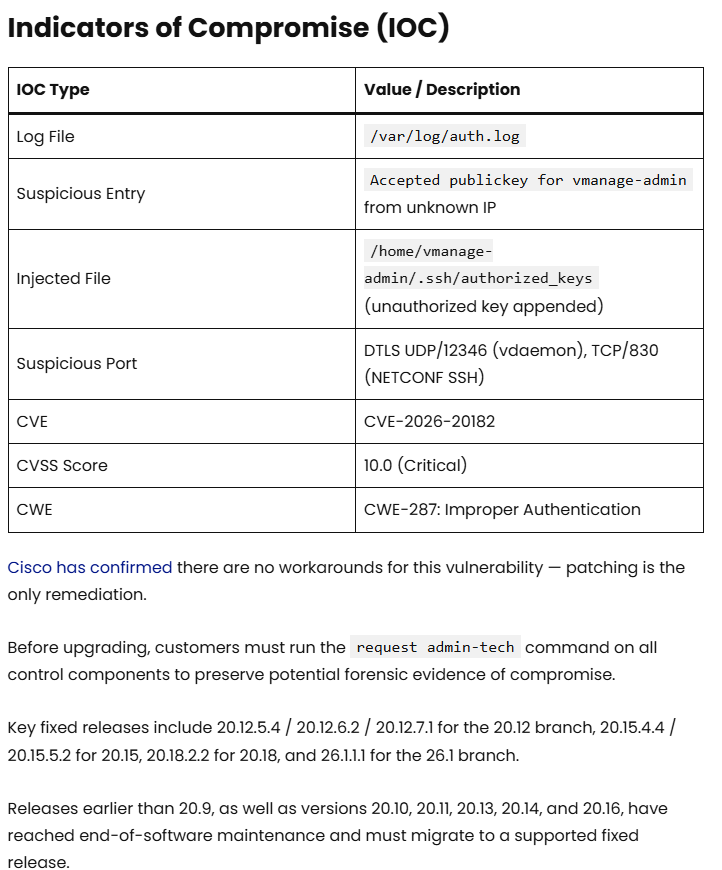
The core of this vulnerability lies in the improper validation of certificates during the DTLS (Datagram Transport Layer Security) handshake. Because the controller fails to properly verify the identity of connecting devices, an attacker can effectively impersonate a trusted edge device. Once this spoofing is successful, the attacker can establish a foothold in the control plane, effectively bypassing perimeter defenses and gaining administrative access to the network management environment.
Such deep access allows malicious actors to manipulate traffic, intercept sensitive data, or reconfigure network policies entirely. In a complex GCC enterprise environment, where SD-WAN acts as the backbone for inter-office communication and cloud connectivity, the compromise of a controller can lead to cascading failures across business-critical operations.
Proactive Defense and Mitigation
Enterprise security teams must prioritize visibility into their attack surface to identify if their infrastructure is exposed to such control-plane vulnerabilities. Relying on perimeter defenses alone is insufficient against exploits that target the authentication logic of the management plane itself. Enterprises should integrate Attack Surface Management to maintain a continuous inventory of exposed network management interfaces and configurations. Furthermore, conducting regular Penetration Testing is vital to validate whether your current security controls can detect or prevent unauthorized attempts to interact with your controller infrastructure. By simulating the tactics used by adversaries in the wild, your team can build a more resilient security posture that adapts to emerging threats.
Strategic Hardening for the GCC Enterprise
At FemtoSec, we have observed that threats targeting critical networking infrastructure often rely on the assumption that management planes are inherently trusted. As part of a robust security strategy, organizations should implement stringent access controls, ensuring that only authenticated, known-good devices can reach the control plane via restricted management networks. Moving beyond a reactive posture requires a shift toward constant validation of every internal and external connection. Our platform, CyberSec365, provides the visibility required to ensure that such critical infrastructure components are not just deployed, but consistently hardened against sophisticated exploitation techniques.
Conclusion
The exploitation of CVE-2026-20182 serves as a stark reminder of the complexity inherent in securing distributed SD-WAN environments. Organizations must treat the security of their management controllers with the highest priority. If you have concerns regarding your exposure, FemtoSec offers a proactive assessment to help you identify and mitigate risks to your network infrastructure effectively.
How to Defend Against Similar Threats
- Immediate audit of SD-WAN controller management interfaces to restrict unauthorized access.
- Engage in penetration testing to validate control-plane isolation and authentication robustness.
- Implement continuous attack surface monitoring to identify and reduce potential entry points.
- Review vendor advisories and apply available patches or configuration workarounds without delay.
Threat Intel FAQ
What is the primary risk posed by CVE-2026-20182?
How can my organization verify if we are exposed?
Could a similar threat affect your organization?
If your team may be exposed to a similar threat, FemtoSec can help validate blast radius, prioritize remediation, and connect the issue to a practical security program.
Related Threats

A threat actor is auctioning a zero-day exploit targeting an undisclosed WordPress plugin with over 10,000 active installations. The vulnerability allows low-privileged users with the create_users capability to escalate to Administrator, leading to full site takeover. Discover detection and containment strategies.

An alleged sale of unpatched critical zero-day exploits targeting Floci, Gitea, libssh, and c-ares highlights a growing threat. While the zero-day claims on dark web forums are likely fraudulent, the weaponization of legitimate public research repositories poses an immediate risk to enterprise networks.

An underground threat actor is advertising a pre-authentication remote code execution (RCE) zero-day exploit targeting IP PBX software with over 10,000 active installations. Organizations using internet-exposed telephony systems must immediately secure their interfaces to prevent unauthorized administrative takeover.