Affected Versions and Conditions
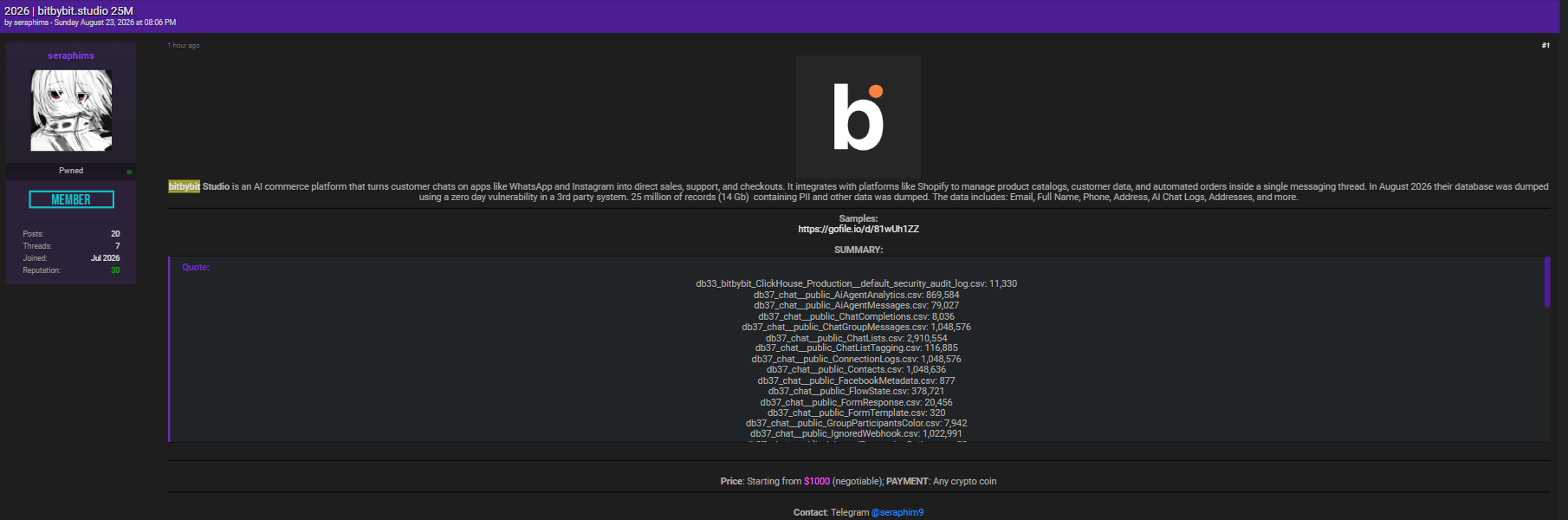
The alleged compromise targets cloud-hosted conversational commerce services, specifically affecting production database clusters and webhooks exposed to third-party messaging integrations. While specific affected software versions have not been officially disclosed through vendor advisories, the threat actor claims the exfiltrated repository spans operational systems active through August 2026.
Organizations operating conversational commerce platforms face heightened exposure under specific architectural conditions:
Unsegmented Database Architecture: Backend PostgreSQL or NoSQL repositories storing message logs directly accessible from public-facing API gateways or microservices.
Insecure Webhook Handlers: Publicly reachable webhook listener endpoints that process incoming Meta Graph API or WhatsApp Business payloads without strict cryptographic signature validation or rate limiting.
Excessive Data Retention: Storing unredacted conversational histories, shipping addresses, customer contact details, and administrative logs in operational data stores indefinitely.
Broad Service Account Privileges: Application service roles possessing blanket read permissions across both transactional message streams and internal security audit logs.
Technical Root Cause and Flaw Mechanics
While the threat actor claims that an unassigned zero-day flaw facilitated entry, typical technical root cause vectors for such platform compromises involve unauthenticated remote code execution (RCE), server-side request forgery (SSRF), or insecure direct object references (IDOR) on ingestion endpoints. Modern conversational commerce stacks aggregate public webhooks from Meta, e-commerce platforms like Shopify, and proprietary AI inference engines, presenting an expansive attack surface.
Attack Chain Mechanics
Security analysis indicates a structured four-stage intrusion path:
Initial Access: The adversary probes public-facing cloud endpoints, exploiting a zero-day flaw in API routing logic or webhook ingestion parsers to bypass gateway perimeter controls.
Privilege Abuse and Data Access: Leveraging compromised service credentials or SQL injection paths, the actor accesses core database clusters hosting customer relationship management tables, conversational transcripts, and security audit logs.
Bulk Query and Staging: Executing unindexed table dumps, the attacker stages approximately 14 GB of structured data into localized archives.
Exfiltration and Monetization: The archive containing 25 million records is transferred to external infrastructure and subsequently listed for sale on cybercrime marketplaces.
Continuous validation of exposed web services and API endpoints via Attack Surface Management is critical to discovering unmonitored routes before threat actors exploit them.