Data Breachhigh
Analysis of Reported Russian Ministry Data Breach
A reported breach targeting the Russian Ministry of Internal Affairs serves as a reminder of the persistent risk posed by data exfiltration and credential exposure.
A reported breach targeting the Russian Ministry of Internal Affairs serves as a reminder of the persistent risk posed by data exfiltration and credential exposure.
Recent threat intelligence reports have highlighted a security incident involving the Ministry of Internal Affairs of the Russian Federation. While the details of the exfiltration are still being evaluated, the claim involves the exposure of sensitive databases linked to the organization's digital infrastructure. For enterprise security leaders, this incident underscores the critical necessity of maintaining robust Attack Surface Management to identify and remediate potential entry points before they are weaponized by threat actors.
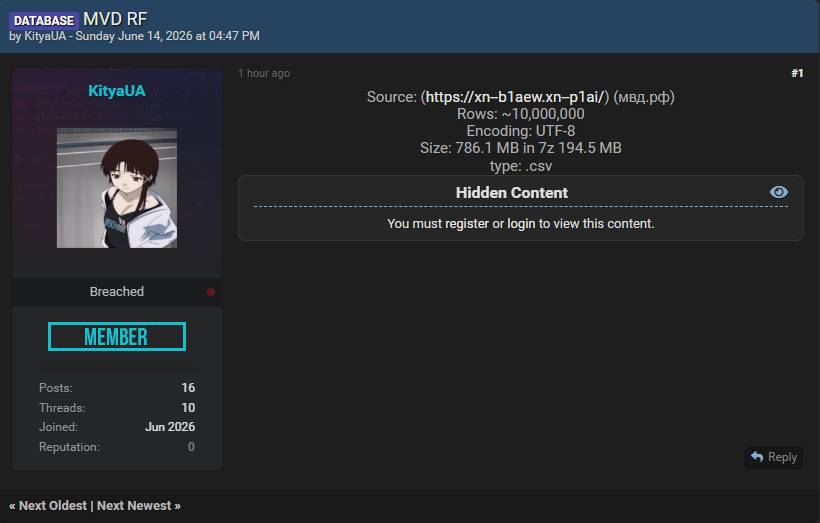
When high-profile government institutions suffer potential data compromises, the impact often ripples through the broader digital ecosystem. Unauthorized access to internal systems frequently begins with compromised credentials, misconfigured public-facing assets, or unpatched vulnerabilities. In an era where data is the most valuable commodity for adversaries, protecting your organization's perimeter is not just about perimeter defense, it is about visibility. Without continuous monitoring, hidden assets or leaked credentials can provide attackers with an unchecked pathway to critical systems.
Proactive security requires a transition from reactive patching to a continuous validation model. Organizations must assess their risk exposure regularly to ensure that secrets, API keys, and sensitive user data are not circulating in underground forums. If the domain already looks exposed, use Dark Web Scanner before requesting a full report. Our approach at FemtoSec combines deep offensive security research with compliance-first governance, ensuring that GCC-based enterprises are shielded from the types of lateral movement and exfiltration tactics often seen in these large-scale incidents.
Free exposure check
Dark Web Scanner
check dark web mentions, compromised account indicators, malware log signals, public breach exposure, and recent underground market activity for your domain.
Modern adversaries utilize automated scanners to identify low-hanging fruit. If your organization relies on legacy perimeter defenses, it is likely already under constant, automated reconnaissance. By engaging in regular Penetration Testing, your security team can validate existing controls against real-world attack scenarios, effectively closing the gap between known vulnerabilities and actual exploitability. This proactive stance is essential for maintaining trust and ensuring compliance with regional standards in the GCC.
In the aftermath of such events, the focus for internal security teams should remain on rigorous log review, rapid access rotation for privileged accounts, and a thorough assessment of external-facing cloud assets. Resilience is not static; it requires constant iteration and the ability to detect signals of compromise long before an incident is reported publicly.
If your team may be exposed to a similar threat, FemtoSec can help validate blast radius, prioritize remediation, and connect the issue to a practical security program.
September 20, 2026
A threat actor claims to have leaked more than 100,000 records from a public water management entity, exposing Peruvian national identity document numbers, citizen names, emails, and internal complaint registries.
October 16, 2026
A dark web forum breach exposing 200,000 citizen records has highlighted severe identity theft and social engineering risks across public administration databases. FemtoSec provides deep technical analysis of the exfiltration vectors, MITRE ATT&CK mapping, and actionable containment measures for security teams.

October 14, 2026
A threat actor claims to have published approximately 100,000 billing, payment, and customer records from a prominent Cambodian payment gateway on an underground forum, highlighting significant operational and fraud risks for integrated merchants and consumers.