In practice, an attacker can manipulate memory consumption by streaming a persistent HTTP request body that never declares its length, forcing the runtime to dynamically reallocate buffers until limits are exhausted. Alternatively, an attacker can supply tiny inputs that amplify into disproportionately large internal structures during engine processing. When the engine's memory limit trips at the wrong operational moment, PHP initiates its emergency exit bailout.
Once the memory ceiling trips at this critical juncture, PHP's emergency exit leaves internal request data in an invalid state. If CVE-2026-109618 is leveraged, the internal request shutdown procedure itself processes these invalid structures. If CVE-2026-109619 is triggered, the worker process remains alive, and the next request routed to that same worker consumes the surviving freed memory. In both paths, under the right conditions, the resulting memory corruption permits remote code execution within the security context of the web server worker process.
Proof of Concept and Validation
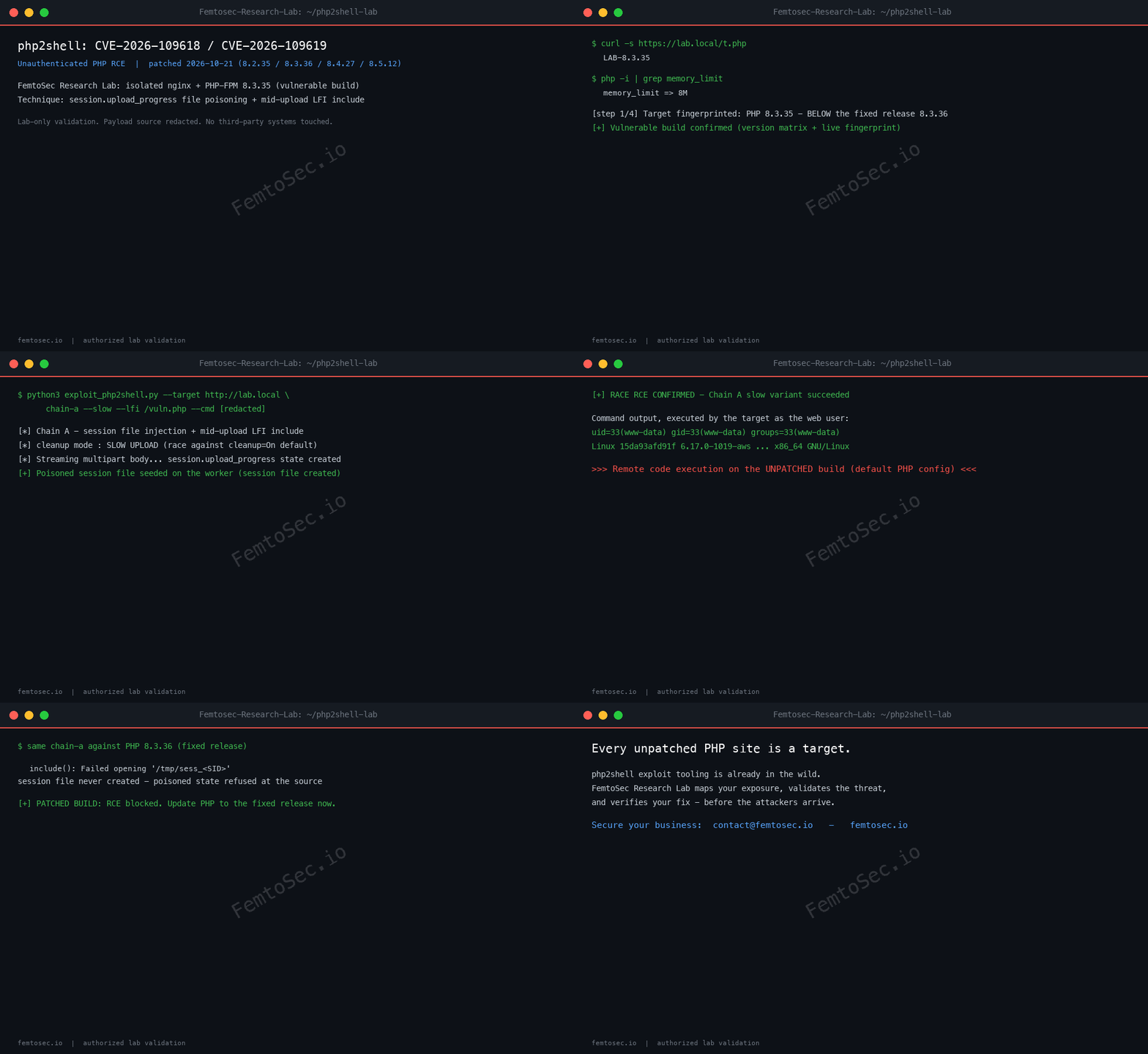
Following the public disclosure and exploit leakage, the Femto Security Vulnerability Research Team conducted controlled laboratory reproductions to validate the failure mechanics and confirm the efficacy of official vendor patches. Testing was performed within an isolated research environment against representative vulnerable builds and official patch targets.
Researchers evaluated four distinct documented trigger strategies against an unpatched PHP build. The laboratory tests confirmed that all four trigger strategies deterministically forced the target process into the expected out-of-memory state and reproduced the prerequisite memory-corruption condition in 4 out of 4 strategies. Subsequently, the full proof-of-concept exploitation chain was validated against the vulnerable build. When the identical attack sequences were transmitted against a patched instance running PHP 8.3.36, the runtime rejected the attack before the vulnerable state could persist.
To document operational efficiency during this rapid response, the Femto Security Vulnerability Research Team recorded the precise timeline of actions conducted on 21 October:
Chronological Response and Validation Timeline (21 October, UTC)
- 01
- Action
Pre-advisory exposure checker built and executed: the full PHP asset inventory across our monitored clients was already in place
- 02
- Action
Version classification delivered: end-of-life hosts flagged for urgent upgrade, supported-but-unpatched hosts flagged for same-day patching, undisclosed versions queued for direct client verification
- 03
- Action
Advisory published. Fixed versions extracted and the exposure list re-classified automatically
- 04
- Action
FemtoSec Lab reproduction: the documented trigger strategies replayed against an isolated vulnerable PHP instance: the memory-corruption precondition reproduced 4 out of 4 strategies
- 05
- Action
Full proof-of-concept chain validated in FemtoSec lab against the vulnerable build, with the patched build (8.3.36) rejecting the identical attack
In accordance with responsible research boundaries, the Femto Security Vulnerability Research Team is deliberately not publishing the exploitation payloads. The proofs shown in demonstration material are redacted to evidence-level markers, displaying execution markers and command output sufficient to demonstrate exposure without providing a how-to guide.
Security Impact and Preconditions
The security impact of CVE-2026-109618 and CVE-2026-109619 is exceptionally severe. Because exploitation requires zero authentication, zero user interaction, and only standard HTTP requests, internet-accessible services running vulnerable versions of PHP face direct process takeover. Successful exploitation grants an adversary arbitrary code execution within the privileges of the web daemon, opening an immediate path to host compromise, data exfiltration, and lateral movement.
The scope of affected software spans legacy code originating from PHP 6.9.0-6.9.4-era memory handling routines through all current active development branches. Official security updates resolving the vulnerabilities were delivered exclusively for supported releases: PHP 8.2.35, 8.3.36, 8.4.27, and 8.5.12. Critical risk considerations apply to legacy branches: PHP 7.4 and older releases receive no official patch path from the upstream vendor, leaving organizations reliant solely on manual source-level backports or complete distribution upgrades.
Client telemetry and inventory analysis executed during the incident revealed three key asset categories requiring operational triage across monitored estates:
Hosts running end-of-life PHP versions: Systems that will not receive an official patch from the upstream vendor. These require full upgrades and are treated as incidents, not tickets.
Hosts on supported versions below the fixed release: Systems running supported branches (8.2, 8.3, 8.4, or 8.5) that remain unpatched. These are resolved by applying today's point update.
Hosts that do not disclose their version externally: Systems concealing version banners from network probes. These were verified directly with clients and queued to be re-fingerprinted after patching.
Remediation
The primary and definitive remediation for CVE-2026-109618 and CVE-2026-109619 is immediate software upgrading. Organizations must inventory all web servers, appliances, and internal tools to locate running PHP instances, patch to the fixed release for their branch (PHP 8.2.35, 8.3.36, 8.4.27, or 8.5.12), and treat any host that cannot be patched as an incident until upgraded.
If production constraints prevent immediate patching, organizations should implement the interim operational mitigations outlined by the PHP project. Per the PHP project's own guidance, these reduce, but do not remove, exposure:
Enforce unrestricted server memory limits: Enforce memory_limit=-1 at the server level (via php_admin_value in FPM pools or Apache configuration) so applications cannot override it.
Constrain request payload parameters: Set a low post_max_size (8M; 32M if uploads are required), with upload_max_filesize below it.
Restrict exposure: Restrict exposure of PHP endpoints at the edge while you patch.
Research Scope
The research and exposure validation conducted by the Femto Security Vulnerability Research Team encompassed internet-wide deployment architectures and the complete PHP inventory across all monitored client estates. In-scope targets included external web servers, embedded appliances, and internal administrative tooling exposing PHP runtimes. Laboratory validation was conducted strictly against isolated vulnerable and patched PHP instances to safely confirm memory corruption mechanics. Additional reference intelligence regarding this disclosure is tracked via Femto Security Threat Intelligence.
Technical Takeaways
This event is the argument for continuous attack surface management (ASM) in one morning: you cannot respond to a disclosure within hours if you do not already know where your exposure is. The Femto Security platform had the PHP asset map, the version data, and the classification pipeline ready before the advisory existed; the disclosure only required running the classifier again.
If your organization runs PHP anywhere, on web servers, appliances, or internal tools, inventory it today, patch to the fixed release for your branch, and treat any host you cannot patch as an incident until upgraded. If you do not know where your PHP is running, that is the first conversation to have. The Femto Security Vulnerability Research Team will publish patch-verification results for all monitored clients as re-scans complete.