

Smart Contract Security Audit: 2026 Ultimate Guide for Web3 and VARA Firms
Continue Reading
October 9, 2026
LLM security testing explained: compare pentesting, red teaming, and automated scanning, and learn how to test agents, RAG apps, and AI-powered tools.

October 7, 2026
The NIST AI RMF explained: what Govern, Map, Measure and Manage require, the seven trustworthy AI traits, and how to put each function into practice.

September 30, 2026
AI supply chain security explained: how models, datasets, and agent tools get compromised, real attack case studies, and the controls that stop them.
Every year, billions of dollars evaporate from the blockchain ecosystem not because of market volatility, but because of preventable code vulnerabilities. In 2023 alone, over $1.8 billion was lost to smart contract exploits. In 2024, that number climbed further as DeFi adoption surged across the Middle East, Southeast Asia, and beyond. And yet, a significant portion of these losses could have been avoided with one proactive measure: a professional smart contract security audit.
If you are building, deploying, or operating any decentralized application (dApp), DeFi protocol, NFT platform, token contract, or blockchain-powered product your smart contract is your most vulnerable attack surface. Unlike traditional software, smart contracts are immutable once deployed. There is no "patch Tuesday." There is no rollback. A single unchecked vulnerability can drain your treasury, compromise your users, and destroy years of development work in minutes.
This guide is written for founders, CTOs, compliance officers, and blockchain developers who want to understand what a smart contract security audit really involves, why it is non-negotiable in today's regulatory and threat landscape especially under Dubai's VARA framework and how Femto Security smart contract auditing services provide the assurance your project needs before going live.
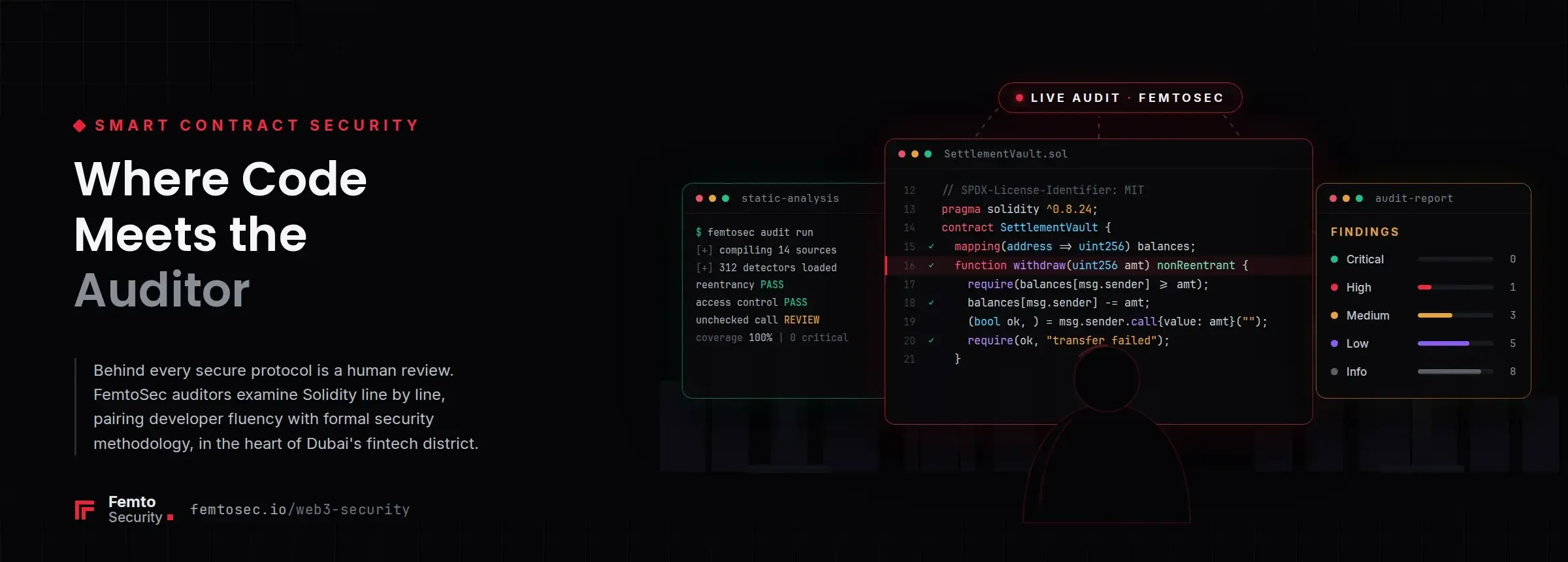
A smart contract security audit is a rigorous, structured technical examination of your blockchain code primarily written in Solidity for Ethereum-compatible chains designed to identify vulnerabilities, logic errors, design flaws, and inefficiencies before the contract is deployed on a live blockchain network.
Unlike a standard software code review, a smart contract audit operates under a uniquely unforgiving constraint: immutability. Once a smart contract is deployed, its code cannot be altered. Any bug embedded in that code is permanent. Any vulnerability becomes a permanent entry point for attackers unless an entirely new contract is deployed and liquidity migrated a costly, disruptive, and trust-destroying process.
This is why leading blockchain projects, regulated entities, and institutional investors treat smart contract auditing as an essential pre-deployment requirement, not an optional nice-to-have.
A professional smart contract security audit typically examines:
Reentrancy vulnerabilities — one of the most infamous attack vectors, responsible for the $60M DAO hack in 2016
Integer overflow and underflow — mathematical errors that allow attackers to manipulate balances
Access control flaws — functions that should be restricted but are publicly callable
Front-running and MEV (Miner Extractable Value) risks — transaction ordering exploits
Denial-of-Service (DoS) vulnerabilities — logic that can permanently lock contract functionality
Oracle manipulation — exploits targeting price feeds and external data sources
Logic errors — code that works technically but behaves incorrectly under specific conditions
Gas optimization issues — inefficiencies that drive up transaction costs
Upgrade mechanism risks — vulnerabilities in proxy patterns and governance logic
Let us be direct: a smart contract audit is not a cost center. It is insurance, reputation management, and regulatory compliance all in one.
Year | Total Lost to Smart Contract Exploits | Notable Incidents |
|---|---|---|
2021 | $1.3 Billion | Poly Network ($611M), Cream Finance ($130M) |
2022 | $3.8 Billion | Ronin Network ($625M), Wormhole ($320M) |
2023 | $1.8 Billion | Euler Finance ($197M), Mixin Network ($200M) |
2024 | $2.1 Billion | Multiple DeFi and bridge exploits |
2025 | $900M+ | Bybit-related ecosystem attacks, DEX exploits |
These are not abstract statistics. Behind every figure is a project that believed their code was secure until it wasn't.
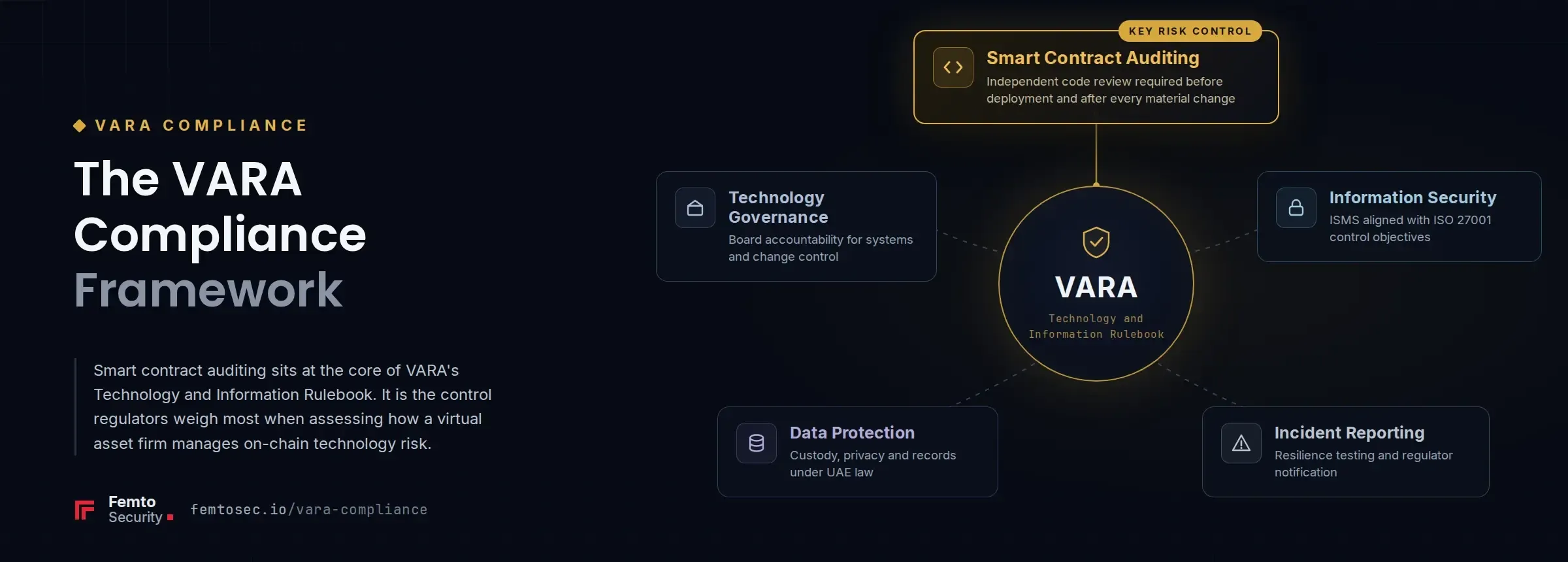
In the UAE, the Virtual Assets Regulatory Authority (VARA) has established one of the world's most comprehensive frameworks for virtual asset service providers (VASPs). Under VARA's Compulsory Standards, licensed entities must demonstrate robust technology risk management, including the integrity of smart contract infrastructure.
If your project operates under a VARA license or is seeking one a professionally conducted smart contract security audit is directly relevant to your compliance obligations. Our team at Femto Security has deep expertise in both blockchain security and VARA regulatory requirements. You can explore our dedicated VARA compliance services to understand how smart contract auditing integrates with your broader compliance posture.

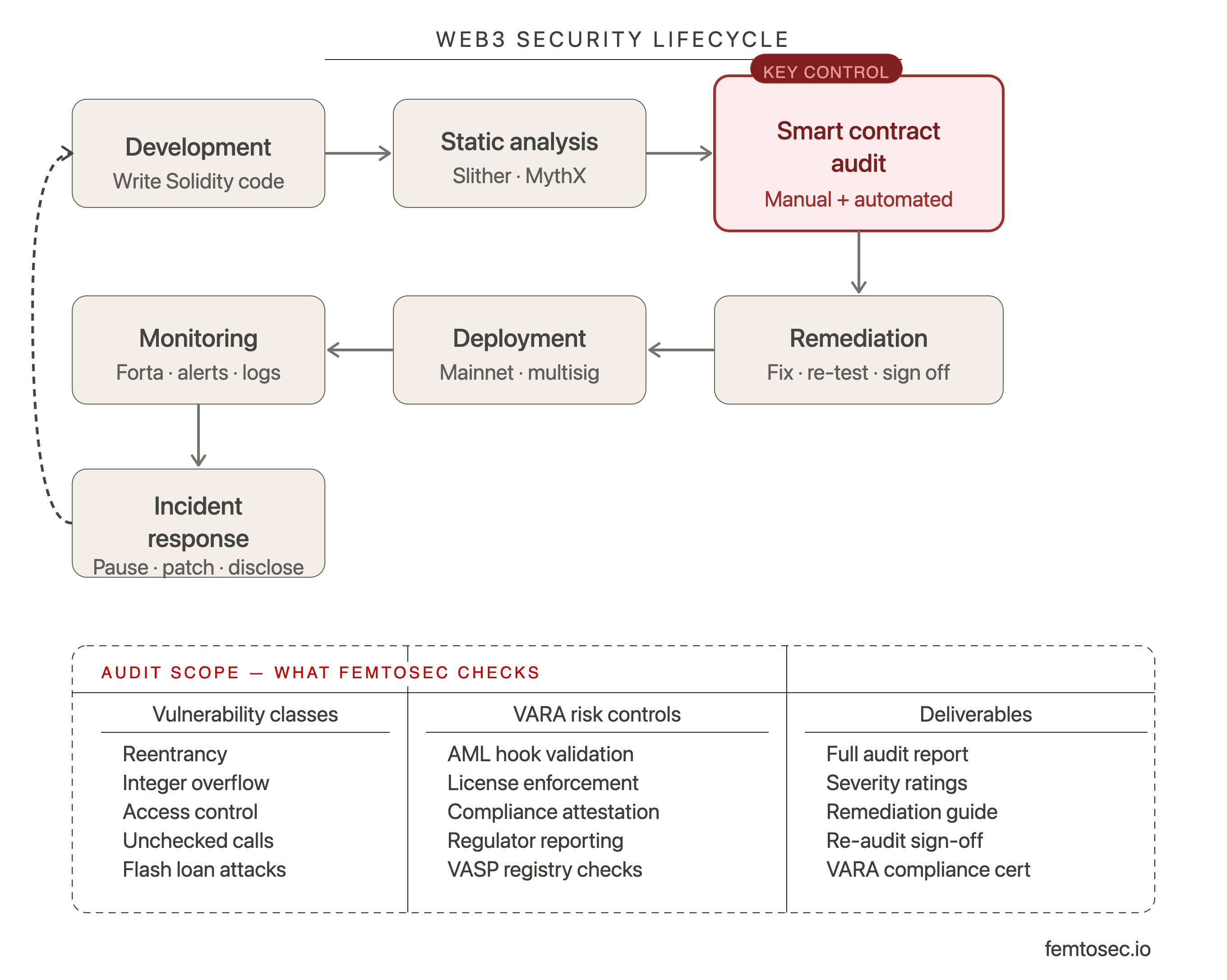
Understanding the audit process helps you prepare effectively and set realistic expectations. Here is how a professional smart contract auditing engagement typically unfolds at Femto Security.
Before any code is reviewed, the auditing team works with your development team to define:
Which contracts are in scope
The blockchain network(s) involved (Ethereum, Polygon, BNB Chain, etc.)
The business logic and intended functionality
Any known areas of concern
Timeline and delivery expectations
Architecture diagrams
Function-by-function specification
Unit test suite
Deployment scripts
Any prior audit reports
Once the audit begins, a code freeze is mandatory. No new features, refactors, or commits should be introduced during the audit window. Introducing changes mid-audit invalidates findings and can introduce new vulnerabilities that are then unreviewed. This is one of the most commonly overlooked preparation steps.
The auditing team deploys a battery of automated analysis tools to surface known vulnerability patterns rapidly. Tools commonly used in professional smart contract auditing services include:
Slither — static analysis framework by Trail of Bits
Mythril — symbolic execution engine
Echidna — property-based fuzzer
Manticore — dynamic binary analysis
Automated tools are fast and consistent, but they generate false positives and cannot understand business logic. This is why automated scanning is the starting point not the endpoint of a professional audit.
This is where the real value of expert smart contract audit consulting is delivered. Experienced auditors read the code the way an attacker would line by line, function by function, looking for:
Logic that is correct syntactically but wrong semantically
Interactions between contracts that create unexpected behavior
Edge cases in mathematical operations
Governance and upgrade mechanisms that could be abused
Business logic flaws invisible to automated tools
Manual review typically constitutes 60–70% of the total audit effort and is where the most critical, high-severity findings originate.
For significant findings, auditors write proof-of-concept (PoC) exploit scripts that demonstrate the vulnerability in a forked test environment. This serves two purposes: it validates that the vulnerability is genuinely exploitable, and it gives your development team a concrete reproduction case to work from when implementing fixes.
This is part of what distinguishes genuine smart contract auditing services from a superficial checklist review.
The audit team delivers a comprehensive written report including:
Executive Summary — accessible to non-technical stakeholders and investors
Detailed Findings — each vulnerability described with severity, impact, root cause, and remediation guidance
Risk Matrix — classifying findings by severity (Critical, High, Medium, Low, Informational)
Code Snippets — the specific lines of vulnerable code
Recommendations — concrete, actionable fixes
Your development team implements the recommended fixes. The auditing team then reviews the changes a process called fix verification or remediation review to confirm that each issue has been correctly resolved without introducing new vulnerabilities.
Once all critical and high-priority findings are resolved and verified, the audit team issues a final report—the document that carries the audit firm's attestation of the review. This is the report you share with investors, exchanges, regulators, and users.
The following table provides a technical reference for the most commonly discovered vulnerability classes in smart contract audits, along with their typical severity and real-world examples.
Vulnerability Class | Severity | Description | Real-World Example |
|---|---|---|---|
Reentrancy | Critical | External contract called before state update, enabling recursive fund withdrawal | The DAO Hack (2016) — $60M lost |
Integer Overflow/Underflow | Critical | Arithmetic wraps around due to type limits | BeautyChain (BEC) Token (2018) |
Access Control | High–Critical | Sensitive functions lack proper role/ownership checks | Parity Multisig Wallet (2017) |
Front-Running | High | Attacker exploits mempool visibility to extract value | Multiple DEX exploits |
Unchecked External Calls | High | Return values from external calls not verified | King of the Ether (2016) |
Oracle Manipulation | High–Critical | Price oracle data manipulated via flash loans | Mango Markets (2022) — $117M |
Denial of Service | Medium–High | Logic that can be permanently locked or bricked | GovernMental (2016) |
Flash Loan Attacks | Critical | Capital borrowed and returned in one transaction to manipulate contract state | Euler Finance (2023) — $197M |
Signature Replay | High | Valid signatures reused in unintended contexts | Multiple ERC20 bridge exploits |
Upgrade Logic Flaws | Critical | Proxy patterns with exploitable upgrade mechanisms | Multiple DAO governance attacks |
The UAE and Dubai specifically — has emerged as one of the world's leading jurisdictions for blockchain innovation and virtual asset regulation. VARA's licensing framework has attracted hundreds of Web3 companies, exchanges, DeFi protocols, and asset tokenisation platforms to the emirate.
But with this opportunity comes obligation. VARA's regulatory standards are among the most technically rigorous in the world. Regulated entities must demonstrate:
Robust cybersecurity governance
Technology risk management frameworks
Incident response capabilities
Vendor and third-party risk controls
For any VARA-licensed entity deploying smart contracts whether for asset issuance, token distribution, staking, or DeFi functionality smart contract auditing services in UAE are not merely a technical best practice. They are a component of your demonstrable compliance posture.
Our blog on VARA's regulatory compliance requirements for 2026 explores this in depth, and our dedicated VARA compliance guide provides the foundational framework context.
Femto Security's position as a specialist cybersecurity firm serving both the Web3 ecosystem and UAE-regulated enterprises makes us uniquely qualified to deliver smart contract auditing services in the UAE that are technically rigorous and regulatory context-aware. Our vCISO for VARA compliance service helps organizations embed smart contract security into their broader compliance program.
Femto Security is not a general-purpose IT firm that offers smart contract audits as an add-on. Our blockchain security practice is purpose-built, staffed by specialists who combine deep cryptographic knowledge, Solidity expertise, and real-world offensive security experience.
Here is what distinguishes our approach:
We do not review smart contracts in isolation. We examine them in the context of your entire attack surface including off-chain infrastructure, API integrations, admin panel security, and key management practices. This is reflected in our broader service portfolio, which includes attack surface management,penetration testing, and source code review.
Our team approaches your code the way an attacker would not to find what you did wrong, but to find what an adversary would exploit first. This mindset stems from our red teaming practice, which simulates real-world attackers as our core methodology.
Unlike pure Web3 audit shops, Femto Security understands the UAE's regulatory landscape. Our smart contract auditing engagements are documented to support regulatory submissions, investor due diligence, and VARA license applications. See ourcompliance services for more detail.
Smart contract security is one layer of your total security posture. Our clients benefit from a full suite of complementary services:vulnerability assessments,dark web monitoring,security awareness training, and AI agentic pentesting for AI-powered blockchain applications.
We serve both enterprise clients and government entities, which means our audit reports are written to meet the documentation standards of institutional stakeholders not just technical teams.
The quality and speed of your audit depends significantly on how well-prepared your codebase is when you engage an audit firm. Here is a practical checklist for preparing for smart contract auditing engagements, drawn from our experience.
All contracts are finalised — no planned features outstanding
Code freeze in place for the audit period
Code is written in the final target language and compiler version
All external dependencies (OpenZeppelin, Chainlink, etc.) are pinned to specific versions
No commented-out code blocks or developer debugging functions remain
Architecture overview document prepared
Function-level specification for all public/external functions
Description of intended user flows and business logic
Known risks or areas of concern flagged for the audit team
Deployment parameters documented (constructor arguments, admin addresses, etc.)
Unit tests covering all core functions
Integration tests for multi-contract interactions
Edge case tests for mathematical operations
Test coverage report generated (aim for 80%+ line coverage minimum)
Deployment scripts tested on a public testnet
Any prior audit reports shared with the new audit team
Any findings from internal reviews documented
Bug bounty program details shared if applicable
Euler Finance was one of the most technically sophisticated DeFi lending protocols on Ethereum. It had been audited but its donation function, introduced in a subsequent upgrade, had not been thoroughly re-audited. An attacker exploited a logic flaw in that function combined with a flash loan to drain $197M in a single transaction. The protocol never fully recovered.
Lesson: Every new contract deployment and every material code change requires re-audit.
While not a pure smart contract exploit, the Ronin hack exposed how smart contract access-control flaws specifically, insufficient validation of validator signatures can be combined with social engineering to enable the largest DeFi hack at the time.
Lesson: Access control logic must be reviewed not just for technical correctness but for the real-world threat model it operates within.
Cream Finance suffered multiple exploits in 2021, resulting in cumulative losses of over $130M. Each exploit leveraged flash loan manipulation of price oracles. Despite audits, the Oracle dependency risks were not adequately mitigated.
Lesson: An audit is not a one-time event. Ongoing smart contract audit consulting and periodic re-review are essential as your protocol evolves and the threat landscape matures.
Many organizations confuse smart contract auditing with adjacent security services. Here is a clear comparison to help you understand what each service delivers and how they complement each other.
Service | What It Examines | Output | When You Need It |
|---|---|---|---|
Smart Contract Security Audit | Solidity and blockchain smart contract code | Audit report with findings, risk ratings, and remediation recommendations | Before deployment and after major upgrades |
Source Code Review | Application-layer source code, including backend services and APIs | Detailed code review report | Before launch and periodically throughout the development lifecycle |
Penetration Testing | Live applications, APIs, and production environments | Penetration testing report with validated findings and exploitation evidence | After deployment and at least annually |
Red Teaming | Entire organization, including people, processes, and technology | Red team assessment report with attack paths and security gaps | Annually and before major business events or product launches |
Vulnerability Assessment | Infrastructure, cloud environments, networks, and systems | Vulnerability assessment report with prioritized risks | Quarterly or after significant infrastructure changes |
AI Agentic Pentesting | AI-powered applications, LLM integrations, autonomous agents, and AI workflows | Specialized AI security assessment and pentest report | For AI-augmented blockchain applications and AI-enabled platforms |
The blockchain threat landscape is evolving rapidly. Here are the key trends shaping smart contract security audit priorities in 2026.
Attackers are now using large language models to assist in the discovery of smart contract vulnerabilities, dramatically accelerating the pace at which new exploits are developed after a contract is deployed. This narrows the window between deployment and attack, making pre-deployment auditing more critical than ever.
As multi-chain deployments become the norm, bridge contracts which facilitate asset transfers between chains have become high-value attack targets. Bridge auditing requires specialised expertise beyond standard single-chain Solidity review.
The tokenisation of real-world assets from real estate to sukuk bonds is accelerating in the UAE under VARA's framework. These contracts entail regulatory obligations and financial risks, making comprehensive smart contract auditing services essential. Our blog on VARA's global standard for crypto governance explores how this is shaping the regulatory landscape.
On-chain governance mechanisms voting, proposal execution, timelock bypasses are increasingly targeted. Smart contract audit consulting in 2026 must encompass governance logic as a primary scope area.
Regulators globally including VARA are increasingly reviewing audit reports as part of licensing and compliance assessments. The quality, methodology, and scope of your audit report now carries regulatory weight, not just technical value.
The blockchain ecosystem has matured beyond the era of "move fast and break things." Today, deploying an unaudited smart contract is not bold it is negligent. The financial stakes are too high, the threat actors too sophisticated, and the regulatory expectations too clear.
A professional smart contract security audit is the foundational step that separates serious blockchain projects from vulnerable ones. It is the signal to your users, investors, and regulators that you have taken the irreversibility of blockchain code seriously and that you have done the work to ensure your contract behaves exactly as intended, under every condition an attacker might engineer.
For Web3 businesses operating in or looking to enter the UAE market under VARA's framework, smart contract auditing is not just good practice; it is essential. It is part of the compliance architecture that underpins your license, your reputation, and your users' trust.
Femto Security brings together the technical depth of a specialist blockchain security firm and the regulatory context of a UAE-focused cybersecurity consultancy. Oursmart contract auditing services are designed to deliver the rigor your code demands and the documentation your compliance program requires.
Ready to secure your smart contract before deployment? Contact Femto Security for a scoped audit proposal.
The timeline depends on the size and complexity of the codebase. A simple token contract may take 3–5 business days. A complex DeFi protocol with multiple interacting contracts, governance mechanisms, and upgrade logic can take 3–6 weeks to develop. At Femto Security, we provide timeline estimates during the scoping phase.
Costs vary based on lines of code, complexity, number of contracts, and urgency. Industry pricing for professional smart contract auditing services ranges from $5,000 for simple contracts to $100,000+ for complex protocols. Contact Femto Security for a scoped proposal tailored to your project.
No, If your contract uses an upgradeable proxy pattern, each new implementation must be separately audited. Even for non-upgradeable contracts, if you deploy new supporting contracts or change external integrations, those changes require independent review.
Our smart contract auditing practice covers Ethereum and all EVM-compatible networks including Polygon, BNB Chain, Avalanche, Arbitrum, Optimism, and Base. We also support non-EVM audits on a case-by-case basis.
VARA does not prescribe a specific list of mandatory audits by name, but its technology risk management standards require demonstrable assurance over the integrity of smart contract infrastructure. For any VARA-regulated entity deploying smart contracts, a professional audit is effectively required. Our vCISO for VARA compliance service can guide you through this requirement.
Automated tools are fast and effective at identifying known vulnerability patterns. Manual review by expert auditors is essential for understanding business logic, identifying complex logic flaws, and discovering novel attack vectors that automated tools cannot detect. Professional smart contract audit consulting always combines both methodologies.
Bug bounties are valuable as a complementary measure but are not a substitute for a formal audit. A bug bounty is reactive it depends on external researchers finding and reporting issues after deployment. An audit is proactive it catches vulnerabilities before users are exposed and before funds are at risk.