
What Is ISO 42001? The Complete AI Management System Guide
ISO/IEC 42001:2023 is an international standard for an artificial intelligence management system (AIMS). It sets requirements for how an organization governs, builds, and uses AI responsibly, covering risk, accountability, transparency, and human oversight. Organizations can be independently audited and certified against it.
The need is real. IBM's 2025 Cost of a Data Breach Report found that 63% of breached organizations either had no AI governance policy or were still developing one. ISO 42001 gives that gap a structure: defined owners, documented risk assessments, and evidence an auditor can check.
This guide is for compliance leads, CISOs, and founders at companies that build AI, buy it, or embed it in their products. That includes fintech, crypto and Web3, SaaS, and government-linked organizations across the GCC and beyond, where customers and regulators increasingly ask for proof of AI governance. You will learn what the standard requires, how its Annex A controls work, how certification runs, how it compares with ISO 27001 and the EU AI Act, and what implementation involves in practice.
What Is ISO 42001?
ISO/IEC 42001:2023 is an international standard that sets requirements for establishing, implementing, maintaining, and continually improving an artificial intelligence management system inside an organization. In practice, it is a governance framework for AI that a company can build, operate, and have an independent body audit.
ISO/IEC 42001:2023 in plain English
The standard does not tell you how to build a better model. It tells you how to run AI responsibly as an organization: who is accountable for each AI system, how risks and impacts get assessed, how data is handled, and how problems are caught and corrected over time. A company that meets it can show customers, regulators, and partners that its AI work follows a documented, repeatable process.
Scope is deliberately broad. The standard applies to any organization, regardless of size, type, or nature, that provides or uses products or services built on AI systems. A bank training its own credit models and a retailer using a third-party chatbot both fall inside it.
What AI management system actually means
An AI management system is the set of policies, roles, processes, and records an organization uses to direct and control its AI activities. Think of it as the operating structure around AI, not software you install. It typically covers an AI policy, an inventory of AI systems in use, a risk and impact assessment process, supplier oversight, monitoring, internal audits, and management review.
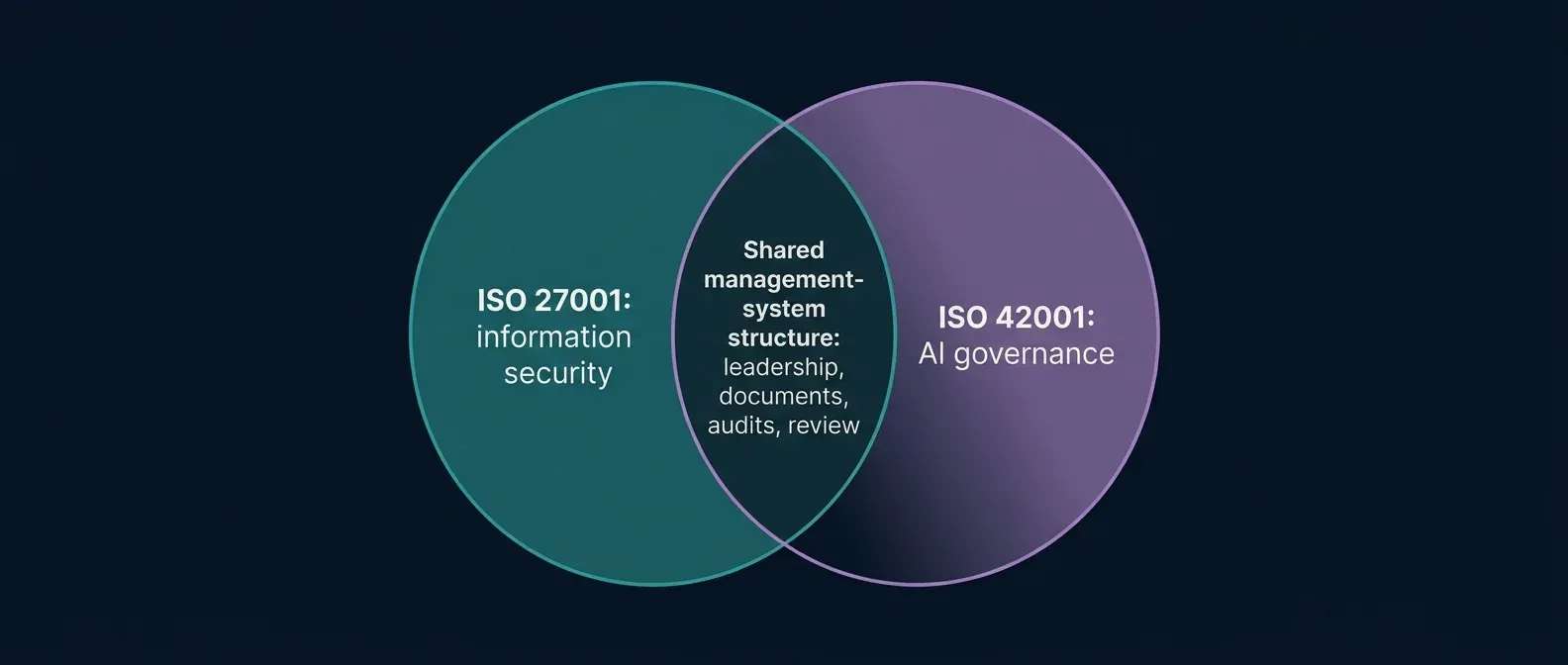
This is what makes 42001 a management system standard. It follows the same continual-improvement logic as ISO standards for quality and information security, which is why organisations already running ISO 27001 find the structure familiar.
Who published it and when
ISO/IEC 42001:2023 was published on 18 December 2023 by ISO/IEC JTC 1/SC 42, the joint ISO and IEC subcommittee on artificial intelligence. ISO describes it as the world's first AI management system standard. The current version is Edition 1. Because the standard is recent, supporting guidance and certification practice are still maturing, so check the ISO catalogue page for the latest status.
What it is not
ISO 42001 is not a technical AI safety test. Auditors assess whether your management system exists and works: your processes, evidence, and accountability. They do not probe a model for prompt injection, data leakage, bias, or adversarial weaknesses. A company can hold the certificate and still ship a vulnerable AI application, which is why AI agentic testing sits alongside the standard and does not replace it.
It is not a law. ISO standards are voluntary, and no regulator mandates 42001 on its own. Laws such as the EU AI Act carry legal obligations, and 42001 can support preparation for them, but certification alone does not prove legal compliance.
It is also not a benchmark for models. It does not score accuracy, fairness, or performance, and it does not certify a specific AI product. It certifies that an organization manages AI in a structured, accountable way.
Who Needs ISO 42001?
ISO 42001 is for any organization that develops, provides, or uses AI systems and needs to show customers, regulators, or partners that it governs them in a structured, auditable way. It is voluntary, so "needs" usually means a buyer, regulator, or partner is asking for proof, not that a law requires the certificate.
AI developers vs AI users vs AI providers in the supply chain
The standard applies to organizations that provide or use AI-built products and services, so it reaches every link in the chain. An AI developer, such as a company training its own fraud or credit-scoring model, carries the heaviest load: data quality, model lifecycle, testing, and impact assessment. An AI provider, such as a SaaS vendor that embeds AI features in a product sold to customers, must show those customers how it governs the AI. An AI user, such as a bank deploying a third-party chatbot, is still in scope because it remains accountable for how that system behaves and what data it touches.
In practice, pressure flows downstream. When a large buyer asks its vendors for evidence of AI governance, every supplier in the chain feels it, including those who only integrate someone else's model. The risks of this chain are covered in more depth in our guide to AI supply chain security.
Industries seeing demand first
Demand is strongest where AI decisions affect money, personal data, or public trust, and where buyers already ask for formal assurance. That points to fintech, crypto and Web3, government cybersecurity and public-sector bodies, healthcare, and SaaS vendors selling to regulated customers.
Fintech and crypto firms use AI for fraud detection, transaction monitoring, and customer onboarding, and they already operate under strict frameworks such as the VARA cybersecurity requirements. Healthcare and the government handle sensitive data where errors carry public consequences. SaaS vendors face procurement questionnaires from their enterprise customers.
This ranking reflects where scrutiny is highest. It is an editorial judgment, not a measured market ranking, so check it against current procurement trends in your own sector.
ISO 42001 in the GCC: where UAE and Saudi AI governance expectations fit
The strongest regional proof point comes from Saudi Arabia, where the Saudi Data and Artificial Intelligence Authority (SDAIA) was reported as the first organization in the world to achieve ISO/IEC 42001:2023 certification in 2024. A national AI regulator certifying itself signals that the standard is a credible reference point in the region.
Regional expectations still come mainly from national AI ethics principles and guidance, such as SDAIA's AI ethics and adoption frameworks and the UAE's AI ethics principles, plus data protection law such as the UAE and Saudi PDPLs. As far as we could verify, none of these mandates ISO 42001. The standard complements them by giving organisations a certifiable way to show they operate those principles in practice. For the wider picture, see our overview of cybersecurity regulations in the UAE and the related theme of AI sovereignty. Regional AI rules are still evolving, so confirm the current position with official government sources.
When you probably don't need it yet
You probably don't need ISO 42001 certification if your AI use is limited to staff using off-the-shelf tools for low-risk tasks, if no customer, regulator, or investor has asked for AI governance evidence, or if your AI activity is still experimental. Certification takes real time and ongoing effort, and the audit cost buys little without a buyer or risk driver behind it.
That does not mean ignoring governance. A lighter first step is an AI usage policy, an inventory of the AI tools in use, and a named owner for AI risk. Those foundations are the same ones an ISO 42001 program builds on, so the work carries over if demand arrives later.
How ISO 42001 Is Structured
ISO 42001 has two main parts: clauses 4 to 10, which define the AI management system and are what auditors assess, and Annex A, a reference set of 38 AI-specific controls you select from. Three informative annexes (B, C, and D) add implementation guidance, risk and objective examples, and sector-use advice.
Clauses 4–10
Clauses 4 to 10 are the mandatory, certifiable core. Clauses 1 to 3 cover scope, normative references, and terminology, and they carry no auditable requirements of their own. The remaining clauses follow the high-level structure shared with ISO 27001, ISO 9001, and ISO 14001, so the headings will look familiar to anyone who has run another ISO program.
Clause 4, Context: define your AI role, interested parties, and the scope of the AIMS.
Clause 5, Leadership: top management owns the AI policy and assigns accountability.
Clause 6, Planning: assess AI risks and impacts, set objectives, and decide which controls apply.
Clause 7, Support: resources, competence, awareness, communication, and documented information.
Clause 8, Operation: run the processes, including risk treatment and impact assessment, in live AI work.
Clause 9, Performance evaluation: monitoring, internal audit, and management review.
Clause 10, Improvement: corrective action and continual improvement.
The generic structure is shared, but the content is AI-specific. Clauses 6 and 8, plus Annex A, are where the AI-specific substance sits.
Annex A controls, explained with examples
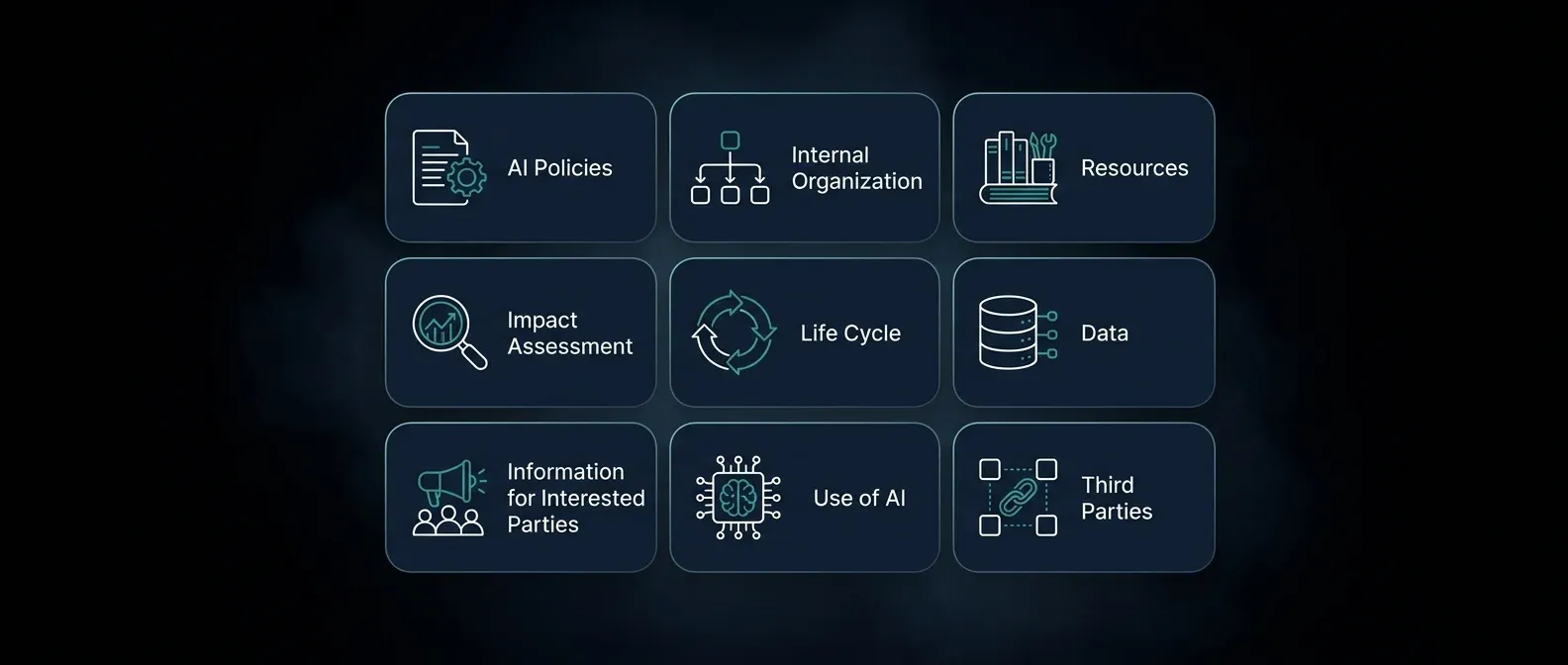
Annex A lists 38 reference controls grouped under nine control objectives, numbered A.2 to A.10. The objectives cover AI policies, internal organization, resources, impact assessment, the AI system life cycle, data, information for interested parties, use of AI systems, and third-party and customer relationships.
Annex A is not a checklist you must complete in full. You decide which controls apply through a Statement of Applicability, and you must justify any you exclude. Your risk assessment drives the selection under clause 6, and you can add controls Annex A does not list.
A concrete example: a fintech running a fraud-detection model would likely select controls on data quality and provenance, life-cycle testing, and human oversight. It might exclude controls that apply only to organisations building public-facing generative AI, and record why. The next major section covers each control group in detail.
Annexes B–D: implementation guidance, objectives and risk sources, sector use
Annexes B to D are informative, so they guide your work but are not audited requirements. Annex B gives implementation guidance for the Annex A controls. Annex C lists potential AI-related organisational objectives and risk sources, which helps when setting objectives and identifying risks. Annex D explains how to apply the AIMS across different domains and sectors and how to combine it with other management systems, such as ISO 27001.
In practice, teams use Annex B most. It turns a one-line control into a description of what good looks like.
The Plan-Do-Check-Act logic behind it
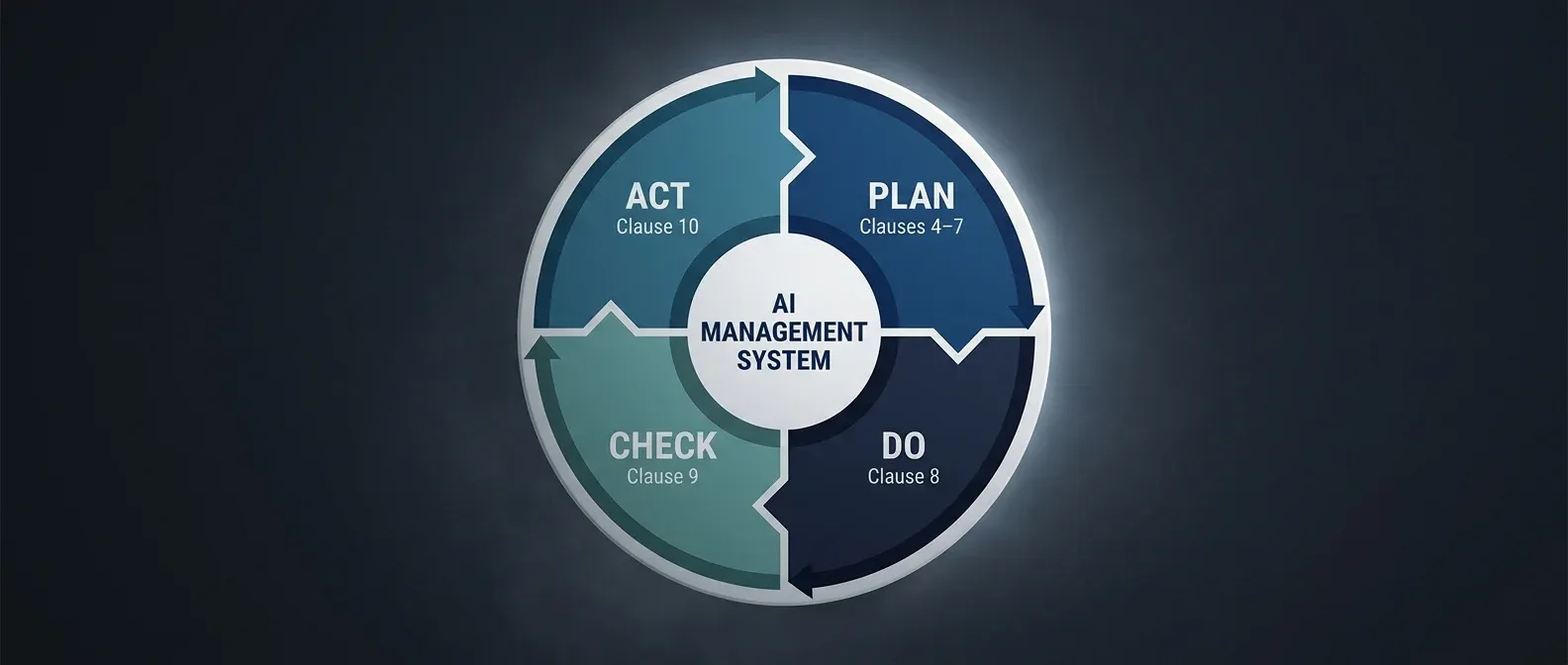
ISO 42001 follows the Plan-Do-Check-Act cycle that underpins ISO management systems. Plan covers clauses 4 to 7: understanding context, securing leadership commitment, assessing risks, and providing resources. Do is clause 8, where processes run in real AI work. Check is clause 9, where you measure, audit, and review. Act is clause 10, where you fix findings and improve.
The cycle matters because AI systems change after deployment through retraining, data drift, and new use cases. A one-time compliance project does not hold up, so the structure forces repeated review. Auditors look for evidence that the loop actually runs, not just that policies exist.
ISO 42001 Annex A Controls Explained
The ISO 42001 Annex A controls are 38 reference controls, grouped into nine objectives (A.2 to A.10), that tell you what to put in place to manage AI risk once you've completed your risk and impact assessments. You select the ones that apply, record your reasoning in a Statement of Applicability, and justify any you leave out. Lifecycle is the largest group, with 9 of the 38 controls, reflecting where most AI risk is created.
AI policies and governance
Objective A.2 requires a documented AI policy, set by leadership, aligned with your security, privacy, and procurement policies, and reviewed at planned intervals and after significant change. The policy is the anchor for everything else. It states what responsible AI means for your organization, and auditors use it to test whether your practice matches your stated intent. Keep it consistent with your information security policy, because a policy that contradicts your other rules is the most common weak point.
Roles, accountability, and internal organization
Objective A.3 requires defined AI roles and responsibilities, plus a way for people to report concerns about AI systems. Objective A.4 adds that you document the resources each AI system depends on, including data, tooling, computing, and people, and that the people responsible are competent. The test is simple: for any AI system, can you name who owns it, who approves changes, and where an employee raises a problem? If the answer is "the data science team, informally," the control is not met.
AI system lifecycle and impact assessment
Objective A.5 requires a repeatable process for assessing how an AI system affects individuals, groups, and society, and for documenting the results. Objective A.6 then covers the lifecycle: responsible-development objectives, requirements specification, documented design decisions, verification and validation before release, controlled deployment, monitoring in operation (including drift), technical documentation, and event logs.
These two objectives work as a pair. The impact assessment tells you what can go wrong and for whom, and the lifecycle controls are where you prevent and detect it. Verification is also where penetration testing fits, since a management system proves you test, while testing finds the actual weaknesses.
Data for AI systems (quality, provenance, preparation)
Objective A.7 governs the data behind the model. It covers defining what data is needed, how it is acquired (including rights and consent), its quality, its provenance, and how it is prepared through labeling, cleaning, and transformation. Provenance is the control teams underestimate. If you cannot show where training data came from and what you were permitted to do with it, you cannot defend the model's outputs or answer a regulator's question about personal data use.
Transparency and information for interested parties
Objective A.8 requires that users get the information they need to use an AI system appropriately, that external parties can report adverse effects, that AI incidents are communicated to those affected, and that interested parties can get what they need to assess the system. In plain terms, this is your duty to be clear about what the system does, where it falls short, and what happens when it fails. Incident communication is the part most organizations have not rehearsed, so connect it to your existing incident response process.
Responsible use of AI systems
Objective A.9 has three controls: define processes for responsible use, set objectives, and use each system only for its documented intended purpose. It matters most for AI you buy or deploy rather than build. A model approved for triaging support tickets quietly reused to assess customer eligibility is the kind of drift this objective is meant to catch.
Third-party and supplier relationships
Objective A.10 allocates responsibilities across the AI value chain and requires you to manage risks from suppliers and customers. If your product depends on a third-party model, API, or data feed, you remain accountable for what it does in your service. Supplier contracts and due diligence should cover model changes, data handling, and incident notification.
A worked example: a fraud-detection model at a UAE fintech
This is an illustrative scenario, not a real client case. A UAE payments company runs a model that scores card transactions and automatically blocks high-risk ones. It buys a device-intelligence feed from a vendor.
Policy and ownership (A.2, A.3): the AI policy names the head of risk as owner, and analysts have a channel to flag false-block patterns.
Impact (A.5): wrongly blocking legitimate transactions harms customers, and bias against certain merchant or customer groups is a documented risk.
Lifecycle (A.6): the team validates the model on held-out data before release, monitors drift monthly, and logs every blocking decision for traceability.
Data (A.7): the firm records the origin of its training data and checks it was lawfully obtained under UAE data protection rules.
Transparency (A.8): customers can contest a block, and incidents trigger defined notifications.
Use (A.9): the model is limited to fraud scoring, not credit decisions.
Supplier (A.10): the device-intelligence contract requires notice before the vendor changes its model.
The company might exclude controls aimed at public-facing generative AI and record that in its Statement of Applicability.
ISO 42001 Certification: How It Works
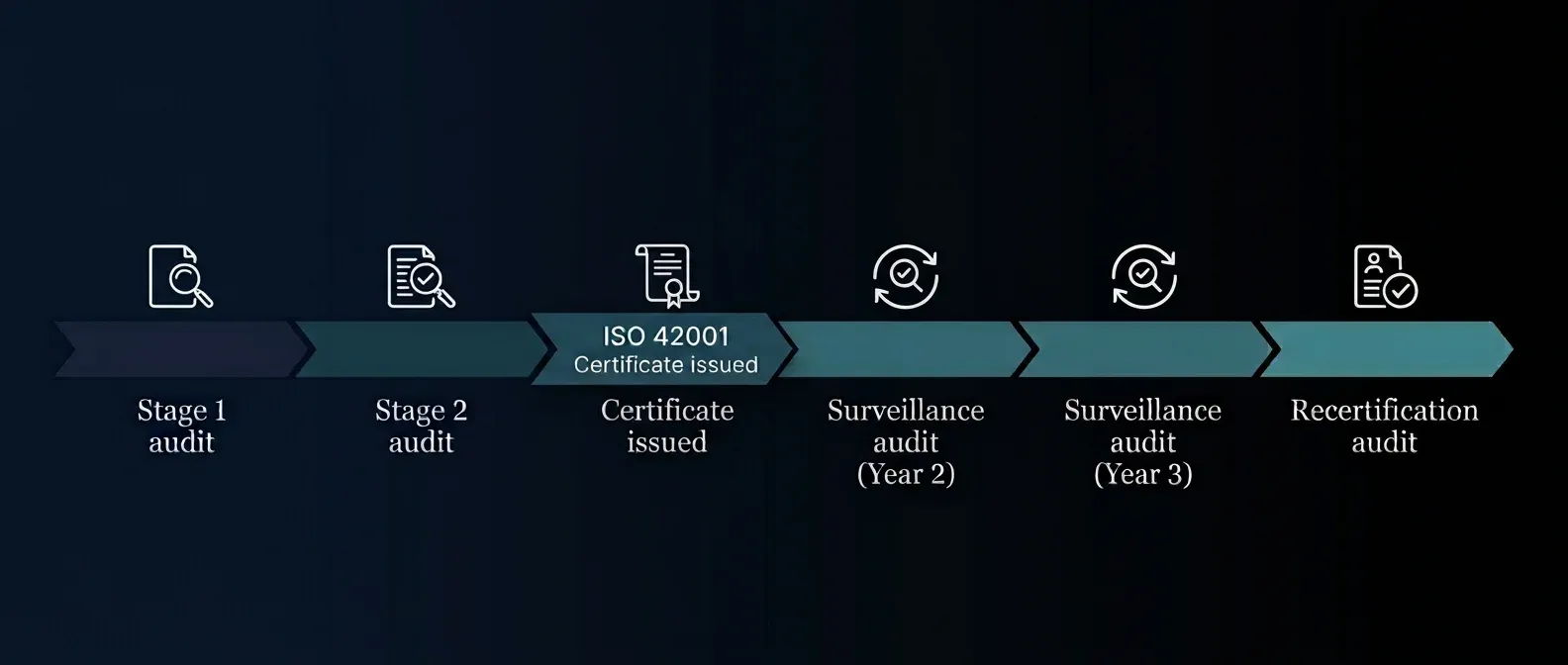
ISO 42001 certification is an independent audit of your AI management system, carried out by an accredited certification body in two stages, followed by annual surveillance audits. A successful audit produces a certificate valid for three years, after which a recertification audit renews it. What gets certified is your management system, not any individual AI product.
Who certifies (accredited certification bodies, not ISO itself)
ISO does not issue ISO 42001 certificates. Independent certification bodies do, and they should be accredited by a national accreditation body for this standard. Since July 2025, those bodies work to ISO/IEC 42006:2025, which adds AI-specific competence and impartiality requirements on top of the general rules for management-system certifiers (ISO/IEC 17021-1).
When shortlisting a body, confirm that its accreditation scope explicitly covers ISO/IEC 42001, not just ISO 27001. A certificate from a body with no accreditation for the standard may satisfy you but carry little weight with customers, regulators, or procurement teams.
Stage 1 and Stage 2 audits
Stage 1 is a readiness review. The auditor checks that your AI management system is documented and designed to meet the standard, including scope, the AI policy, risk and impact assessment methods, the Statement of Applicability, and evidence of internal audits and management reviews. The auditor fixes gaps found here before the next stage.
Stage 2 tests whether the system operates as intended. The auditor samples real records, interviews the people who run AI systems, and checks that your controls work in practice, not just on paper. Any nonconformities must be corrected, and a reviewer independent of the audit team makes the certification decision.
Surveillance audits and recertification cycle
The certificate lasts three years. Between issue and expiry, the body conducts surveillance audits, typically once a year, to confirm the system is still operating and improving. At the end of the cycle, a recertification audit reviews the whole system again, with credit given for its track record. This follows the same cadence as ISO 27001, so organisations already certified to that standard will recognise it. Your certification body sets the exact audit schedule, so confirm it in the contract.
Timeline and effort by organization size
No authoritative timeline exists, so treat any single figure with caution. Effort depends mainly on scope, the number and risk of AI systems in scope, and the maturity of your existing governance. Certification bodies set audit duration from factors like scope breadth, AI lifecycle activity, and number of locations.
Vendor guidance suggests Stage 1 often takes a few days and Stage 2 a bit longer for smaller organisations, and surveillance audits take a fraction of the initial audit effort. These are vendor-reported ranges, not ISO figures, so get quotes from accredited bodies for your own case. As a general pattern, a small company with one AI product and a narrow scope has a lighter path than a large enterprise with many systems across several teams. Organizations that already run ISO 27001 usually have less to build, since the clauses share a structure.
What auditors actually ask for
Auditors want evidence, not assurances. Expect requests for:
your scope statement and AI system inventory
the AI policy and proof leadership approved it
your risk and impact assessment method and completed assessments
the Statement of Applicability, with justification for every excluded control
internal audit records and management review minutes
operational evidence, such as lifecycle test results, monitoring records, event logs, supplier reviews, and incident handling
They will also interview staff to see whether the documented process matches what people actually do. The most common failure is polished documentation that describes controls nobody operates. A structured compliance consulting review before the audit helps catch those gaps early.
Certified vs aligned: what each does and doesn't prove
Certified means an accredited third party audited your AI management system and found it conforms to ISO/IEC 42001 within a defined scope. It proves your governance process exists and works. It does not prove that a specific model is accurate, fair, or secure, and it does not prove legal compliance under laws such as the EU AI Act. Saying "our AI is ISO 42001 certified" overstates it. The accurate claim is that your AI management system is certified.
Aligned means you have designed your practices around the standard without an external audit. That is a legitimate starting point and useful internally, but it is a self-assessment and carries no independent assurance. Make the difference clear in marketing and customer questionnaires. When you review a vendor's certificate, check the scope statement, the issuing body's accreditation, and the expiry date.
How to Implement ISO 42001: Step by Step
Implementing ISO 42001 means building an AI management system in a set order: define scope and inventory your AI, assess gaps, assess risks and impacts, document policies and roles, run the controls and keep evidence, then audit and review the system internally before the certification audit. The work is mostly governance and evidence, not new technology.
Define AIMS scope and build an AI system inventory
Start by deciding what the management system covers: which business units, products, locations, and AI systems are in scope. Then build an inventory of every AI system you develop, provide, or use inside that boundary, including third-party tools and models embedded in vendor software. For each entry, record the owner, purpose, data used, who is affected, and whether you built it or bought it. Exposed AI endpoints and forgotten tools often surface through attack surface management, which is a useful cross-check on your list.
The inventory drives every later step, so completeness matters more than polish. A scope that is too narrow is easy to audit but may not satisfy the customers asking for the certificate. A scope that is too broad becomes impossible to evidence. Pick the boundary that matches the business reason for certifying.
Gap assessment
A gap assessment compares what you do today against the clauses and the Annex A controls, then lists what is missing, informal, or undocumented. Most organizations find they already do some of the work, such as security reviews, vendor due diligence, and data protection checks, but without AI-specific ownership or records. The output should be a prioritized list of gaps with named owners. If you already run an ISO 27001 system, much of the management-system scaffolding (leadership, document control, internal audit) can be reused, and the gaps concentrate in the AI-specific parts.
AI risk and impact assessment
This is the step that decides the rest of your program. Define a method for assessing AI risks to the organization and a separate process for assessing impacts on individuals, groups, and society, then apply both to every in-scope system. A fraud model, a hiring screener, and an internal drafting assistant carry very different risks, and the assessment should show that. If you already run a GRC program, extend its risk method to cover impacts on others, not just on the organization.
The results determine which Annex A controls you apply, which ones you exclude, and why. Record those decisions in the Statement of Applicability. ISO/IEC 42005:2025 is the companion standard on AI impact assessment and is worth reading before you design your method.
Policies, roles, and documentation
Write the documents the standard requires and the ones your risk assessment demands: an AI policy approved by leadership, defined AI objectives, a risk methodology, lifecycle procedures, and clear role assignments for who owns each AI system, who approves changes, and where concerns are raised. Keep the documentation proportionate. Auditors prefer a short, accurate procedure that people follow over a long one nobody reads. Every document should trace back to a clause or control so you can show why it exists.
Operating the controls and collecting evidence
Documents do not earn certification. Operation does. Run the selected controls in live work: test models before release, monitor them in production, keep event logs, review suppliers, handle incidents, and record impact assessments as systems change. Capture evidence as a by-product of normal work, such as validation reports, monitoring dashboards, review sign-offs, and training records, so you are not reconstructing proof weeks before the audit. Give the system enough time to run, because auditors will look for a track record, not a single snapshot.
Internal audit and management review
Before the external audit, an internal audit tests whether the system conforms to the standard and to your own procedures, and management review gives leadership a structured look at performance, risks, and resource needs. Use someone independent of the work being audited, such as a different team or an outside specialist. Fix the findings, record the corrective actions, and keep the minutes. Certification bodies commonly expect both to have happened before Stage 1, so schedule them early enough to leave time for fixes.
Common implementation mistakes
The first is ignoring shadow AI. Employees adopt AI tools without approval, and those tools sit outside your inventory and controls. IBM's 2025 Cost of a Data Breach Report found that one in five organizations reported a breach linked to shadow AI, and only 37% had policies to manage AI or detect shadow AI. If your inventory only lists sanctioned systems, it is incomplete. Clear rules and regular security awareness training help staff understand which AI tools are approved and why.
The second is scoping too narrowly to make certification easy, then discovering the certificate doesn't cover the AI customers care about. The third is paper-only compliance: thorough documents describing controls nobody operates, which auditors find quickly through interviews and sampling. The fourth is treating implementation as a one-off project. AI systems change through retraining, new data, and new uses, so the assessments and controls need regular review to stay true.
ISO 42001 vs ISO 27001
ISO 27001 manages information security risk, while ISO 42001 manages the risks of developing and using AI, including its effects on people and society. They are separate certifiable standards built on the same management-system structure, so organizations often run them together. ISO 27001:2022 has 93 Annex A controls in four themes, while ISO 42001 has 38 in nine objectives, and the two do not substitute for each other.
Dimension | ISO/IEC 27001 | ISO/IEC 42001 |
|---|---|---|
Purpose | Protect the confidentiality, integrity, and availability of information | Govern the responsible development, provision, and use of AI |
Scope | An information security management system (ISMS) covering information assets | An AI management system (AIMS) covering AI systems you build, provide, or use |
Controls | 93 controls in four themes: organizational, people, physical, and technological | 38 controls in nine objectives (A.2 to A.10), including impact assessment, lifecycle, and data |
Risk focus | Risks to the organization's information | Risks to the organization and impacts on individuals, groups, and society |
Certification | Accredited certification body, three-year cycle with surveillance audits | Accredited certification body, same cycle, audited under ISO/IEC 42006 |
Overlap | Shared clauses 4–10 structure, document control, internal audit, and management review | Same clause structure, with AI-specific content layered on top |
The main difference is the direction of the risk. ISO 27001 asks what could harm your information. ISO 42001 also asks what your AI could do to the people it affects, such as wrongly declining a transaction, producing a biased hiring screen, or making an opaque decision nobody can explain. A system can be well secured and still fail the second question. For a wider comparison of frameworks, see ISO 27001 vs SOC 2 vs PCI DSS.
Can you integrate both into one management system?
Yes. Both standards follow the same high-level structure, so one management system can serve both. ISO 42001 itself includes guidance in Annex D on using the AI management system alongside other management systems. In practice, you keep one set of core processes for leadership, document control, internal audit, management review, and corrective action, and add the AI-specific layer: the AI policy, system inventory, impact assessments, lifecycle controls, and the 42001 Statement of Applicability.
Integration works best when you resist merging everything. Keep separate scope statements and separate Statements of Applicability, because each certificate is issued for its own scope, and auditors need to trace each standard's requirements clearly. Ask your certification body whether it offers combined audits, which can reduce duplicated effort, but confirm how it plans audit time for each standard.
What an ISO 27001-certified firm already has covered
An organization with a working ISMS has most of the scaffolding in place: leadership commitment, a documented risk process, document control, competence and awareness records, supplier management, incident handling, access control, logging, internal audit, and management review. Security controls also protect AI assets directly, such as access to training data, model repositories, and APIs, which is where many AI incidents start. IBM's 2025 Cost of a Data Breach Report found that 97% of organizations that reported an AI-related breach lacked proper AI access controls. Firms preparing for either standard can start with ISO 27001 compliance support.
What the ISMS does not cover is the AI-specific substance. Expect new work on AI impact assessment, lifecycle requirements and verification, data provenance and quality, transparency to users and affected parties, responsible-use rules, and objectives for AI itself. The risk method also needs extending, because a 27001 risk assessment centers on harm to the organization, while 42001 requires you to assess harm to others. A 27001 certificate is a strong starting point, not evidence of 42001 conformity.
ISO 42001 vs EU AI Act, NIST AI RMF, and Regional Frameworks
ISO 42001 is a voluntary, certifiable management-system standard, the EU AI Act is binding law, and the NIST AI RMF is voluntary guidance that cannot be certified. They complement each other: ISO 42001 can organize the governance work that laws and frameworks expect, but it does not replace legal compliance.
Framework | Type | Certifiable? | Geographic reach |
|---|---|---|---|
ISO/IEC 42001:2023 | Voluntary international standard | Yes, by accredited certification bodies | Global |
EU AI Act (Regulation (EU) 2024/1689) | Binding law | No. High-risk systems follow the Act's conformity assessment procedures, not an ISO-style certificate | EU, plus providers and deployers whose AI is placed on or used in the EU market |
NIST AI Risk Management Framework | Voluntary guidance | No | US-origin, used globally |
UAE PDPL (Federal Decree-Law No. 45 of 2021) | Binding data protection law | No | UAE onshore; DIFC and ADGM run separate regimes |
Saudi SDAIA frameworks (AI ethics principles, AI Adoption Framework) | Government guidance | No | Saudi Arabia |
The type column is what matters most when you decide where to spend effort. Laws create obligations you must meet. Standards and frameworks give you a way to meet them, and only standards provide independent assurance.
Does ISO 42001 satisfy the EU AI Act?
No. ISO 42001 supports preparation for the EU AI Act, but it is not automatic proof of compliance. The Act is designed so that harmonised standards cited in the EU Official Journal give providers a presumption of conformity with the requirements they cover (Article 40). ISO 42001 predates the Act and is not one of those harmonised standards, so certification does not create a legal presumption of conformity or replace the Act's conformity assessment steps for high-risk systems.
The overlap is still real. Both require risk management, documentation, defined roles, and human oversight, so an organisation with a working AI management system has less to build from scratch. What the Act adds is legal specificity: obligations depend on your role (provider or deployer) and your system's risk tier, and some requirements, such as conformity assessment and registration for high-risk systems, have no equivalent in a management-system audit.
Timing has shifted.
The Digital Omnibus on AI, Regulation (EU) 2026/1744, entered into force on 27 July 2026 and moved the high-risk obligations for stand-alone Annex III systems to 2 December 2027, and for AI embedded in regulated products under Annex I to 2 August 2028. The reason cited was that the harmonised standards and supporting infrastructure were not ready. Because this area is changing, confirm dates against EUR-Lex and the European Commission before relying on them. Organizations that process EU personal data should also review GDPR requirements alongside the AI Act.
NIST AI RMF and ISO 42001
The NIST AI RMF is a voluntary framework from the US National Institute of Standards and Technology that organizes AI risk work around four functions: govern, map, measure, and manage. It tells you what good risk practice looks like but offers no certification. ISO 42001 offers the management-system wrapper and an audit path. Many organizations use the RMF's language to design their risk method and ISO 42001 to make the program auditable.
GCC and UAE considerations, including PDPL where AI processes personal data
The UAE has no single comprehensive federal AI law, so AI obligations mostly arise through data protection and sector rules. The federal PDPL applies wherever AI systems process personal data. It includes a right to object to decisions based solely on automated processing, including profiling, and a duty to conduct an impact assessment for high-risk processing with new technologies. Those provisions map closely to ISO 42001's impact assessment and human oversight controls. Our guide to the UAE data protection law covers the PDPL, DIFC, and ADGM regimes in more detail.
Free zones add detail. DIFC's Regulation 10 addresses personal data processed by autonomous and semi-autonomous systems, and has been in force since 1 September 2023. ADGM runs its own data protection regulations. A fintech licensed in DIFC therefore answers to DIFC rules, while an onshore firm answers to the PDPL and the UAE Data Office.
In Saudi Arabia, expectations come from SDAIA's AI ethics principles and its 2024 AI Adoption Framework, alongside the Saudi personal data protection law. SDAIA was reported in 2024 as the first organisation to achieve ISO 42001 certification, signalling regional support for the standard. As far as we can verify, none of these regimes mandates ISO 42001, but the standard provides a certifiable way to show you operate its principles. Regional AI rules are evolving, so check current official sources.
Benefits and Limitations of ISO 42001 Certification
ISO 42001 certification gives you independently verified proof that your organisation governs AI in a structured, auditable way, which helps build customer trust and support procurement. It does not test whether any individual AI system is secure, accurate, or fair, and it takes ongoing effort to maintain. Treat it as the governance layer in your AI assurance program, not the whole of it.
Real benefits
Procurement credibility. An ISO 42001 certificate from an accredited body answers a question that buyers increasingly ask in vendor questionnaires: how do you govern the AI you build or use? It gives procurement and risk teams a recognized reference point instead of a bespoke explanation, which can shorten security reviews and strengthen your position against vendors who can only offer self-attestation. The value depends on the buyer. A certificate matters most where customers already ask for management-system assurance, such as banks, regulated platforms, and public-sector bodies.
Structured governance. The standard forces decisions many organizations postpone: who owns each AI system, how risks and impacts are assessed, what data may be used, and when a system must be reviewed or retired. Without that structure, AI governance tends to live in a few engineers' heads. With it, accountability survives staff changes and product growth.
Audit-ready evidence. A working AI management system produces records as a by-product: impact assessments, validation results, monitoring logs, supplier reviews, and management review minutes. That evidence helps when a regulator, customer, or insurer asks how you control AI, and it also feeds other frameworks, since much of it overlaps with data protection and security assurance work.
Honest limitations
It doesn't test model security. Auditors assess whether your management system exists and operates. They do not attempt to break your models, exploit your prompts, or probe your APIs. A company can hold a valid certificate and still ship an application vulnerable to prompt injection or data leakage.
It costs time and money. The costs include certification body fees, internal staff time, possible tooling, and often outside advisory support, and they continue through annual surveillance audits and recertification. Costs vary widely with scope and maturity, so get quotes from accredited bodies, and don't rely on a single published figure. The less visible cost is attention: people must keep running the controls after the certificate is issued.
It needs ongoing effort. The certificate lasts three years but only if the system keeps operating. AI systems change through retraining, new data, and new use cases, so assessments and controls need regular review. Organisations that treat certification as a one-time project often struggle at the first surveillance audit.
Its scope can mislead. The certificate covers a defined management system, not every AI system you operate or your products' behaviour. Customers and your own marketing should describe it accurately.
Where AI security testing fits alongside it
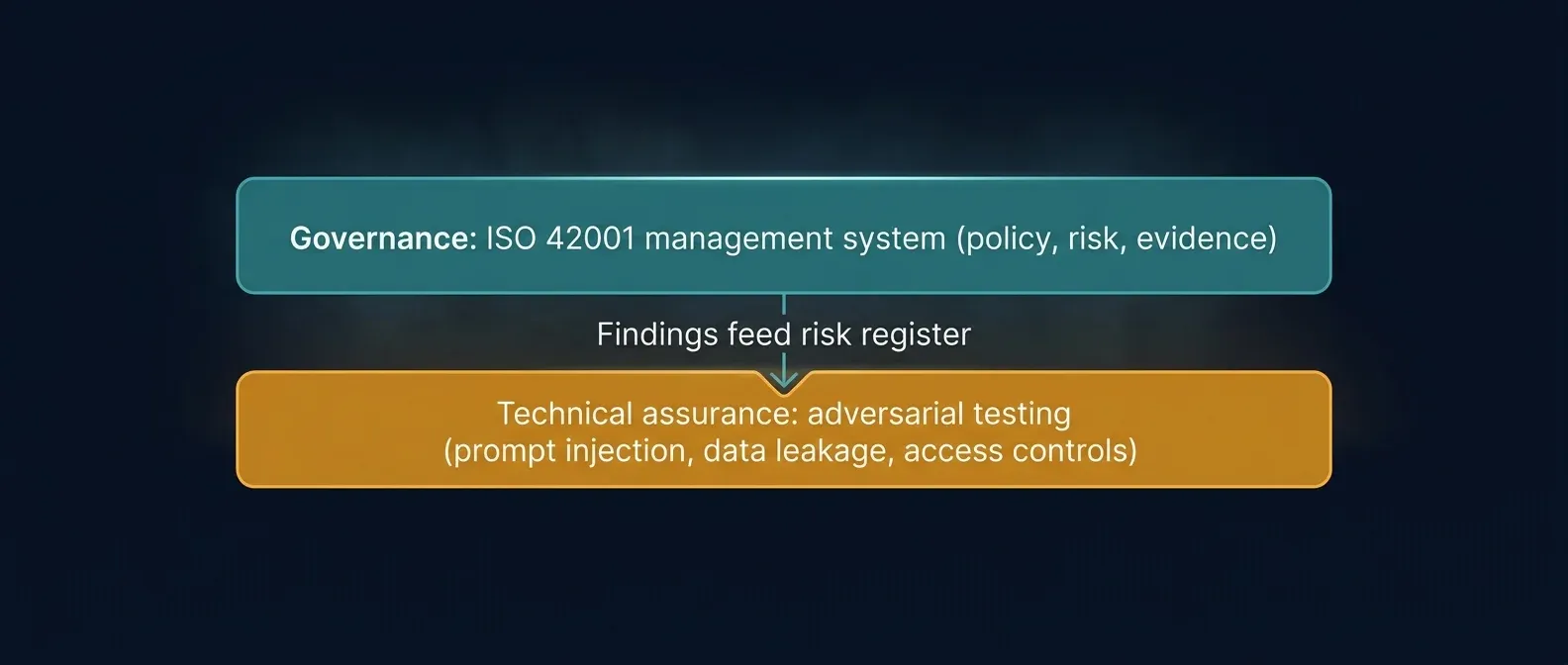
A management system tells you how you manage AI risk. Security testing tells you whether specific systems actually hold up against attack. You need both, and the standard's lifecycle controls create room for testing: verification and validation before release, and monitoring afterward.
The risk is not theoretical. IBM's 2025 Cost of a Data Breach Report found that 13% of organizations reported breaches of their AI models or applications. For LLM-based applications, the OWASP Top 10 for LLM Applications (2025 edition) is a practical baseline for testing scope, with prompt injection ranked first. Typical adversarial testing for AI agents covers prompt injection and jailbreaks, sensitive data disclosure, insecure output handling, excessive agency in tool-using agents, supply-chain weaknesses in models and plug-ins, and the access controls around AI systems. Broader red teaming can show how an attacker might chain AI weaknesses with conventional ones, and our guide to securing sovereign AI infrastructure covers the hardening side for on-premises and private deployments.
In practice, run testing before major releases and after significant changes, and feed the findings into your risk register and corrective actions. That turns testing into audit evidence and gives the management system real data to work with.
ISO 42001 Readiness Checklist
You are ready to approach an ISO 42001 certification audit when you can show, with documents and records, which AI systems you run, who owns them, how you assess their risks, what your policy requires, how you vet suppliers, and what evidence proves it all works. The checklist below covers those six areas. It is a self-check, not an official test, and it does not replace a formal gap assessment.
A useful starting point is the inventory. IBM's 2025 Cost of a Data Breach Report found that among organizations with AI governance policies, only 34% regularly audited unsanctioned AI. If your list of AI systems is built from what teams volunteer, it is probably incomplete.
Inventory
The AIMS scope is documented, including the business units, products, and locations it covers.
The inventory lists every AI system you build, provide, or use, including third-party tools and AI features embedded in vendor software.
Each entry records the owner, purpose, data used, affected parties, and whether it was built or bought.
A method exists to find unapproved AI use, and the inventory is reviewed on a schedule.
Owners
A named person is accountable for each AI system.
Top management has assigned overall responsibility for the AI management system.
Roles for approving changes and retiring systems are defined.
Staff have a documented way to raise AI concerns.
Risk process
A written method exists to assess AI risks to the organisation.
A separate process assesses impacts on individuals, groups, and society.
Both have been applied to every in-scope system, and the results are documented.
The Statement of Applicability lists each Annex A control as applicable or not, with reasons for exclusions.
Policy
Leadership approves an AI policy that aligns with your security and privacy policies.
AI objectives are defined and measurable.
Procedures cover the AI lifecycle, including pre-release testing, monitoring, and incident handling.
Policies have a review date and version control.
Supplier review
Identify and assess suppliers of models, data, and AI services.
Contracts address responsibilities, change notification, data handling, and incident reporting.
Responsibilities across the AI value chain, including those owed to customers, are allocated in writing.
Evidence log
Validation and test results exist for each in-scope system.
Monitoring records and event logs are retained.
Impact assessments, supplier reviews, and training records are stored where an auditor can retrieve them.
An internal audit and a management review have been completed, with corrective actions recorded.
If most boxes are unchecked, start with a gap assessment before booking an audit. If the boxes are checked but the evidence is thin, give the system time to run, because auditors look for a track record. Items checked on paper but not practiced are the most common cause of audit findings.
Conclusion
Start with the question your customers and regulators are actually asking: can you show how your AI is governed? If the answer today is "informally," build the foundations first: an inventory of your AI systems, a named owner for each, and a documented risk and impact process. Those steps are useful whether or not you ever certify, and they are the same work an ISO 42001 audit will examine.
Pursue certification when a buyer, tender, or partner asks for independent proof, and choose an accredited body that covers the standard. Pair it with adversarial testing of your highest-risk AI systems, because a certificate shows that your management system works, not that your models resist attack.
A practical next step is a short gap assessment against the clauses and Annex A controls. It tells you what to fix, what to exclude, and whether certification is worth pursuing now. Our compliance services team can help you scope it.
Frequently Asked Questions (FAQs)
Is ISO 42001 mandatory?
No. ISO 42001 is a voluntary international standard, not a law, and the major AI regulations and frameworks covered in this guide do not require it. It becomes effectively mandatory only when a customer, partner, or tender asks for certification. Check the contracts and regulations that apply to you, since AI rules are still evolving.
How long does certification take?
There is no fixed timeline. Duration depends on your scope, the number and risk of AI systems, and how mature your governance already is. The external audit has two stages, but much of the time goes into preparation, such as inventory, risk assessment, and building evidence. A certification body can estimate audit effort after reviewing your scope.
How much does it cost?
Cost depends on scope, the number of AI systems, organization size, and existing maturity. Main components are certification body audit fees, internal staff time, any advisory or tooling support, and annual surveillance audits plus recertification. Get quotes from several accredited bodies, since published figures vary widely and rarely match your scope.
Is ISO 42001 certification valid worldwide?
Largely yes, when an accredited certification body issues it, because ISO 42001 is an international standard and accredited certificates are widely recognized. Acceptance is still the buyer's decision. Check that the certificate's scope covers the systems the buyer cares about, that the body is accredited for ISO 42001 specifically, and that the certificate has not expired.
How often is it audited?
Certification bodies typically run surveillance audits once a year to confirm the system still conforms. The certificate lasts three years, after which a recertification audit reviews the whole system again. Internal audits and management reviews also run on your schedule between external visits, so evidence must stay current throughout the cycle.
Can a company be certified if it only uses third-party AI tools?
Yes. The standard applies to any organization that provides or uses AI-based products or services, regardless of size or type, so buying AI does not exempt you. Your scope would focus on governance of use: inventory, responsible-use rules, impact assessment, and supplier management. You remain accountable for how third-party systems behave in your service.
Does ISO 42001 cover generative AI and LLMs?
Yes. The standard is technology-neutral, so it applies to generative AI and large language models like any other AI system, but it has no LLM-specific controls. Governance, impact assessment, and data controls apply. Threats such as prompt injection need separate security testing, for example against the OWASP Top 10 for LLM Applications.
Continue Reading
September 24, 2026
VARA Cybersecurity Requirements | What Every VASP Must Do
VARA cybersecurity requirements explained: CISO, annual pen testing, 72-hour incident reporting and key security. Rules vs guidance, and evidence to keep.
September 14, 2026
ISO 9001:2015 vs ISO 9001:2026: What Actually Changed
Discover key changes in ISO 9001:2026 vs ISO 9001:2015. Learn about clause updates, quality culture, ethics, climate change, and the transition timeline.
September 2, 2026
What Is GDPR? Meaning, Purpose, and Key Requirements
What is GDPR? A clear breakdown of its purpose, compliance requirements, key articles, and how it compares to UAE data protection law.