
ISO 27001 UAE: Top Security Advantage 2026 Competitive Edge
The UAE is no longer just a regional financial hub it is a global digital powerhouse. With Vision 2030 accelerating smart city initiatives, Dubai transforming into the world's most ambitious Web3 economy, and Abu Dhabi cementing itself as a data-driven governance model, the question for any serious business operating in this landscape is no longer whether to take information security seriously. It is how fast you can demonstrate that you already do.
ISO 27001 UAE certification has emerged as the gold standard answer to that question.
This internationally recognized framework formally known as ISO/IEC 27001:2022 provides organizations with a systematic, risk-based approach to protecting sensitive business information. But in 2026, it means something bigger than a compliance checkbox. It signals to regulators, enterprise clients, government entities, and investors that your organization has embedded security into its DNA.
This guide is written for decision-makers, CISOs, compliance officers, and operations leads who want to understand ISO 27001 not as a bureaucratic exercise, but as a strategic business enabler in one of the world's most digitally aggressive environments.
What Is ISO 27001 and Why Does It Matter in the UAE?
ISO 27001 is the international standard for an Information Security Management System (ISMS) a comprehensive framework that defines how an organization identifies, manages, and reduces risks to its information assets. The current version, ISO 27001:2022, introduced a modernized set of controls that reflect today's threat landscape, explicitly addressing cloud security, threat intelligence, data masking, and secure coding.
In the UAE, the relevance of information security certification has never been higher. Several converging forces make this the critical moment to act:
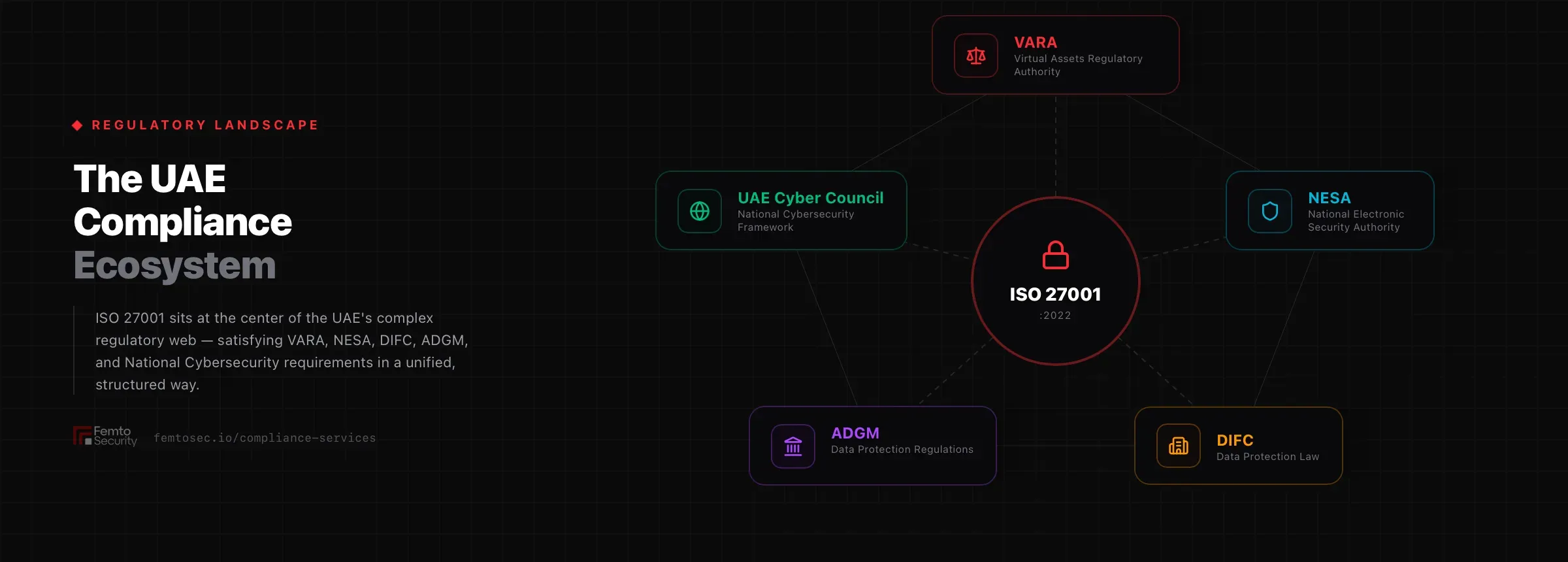
Regulatory pressure is intensifying. The UAE Cybersecurity Council has issued binding frameworks. The Dubai International Financial Centre (DIFC) Data Protection Law, Abu Dhabi Global Market (ADGM) regulations, the National Electronic Security Authority (NESA) controls, and most critically, the Virtual Assets Regulatory Authority (VARA) compliance requirements for crypto and digital asset firms all create a complex web of obligations that ISO 27001 helps satisfy in a unified, structured way.
Enterprise procurement demands it. Multinational corporations operating in the UAE routinely require ISO 27001 certification from vendors and supply chain partners before signing contracts. Without it, your business is disqualified before the conversation begins.
Cyber threats are escalating. The UAE was among the top five most targeted countries in the Middle East for cyberattacks in 2025, with the financial services, government, and healthcare sectors bearing the brunt. A certified ISMS is not just about compliance it is about operational survival.
ISO 27001 UAE: The Regulatory Landscape You Must Understand
Before diving into implementation, it is critical to understand the regulatory ecosystem that makes ISO 27001 particularly valuable in the UAE context.
VARA and the Digital Asset Sector
Dubai's Virtual Assets Regulatory Authority (VARA) has established some of the most sophisticated cybersecurity requirements for virtual asset service providers (VASPs) worldwide. VARA's Cybersecurity Rulebook explicitly requires robust ISMS controls, incident response capabilities, and risk management frameworks all of which align directly with ISO 27001:2022.
If your business operates in the digital assets space exchanges, wallets, DeFi platforms, NFT marketplaces achieving ISO 27001 certification is not just strategically wise; it is essential. It is practically essential for maintaining your VARA license. Our vCISO for VARA Compliance service is specifically designed to bridge the gap between ISO 27001 and VARA requirements for UAE-based virtual asset businesses.
For a deeper understanding of VARA's cybersecurity framework, our VARA Compliance Guide covers the key regulations every crypto business must know.
NESA and Government Contractors
The National Electronic Security Authority (NESA) Information Assurance Standards require government contractors and critical infrastructure operators to demonstrate robust information security. ISO 27001 certification significantly accelerates NESA compliance by providing documented evidence of systematic risk management.
Our Government cybersecurity services are tailored to organizations navigating this specific intersection of NESA requirements and ISO 27001 certification.
DIFC and ADGM Financial Entities
Financial institutions in both free zones face rigorous data protection obligations. The DIFC Data Protection Law (updated 2020) and ADGM Data Protection Regulations align well with ISO 27001's controls for data classification, access management, and incident response making certification a highly efficient way to demonstrate compliance across multiple regulatory frameworks simultaneously.
Key Facts: ISO 27001 UAE in Numbers
Metric | Data |
|---|---|
Current Standard Version | ISO 27001:2022 |
Transition Deadline (from 2013) | October 31, 2025 (now mandatory) |
Number of Annex A Controls | 93 controls across 4 themes |
Typical Implementation Timeline | 4–9 months, depending on organization size |
Average Cost Range (UAE SME) | AED 80,000 – AED 250,000 |
Average Cost Range (Enterprise) | AED 250,000 – AED 700,000+ |
Certification Validity | 3 years (annual surveillance audits required) |
UAE Penetration of Certified Organizations (2025) | Growing at ~28% YoY in the GCC region |
Top UAE Industries Pursuing Certification | Financial Services, Technology, Healthcare, Government, Virtual Assets |
The ISO 27001:2022 Update: What Changed and Why It Matters
The 2022 revision of ISO 27001 was the most significant overhaul in nearly a decade. Organizations that obtained certification under ISO 27001:2013 were required to transition to the 2022 standard by October 31, 2025 a deadline that has now passed, making compliance with the updated standard mandatory.
Key changes in ISO 27001:2022 that UAE businesses should understand:
Restructured Annex A Controls. The 2022 version reduced the total number of controls from 114 to 93, organized into four categories: Organizational, People, Physical, and Technological. Eleven brand-new controls were introduced, including:
Threat intelligence
Information security for cloud services
ICT readiness for business continuity
Physical security monitoring
Configuration management
Data masking
Data leakage prevention
Web filtering
Secure coding
Why this matters for UAE businesses: The new controls directly address the cloud-first, hybrid-work environment that most UAE organizations now operate in. If your organization was certified under the 2013 standard and has not yet transitioned, you are operating with an expired certification a significant risk in enterprise procurement and regulatory contexts.
Our Compliance Services team helps organizations navigate both initial certification and the 2013-to-2022 transition efficiently.
Step-by-Step: Implementing ISO 27001 in Your UAE Organization
Implementation is where many organizations struggle not because the standard is impenetrable, but because it requires disciplined project management, cross-functional collaboration, and specialized security expertise. Here is the framework that best-in-class UAE organizations follow:
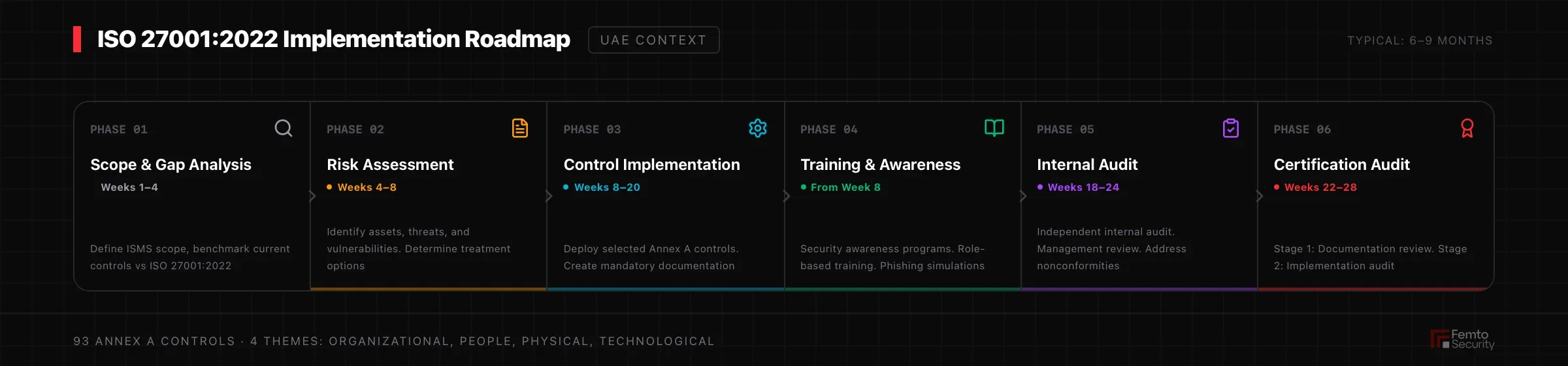
Phase 1: Scope Definition and Gap Analysis (Weeks 1–4)
Before anything else, your organization must define the scope of the ISMS which business units, locations, systems, and data types will be covered. This decision has significant downstream implications for both cost and complexity.
A gap analysis then benchmarks your current security posture against the requirements of ISO 27001:2022. This involves reviewing existing policies, interviewing key stakeholders, assessing technical controls, and identifying the delta between where you are and where the standard requires you to be.
A professional gap analysis typically uncovers three categories of findings: quick wins (simple policy or documentation gaps), medium-term controls (requiring process redesign), and strategic gaps (requiring technology investment or organizational change).
Phase 2: Risk Assessment and Treatment (Weeks 4–8)
ISO 27001 is fundamentally a risk management standard. The risk assessment is its beating heart. Your organization must systematically identify information assets, assess threats and vulnerabilities, evaluate the likelihood and impact of potential security incidents, and determine appropriate risk treatment options: accept, mitigate, transfer, or avoid.
The outputs of the risk assessment directly drive which Annex A controls you implement. This is not a one-size-fits-all process a fintech startup in DIFC will have a very different risk profile than a healthcare provider in Abu Dhabi.
Our Vulnerability Assessments and Attack Surface Management services provide the technical intelligence that informs a genuinely robust risk assessment, going beyond theoretical analysis to surface real, exploitable weaknesses in your environment.
Phase 3: Control Implementation and Documentation (Weeks 8–20)
This is the most labor-intensive phase. Based on the risk treatment plan, your organization must implement the selected controls and create the required documentation per the standard. Key mandatory documents include:
ISMS scope statement
Information security policy
Risk assessment and risk treatment methodology
Statement of Applicability (SoA)
Risk treatment plan
Information security objectives
Competence records and training documentation
Operational planning and control evidence
Monitoring and measurement results
Internal audit program and results
Management review records
Nonconformity and corrective action records
The quality of documentation is often underestimated. Auditors are not just looking for the existence of documents they are looking for evidence that they are actively used, reviewed, and updated.
Phase 4: Security Awareness and Training (Ongoing from Week 8)(H3)
ISO 27001 explicitly requires that all personnel understand their role in maintaining information security. In the UAE context, where organizations often have highly multicultural workforces spanning multiple languages and varying levels of security literacy, this is a particularly nuanced challenge.
Effective security awareness programs go far beyond annual e-learning modules. They build a genuine human firewall through phishing simulations, role-based training, security champion programs, and regular communication that connects security to everyday work.
Our Security Awareness service delivers UAE-specific, culturally intelligent security training programs that measurably reduce human-factor risk. As detailed in our Phishing Awareness 2026 guide, phishing remains the single most common attack vector against UAE enterprises and training is your most cost-effective defense.
Phase 5: Internal Audit and Management Review (Weeks 18–24)
Before inviting a certification body, your organization must conduct at least one complete internal audit of the ISMS. Internal auditors must be independent of the areas they audit a requirement that often catches smaller organizations off guard. The internal audit identifies nonconformities that must be addressed before the external audit.
The management review is a formal meeting in which senior leadership reviews the ISMS's performance, considers audit findings, assesses risks, and allocates resources. Evidence of this review is mandatory for certification.
Phase 6: Certification Audit (Weeks 22–28)
Certification audits are conducted in two stages:
Stage 1 (Documentation Review): The auditor reviews your ISMS documentation, confirms scope, and identifies any areas of concern before the main audit. Stage 1 typically takes 1–3 days.
Stage 2 (Implementation Audit): The auditor visits your organization (in person or virtually) to verify that documented controls are implemented and effective. This stage results in a certification decision or a list of nonconformities that must be addressed.
Technical Security Controls: Where Penetration Testing Fits In
ISO 27001:2022 requires organizations to test the effectiveness of their security controls. This is where technical security services become critical evidence generators not just security tools, but audit artifacts.
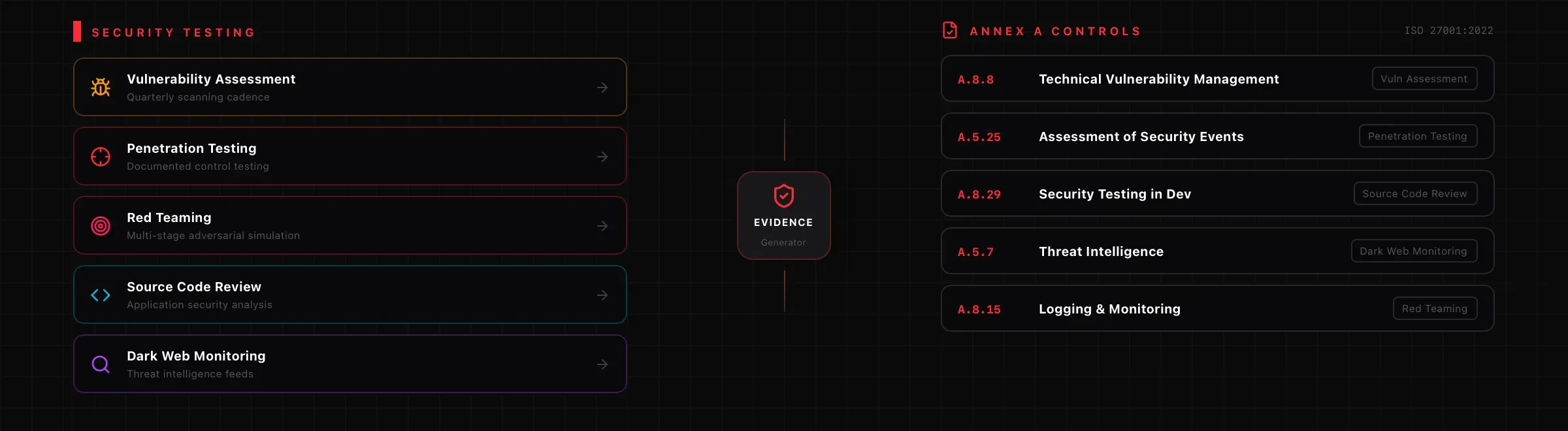
Annex A Control 8.8 (Management of technical vulnerabilities) requires systematic identification and remediation of technical vulnerabilities. Our Vulnerability Assessment services provide the quarterly or annual scanning cadence required to demonstrate ongoing compliance with this control.
Annex A Control 5.25 (Assessment and decision on information security events) requires tested incident response capabilities. Our Penetration Testing service provides documented evidence of control testing and professional reports that auditors can review directly. Regular penetration testing also demonstrates the "continual improvement" principle that auditors look for in mature ISMS programs.
Annex A Control 8.29 (Security testing in development and acquisition) is directly addressed by our Source Code Review and Smart Contract Auditing services particularly relevant for UAE technology companies and Web3 businesses that develop software in-house.
For organizations requiring the most rigorous validation of their defenses, our Red Teaming service simulates sophisticated, multi-stage attack campaigns that test not just technical controls but people and processes simultaneously the kind of adversarial validation that demonstrates ISMS maturity to auditors and board members alike.
Dark Web Monitoring and Ongoing ISMS Vigilance
ISO 27001 is not a one-time achievement it is a continuous management process. The standard's "Plan-Do-Check-Act" cycle requires organizations to monitor their security environment and respond to new threats continuously.
One often-overlooked component of ongoing ISMS vigilance is threat intelligence specifically, understanding when your organization's data, credentials, or intellectual property appears on dark web marketplaces and criminal forums.
Our Dark Web Monitoring service continuously monitors dark web sources for mentions of your organization's domains, employee credentials, customer data, and proprietary information. This directly supports ISO 27001:2022's new Annex A control for threat intelligence (5.7), and provides early warning of potential breaches before they escalate into reportable incidents.
ISO 27001 and VARA: A Strategic Alignment for UAE Web3 Businesses
For virtual asset businesses operating under VARA's regulatory framework, achieving ISO 27001 UAE certification creates a powerful strategic alignment. The overlap between ISO 27001:2022 controls and VARA's Cybersecurity Rulebook requirements is substantial organizations pursuing both simultaneously can dramatically reduce duplication of effort and costs.
VARA Requirement Area | Aligned ISO 27001:2022 Controls |
|---|---|
Access Control and Identity Management | A.8.2, A.8.3, A.8.5 |
Cryptographic Key Management | A.8.24 |
Incident Response | A.5.24, A.5.25, A.5.26 |
Vulnerability Management | A.8.8 |
Third-Party Risk | A.5.19, A.5.20, A.5.21, A.5.22 |
Business Continuity | A.5.29, A.5.30 |
Security Monitoring | A.8.15, A.8.16 |
Data Classification | A.5.12, A.5.13 |
As our ISO 27001 and VARA compliance blog explains in detail, organizations that treat these frameworks as complementary rather than competing actually achieve stronger security outcomes and faster certification timelines than those that pursue them in isolation.
For VARA-licensed or VARA-seeking businesses, our VARA Compliance Services provide the integrated approach that makes simultaneous progress on both frameworks practical and efficient.
The Business Case: ROI of ISO 27001 UAE Certification
Many organizations approach ISO 27001 as a cost center. The data tells a different story.
Breach cost avoidance. The average cost of a data breach in the Middle East reached USD 8.75 million in 2025 the second highest globally, behind only the United States. ISO 27001 certified organizations experience significantly fewer breaches and demonstrate faster, more cost-effective incident response when incidents do occur.
Enterprise contract access. Numerous UAE enterprise procurement policies now require ISO 27001 certification from IT service providers, cloud vendors, and data processors. Certification opens doors to contract opportunities that are structurally closed to non-certified competitors.
Cyber insurance premiums. ISO 27001 certified organizations consistently qualify for lower cyber insurance premiums, with some insurers offering discounts of 15–25% for certified policyholders. Given the escalating cost of cyber insurance in the UAE market, this alone can provide meaningful ROI within the first year of certification.
Regulatory penalty avoidance. Non-compliance with UAE data protection and cybersecurity regulations carries financial penalties and, in some cases, reputational consequences that can be existential for smaller organizations. ISO 27001 provides documented evidence of due diligence that significantly mitigates regulatory risk.
M&A and investment due diligence. For UAE technology companies pursuing fundraising or acquisition, ISO 27001 certification has become a standard due diligence requirement from sophisticated investors. Certification reduces perceived risk and can positively influence valuation.
AI and the Future of ISO 27001 Compliance in the UAE
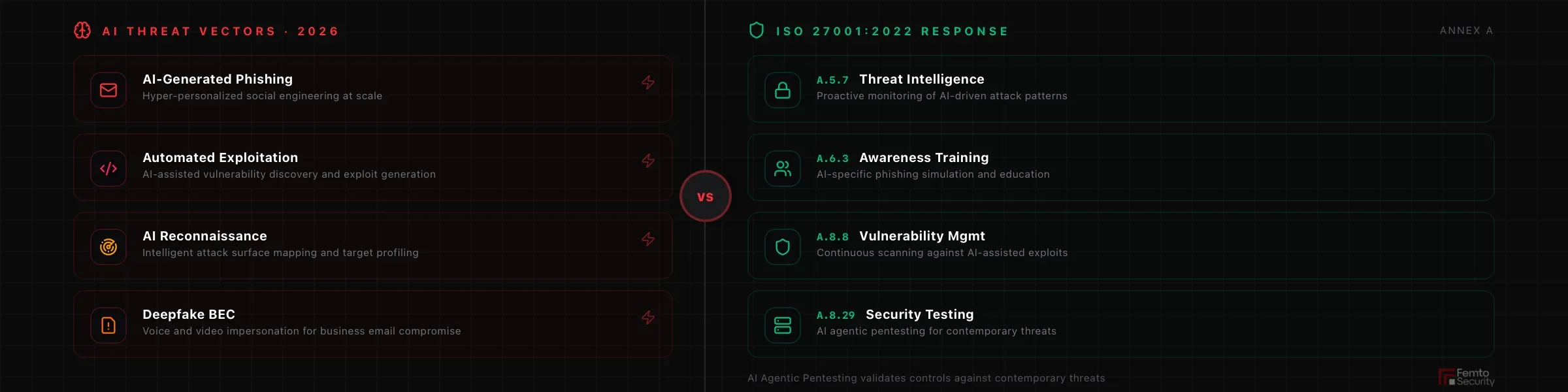
In 2026, artificial intelligence is simultaneously reshaping both the threat and compliance landscapes. ISO 27001:2022's controls already address AI-adjacent risks through data protection, software development security, and threat intelligence requirements but the ISO committee is actively developing AI-specific guidance that organizations should begin preparing for now.
UAE organizations should also understand that AI-driven attack methodologies are significantly raising the bar for what "effective security controls" actually mean. Social engineering attacks powered by generative AI, automated exploitation of vulnerabilities, and AI-assisted reconnaissance are making the human and technical attack surfaces more dynamic than ever.
Our AI Agentic Pentesting service is specifically designed to test organizational defenses against the emerging class of AI-powered attacks providing insights that traditional penetration testing cannot replicate, and ensuring that your ISO 27001 controls are validated against genuinely contemporary threats.
Enterprise ISO 27001: Considerations for Large UAE Organizations
Large UAE enterprises face unique ISO 27001 challenges that smaller organizations do not. Multi-site implementations spanning Dubai, Abu Dhabi, and international offices require careful scope management. Complex supply chain relationships require robust supplier security assessment processes. Legacy IT infrastructure presents control implementation challenges that cloud-native environments do not.
Our Enterprise security services are specifically designed for the scale and complexity that large UAE organizations bring to the ISMS journey. We provide embedded expertise, project management discipline, and technical depth that internal teams however capable rarely possess as a standing capability.
For enterprise organizations in particular, the vCISO model offers significant advantages: access to senior security leadership and ISO 27001 program management expertise without the cost and timeline of a full-time CISO hire. Our vCISO for VARA Compliance service extends this model to organizations navigating the intersection of enterprise scale and VARA regulatory obligations.
Common Mistakes UAE Organizations Make in ISO 27001 Certification
Understanding what goes wrong is as valuable as understanding what goes right. Here are the most common failure patterns we observe in UAE organizations pursuing ISO 27001:
Treating ISO 27001 as an IT project. ISO 27001 is a business management standard, not a technology deployment. Organizations that assign it exclusively to the IT department consistently underestimate the organizational change management component and fail their certification audit as a result.
Underinvesting in the gap analysis. A shallow gap analysis produces an implementation plan that looks complete on paper but misses critical vulnerabilities. Investing in a thorough, expert-led gap analysis pays for itself many times over in avoided rework during the audit phase.
Documentation without implementation. Auditors are experienced at identifying the gap between documented controls and actual operational practice. Creating policies that no one follows or that were written specifically for the audit is one of the most reliably detected audit failures.
Neglecting third-party risk. In the UAE's service-oriented economy, most organizations rely on dozens of vendors, cloud providers, and outsourced service providers who process or access sensitive information. ISO 27001:2022 requires robust supplier security management an area that organizations frequently underinvest in.
Failing to involve leadership. The standard explicitly requires top management commitment. Organizations where the ISMS is driven exclusively by a compliance manager, with no senior sponsorship, consistently struggle to allocate resources, resolve cross-departmental conflicts, and provide the management review evidence auditors require.
Choosing the Right Partner for ISO 27001 UAE Certification
The choice of implementation partner significantly influences both the quality of your ISMS and the efficiency of your certification journey. Key criteria to evaluate:
Demonstrated experience with UAE-specific regulatory frameworks (VARA, NESA, DIFC, ADGM)
Technical security capability the ability to perform real vulnerability assessments, penetration tests, and code reviews, not just documentation consulting
Familiarity with your industry sector and its specific risk profile
Post-certification support capability for ongoing surveillance audit preparation
vCISO or embedded resource options for organizations without in-house security leadership
Femto Security brings all of these capabilities together in a UAE-native practice built specifically for the complexity of the UAE's regulatory and threat environment. From initial gap analysis through certification and beyond, our integrated approach covers the full spectrum from policy documentation through technical security validation.
Conclusion:
The organizations that win in the UAE's digital economy over the next decade will not be those that achieve ISO 27001 certification and then move on. They will be the organizations that internalized what ISO 27001 teaches: that information security is a continuous management discipline, not a project with an end date.
In 2026, ISO 27001 UAE certification is simultaneously a regulatory enabler, a competitive differentiator, a breach risk reducer, and a signal to every stakeholder, clients, partners, regulators, investors that your organization takes its information security obligations seriously.
The implementation journey is demanding. Done properly, with the right expertise and the right technical validation, it makes your organization genuinely more secure not just more certified.
Femto Security brings together the full spectrum of capabilities that UAE organizations need for this journey: from compliance strategy and vCISO leadership, through penetration testing, vulnerability assessment, red teaming, dark web monitoring, and security awareness, to technical security validation that transforms documentation into demonstrable, auditable security.
Frequently Asked Questions (FAQs)
Is ISO 27001 certification mandatory in the UAE?
ISO 27001 is not universally mandatory across all sectors. Still, it is effectively required in several specific contexts: VARA-licensed virtual asset businesses, government contractors subject to NESA requirements, financial institutions in DIFC and ADGM, and organizations that supply services to entities that require certification from their vendors. Beyond formal mandates, ISO 27001 certification in the UAE has become a practical prerequisite for competitive enterprise procurement.
How long does ISO 27001 certification take in the UAE?
For a mid-sized UAE organization (100–500 employees, moderate IT complexity), the implementation journey from kick-off to certification typically takes 6–9 months. Smaller organizations with a focused scope can achieve certification in as little as 4 months. Large enterprises with complex multi-site operations and extensive supplier networks may require 12–18 months to implement a comprehensive ISMS. A professional implementation partner can significantly compress these timelines by front-loading the gap analysis and running implementation workstreams in parallel.
How much does ISO 27001 certification cost in the UAE?
Total cost comprises three components: consultancy and implementation support, internal resource time, and certification body fees. For a UAE SME, total investment typically ranges from AED 80,000 to AED 250,000. Enterprise implementations typically range from AED 250,000 to AED 700,000 or more, depending on scope complexity. Certification body fees alone (for the actual audit) typically range from AED 30,000 to AED 120,000, depending on the organization's size and scope. Annual surveillance audit fees are additional.
What is the difference between ISO 27001 and ISO 27002?
ISO 27001 is the standard that defines the requirements for an ISMS it is the standard against which organizations are certified. ISO 27002 provides detailed implementation guidance for the Annex A controls referenced in ISO 27001. Organizations implement ISO 27001 and use ISO 27002 as a reference for implementing specific controls. You get certified against ISO 27001; ISO 27002 is an implementation guide.
How does ISO 27001 relate to VARA compliance in the UAE?
VARA's Cybersecurity Rulebook and ISO 27001:2022 share substantial overlap in their requirements for access control, incident response, vulnerability management, third-party risk, and security monitoring. Organizations pursuing both frameworks simultaneously with an integrated implementation approach can achieve significantly greater efficiency than those pursuing them sequentially. Femto Security vCISO for VARA Compliance service is purpose-built for this integrated approach.
Continue Reading
October 6, 2026
What Is ISO 42001? The Complete AI Management System Guide
Everything about ISO 42001: what it requires, Annex A controls, certification steps, and how it compares with ISO 27001, the EU AI Act, and NIST.
September 24, 2026
VARA Cybersecurity Requirements | What Every VASP Must Do
VARA cybersecurity requirements explained: CISO, annual pen testing, 72-hour incident reporting and key security. Rules vs guidance, and evidence to keep.
September 14, 2026
ISO 9001:2015 vs ISO 9001:2026: What Actually Changed
Discover key changes in ISO 9001:2026 vs ISO 9001:2015. Learn about clause updates, quality culture, ethics, climate change, and the transition timeline.