
Why Information Security Awareness Is Your Most Powerful Cyber Defence in 2026
Continue Reading
October 12, 2026
A practical AI incident response guide: how to detect, contain, and recover from prompt injection, data leaks, and rogue agents, plus a readiness checklist.
October 9, 2026
LLM security testing explained: compare pentesting, red teaming, and automated scanning, and learn how to test agents, RAG apps, and AI-powered tools.
October 7, 2026
The NIST AI RMF explained: what Govern, Map, Measure and Manage require, the seven trustworthy AI traits, and how to put each function into practice.
Every day, cybercriminals launch thousands of targeted attacks against businesses across the UAE and the wider Middle East. They do not always try to hack through sophisticated technical firewalls first. Instead, they go after the easiest and most exploitable target of all people.
Information security awareness is the knowledge, attitude, and behaviour that every member of an organisation must develop to protect the company's digital and physical assets. It is not a one-time workshop or a forgotten PDF sent to inboxes once a year. It is an ongoing, embedded culture that transforms employees from passive users into an active, human defence layer.
According to IBM's Cost of a Data Breach Report 2025, human error is a contributing factor in over 74% of breaches globally. In the UAE, where digital transformation is accelerating under Vision 2030 and VARA's regulatory framework, organisations face a uniquely complex threat environment from nation-state actors to sophisticated phishing campaigns targeting crypto businesses, financial institutions, and government entities.
This guide explores every dimension of information security awareness its components, its implementation, its ROI, and why it must sit at the core of any serious cybersecurity strategy in 2026.
Information security awareness refers to the collective understanding of security risks, best practices, and organisational responsibilities that employees carry with them in their daily work. It covers far more than recognising a suspicious email. True awareness spans:
Understanding the value of data assets and confidentiality
Knowing how social engineering and psychological manipulation work
Practising safe digital habits at home and at the workplace
Reporting incidents promptly and without fear of blame
Appreciating the legal and regulatory consequences of a breach
The goal is simple but profound: to make security everyone's responsibility, not just the IT department's.
When properly implemented, information security awareness programmes can reduce the risk of successful phishing attacks by up to 70%, according to SANS Institute research. For UAE enterprises operating under VARA regulations, ISO 27001 requirements, or NCA cybersecurity frameworks, awareness training is not just best practice it is increasingly a compliance obligation.
Threat Type | Global Frequency | Top Attack Vector | Impact |
|---|---|---|---|
Phishing Attacks | 3.4 billion emails/day | Email / SMS / Social Media | Credential theft, ransomware |
Social Engineering | 98% of cyberattacks | Human psychology | Data theft, fraud |
Ransomware | Every 11 seconds | Phishing, unpatched systems | Business disruption |
Insider Threats | 34% of all breaches | Negligence or malice | IP theft, regulatory fines |
Supply Chain Attacks | Up 430% since 2020 | Third-party vendors | Full network compromise |
In the UAE specifically, the financial sector, government entities, and VARA-regulated crypto businesses are prime targets. The concentration of high-value assets, the rapid pace of digital adoption, and the growing reliance on AI and blockchain systems make robust information security awareness training an existential requirement not an optional extra.
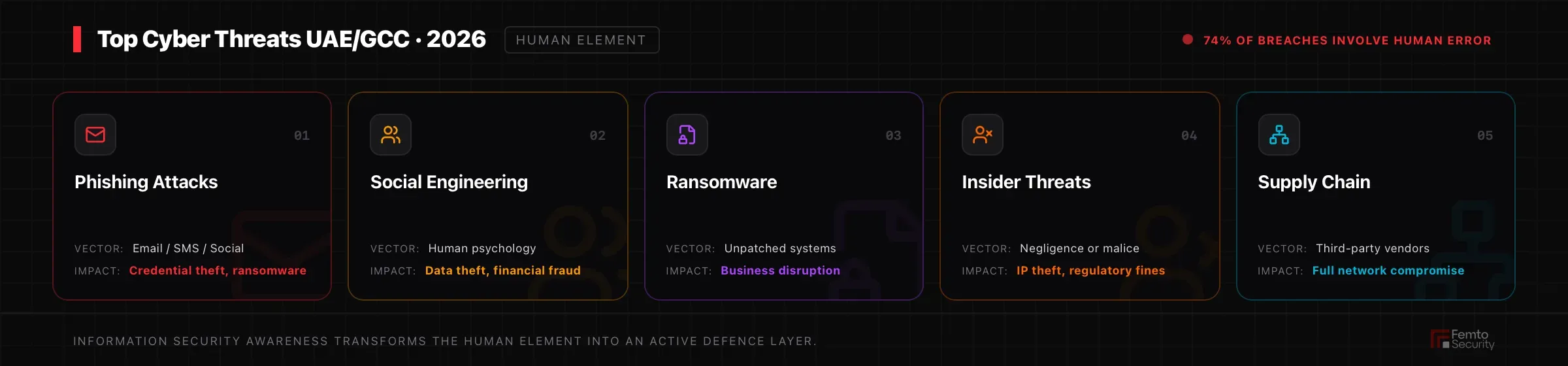
Phishing remains the number one initial access vector for attackers. Modern phishing goes far beyond poorly worded emails today's attacks are hyper-targeted, AI-generated, and indistinguishable from legitimate communications.
What employees must learn to identify:
Urgency and pressure tactics ("Your account will be suspended in 24 hours")
Spoofed sender addresses that mimic trusted brands or internal departments
Suspicious hyperlinks that lead to lookalike domains
Vishing (voice phishing) calls impersonating IT support or executives
Smishing (SMS phishing) messages with malicious links
Pretexting scenarios where attackers build false trust over time
Femto Security Security Awareness Training delivers scenario-based, interactive phishing simulations that test and educate employees simultaneously. Unlike passive compliance-tick training, these simulations replicate the actual tactics used by threat actors targeting UAE enterprises today.
Weak or reused passwords account for billions of compromised accounts every year. Despite decades of warnings, "password123" and "qwerty" remain among the most commonly used credentials globally.
Best practices every employee must adopt:
Minimum 16-character passphrases combining words, numbers, and symbols
Unique passwords for every system and application never reused
Mandatory use of a company-approved password manager
Multi-Factor Authentication (MFA) on every critical account
Never sharing passwords via email, instant message, or verbally over the phone
Immediate password changes following any suspected compromise
Password-related breaches are deeply intertwined with a broader attack surface. Attack Surface Management by Femto Security helps organisations identify which employee credentials and digital assets are exposed externally, often revealing risks that password policy alone cannot solve.
Not all data carries the same sensitivity, and employees who do not understand data classification put everything at equal risk meaning everything is treated carelessly.
A practical data classification framework:
Classification Level | Examples | Permitted Handling |
|---|---|---|
Public | Marketing materials, published reports | Free to share |
Internal | Internal memos, project updates | Internal distribution only |
Confidential | Client data, contracts, financial records | Need-to-know basis, encrypted |
Restricted | Cryptographic keys, PII, credentials | Strict access control, audit logs |
Employees must understand:
How to label and store documents correctly
Risks of sending sensitive data via personal email or unsecured channels
Dangers of using public Wi-Fi for confidential work without a VPN
Physical security locking screens, clean desk policies, secure disposal
For organisations managing sensitive customer data, particularly those under VARA compliance obligations, data classification is a regulatory necessity. Our earlier guide on ISO 27001 in the UAE explores how formal information security governance frameworks anchor data handling responsibilities across the organisation.
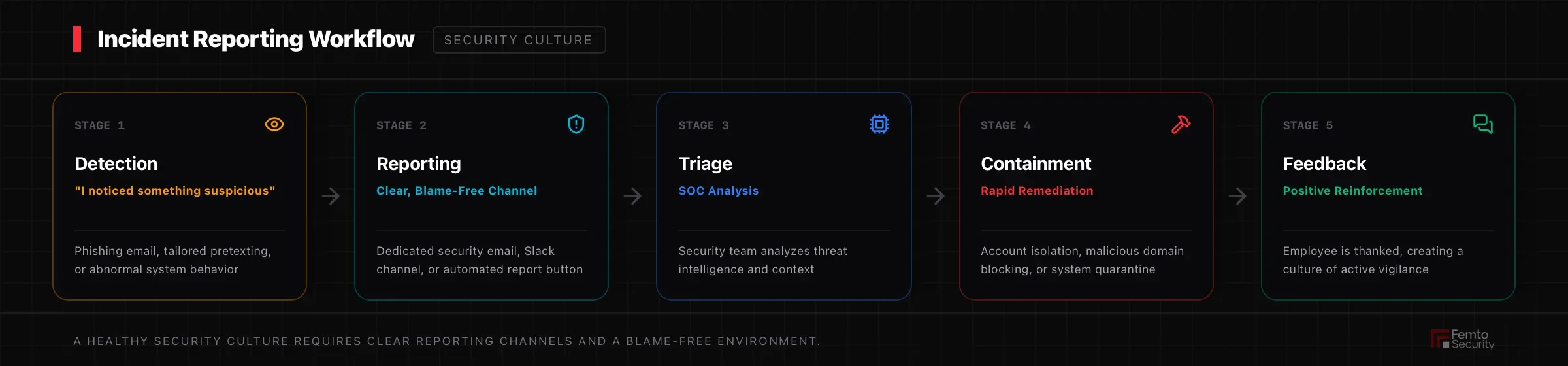
One of the most undervalued aspects of information security awareness is teaching employees what to do when something goes wrong when it feels like it might.
Many breaches are prolonged not because the organisation lacked detection capability, but because employees noticed something suspicious and said nothing, fearing blame or embarrassment.
A healthy security culture requires:
Clear, accessible reporting channels (a dedicated security email, a Slack channel, a hotline)
A blame-free reporting environment it should be safe to report mistakes
Well-defined escalation paths so reports reach the right team quickly
Regular drills and tabletop exercises so employees know what "report an incident" actually looks like in practice
Post-incident reviews that highlight learnings, not punishments
Remote work has permanently expanded the attack surface for most organisations. Personal devices, home networks, shadow IT, and unsanctioned SaaS applications have collectively created new vulnerabilities that technical controls alone cannot address.
Remote and hybrid worker awareness essentials:
Only use company-approved devices and VPNs for work
Never store work data on personal cloud accounts (Google Drive, Dropbox, etc.).
Be vigilant about physical surroundings — shoulder surfing in cafés and airports is real
Lock screens whenever stepping away from a device
Report lost or stolen devices immediately, even outside business hours
Traditional annual security awareness sessions, a 45-minute lecture followed by a quiz do not work. Research from Forrester and Gartner consistently shows that employees forget 50% of training content within a week and 80% within a month without reinforcement.
Effective programmes leverage:
Spaced Repetition — Short, frequent touchpoints that keep security concepts fresh in employees' minds. Weekly micro-learning videos of 2–3 minutes outperform annual marathon sessions.
Simulated Attacks — Running controlled phishing simulations without prior warning gives employees a realistic experience in identifying threats. Those who click receive immediate, contextual education — not punishment.
Gamification — Leaderboards, badges, and team challenges increase engagement and completion rates. Organisations report up to 3x better completion when gamification is used.
Role-Specific Modules — A finance team member faces different threats than a developer or a customer service agent. Tailored content is significantly more effective than generic one-size-fits-all programmes.
Culture and Leadership Buy-In — When the CEO takes the same training as the intern, and when security is discussed openly at every level, the programme succeeds. Culture flows downward.
Femto Security Security Awareness Training is engineered around these principles, combining simulated phishing, role-specific modules, and executive reporting dashboards in a UAE-localised programme.
Information security awareness is not a standalone solution. It is one critical layer in a defence-in-depth strategy. Human training must be paired with robust technical controls to create a resilient security posture.
Awareness Component | Supporting Technical Control | Femto Security Service |
|---|---|---|
Phishing recognition | Email gateway filtering | Penetration Testing |
Password hygiene | MFA, IAM systems | Vulnerability Assessments |
Data handling | DLP, encryption | Source Code Review |
Incident reporting | SIEM, SOC | Red Teaming |
Dark web exposure | Threat intelligence | Dark Web Monitoring |
AI-driven attacks | Adversarial testing | AI Agentic Pentesting |
The connection is direct: an employee who understands phishing is more likely to report a suspicious email, giving the SOC team the signal they need to investigate. An employee who practises good password hygiene reduces the value of credentials discovered on the dark web. Awareness and technology are mutually reinforcing.
For organisations managing complex digital infrastructure, Attack Surface Management reveals the external-facing attack surface that employees may inadvertently expand through shadow IT or misconfigured applications.
Dubai's Virtual Assets Regulatory Authority (VARA) has established one of the world's most comprehensive regulatory frameworks for crypto and digital asset businesses. Security awareness is explicitly embedded within VARA's requirements particularly around staff training, incident response, and risk management.
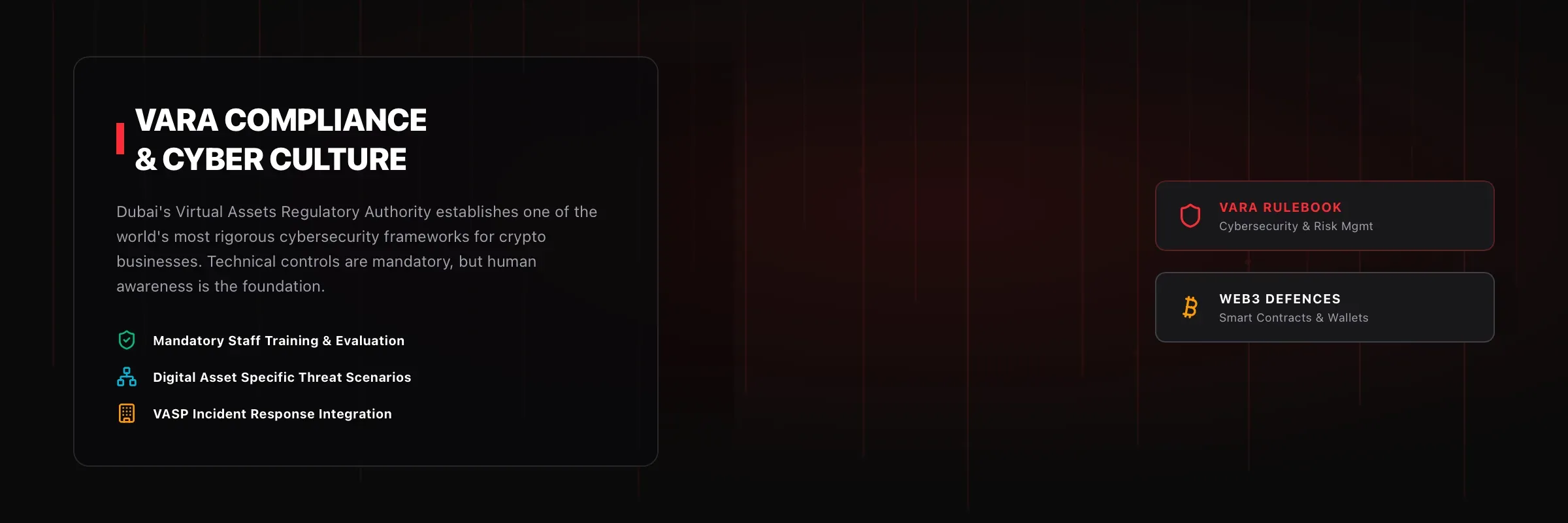
VARA-regulated entities must demonstrate that all staff handling virtual assets have received appropriate training on:
Cybersecurity risks specific to digital asset environments
Social engineering threats targeting crypto wallets and exchange accounts
Secure key management practices
Incident identification and escalation procedures
Our detailed guide on VARA compliance and cybersecurity in Dubai explains how security awareness requirements intersect with VARA's broader regulatory obligations.
Femto Security vCISO for VARA Compliance service provides VARA-licensed businesses with dedicated virtual CISO support, ensuring that awareness training, policy frameworks, and technical controls all align with VARA's evolving standards. Our VARA Compliance Services help organisations build a compliance posture that satisfies regulators while genuinely reducing risk.
For a deeper understanding of what VARA demands, our VARA Dubai Compliance Guide and the 2026 Strategy Guide for Web3 Security are essential reading for any compliance team.
As organisations adopt Web3 technologies and AI-powered workflows, the boundaries of information security awareness must expand accordingly. Employees and developers working with smart contracts, AI agents, and decentralised applications need specialised education on:
Smart Contract Risks:
Reentrancy attacks and integer overflow vulnerabilities
Private key management for contract deployment wallets
Phishing attacks targeting developer credentials and GitHub tokens
Social engineering of DevOps teams responsible for contract deployments
Femto Security Smart Contract Auditing service combines technical code review with developer education, ensuring that teams understand not just what the vulnerabilities are, but how attackers would exploit human and technical weaknesses together.
AI-Powered Attack Awareness: AI is now used by threat actors to generate hyper-personalised phishing emails, deepfake voice calls, and synthetic identities at scale. Employees must understand:
How to verify identity through out-of-band channels when something feels off
The danger of AI-generated voice clones impersonating executives (CEO fraud)
Prompt injection risks in AI tools that employees use daily
Data leakage through consumer AI applications used for work tasks
Femto Security AI Agentic Pentesting service tests how AI systems deployed in enterprise environments can be manipulated giving security teams the intelligence they need to train employees on new-generation threats.
Baseline your organisation's current awareness level before deploying training:
Conduct a phishing simulation with no prior warning
Survey employees on their security knowledge and confidence
Review past incident data for human error patterns
Map your most at-risk roles (finance, HR, IT, executive assistants)
Vulnerability Assessments from Femto Security can complement this phase by identifying technical gaps that awareness training should address.
Define role-specific learning paths
Select delivery mechanisms (LMS, micro-learning, phishing simulations, in-person workshops)
Develop a library of UAE-relevant, industry-specific scenarios
Align content to regulatory obligations (VARA, NCA, ISO 27001)
Set measurable KPIs (phishing click rates, reporting rates, quiz scores)
Launch with visible executive sponsorship
Deploy micro-learning weekly or bi-weekly
Run simulated phishing monthly, with instant feedback loops
Hold "Lunch and Learn" sessions for high-risk departments
Publish a monthly internal security newsletter
Celebrate teams and individuals who demonstrate strong security behaviour
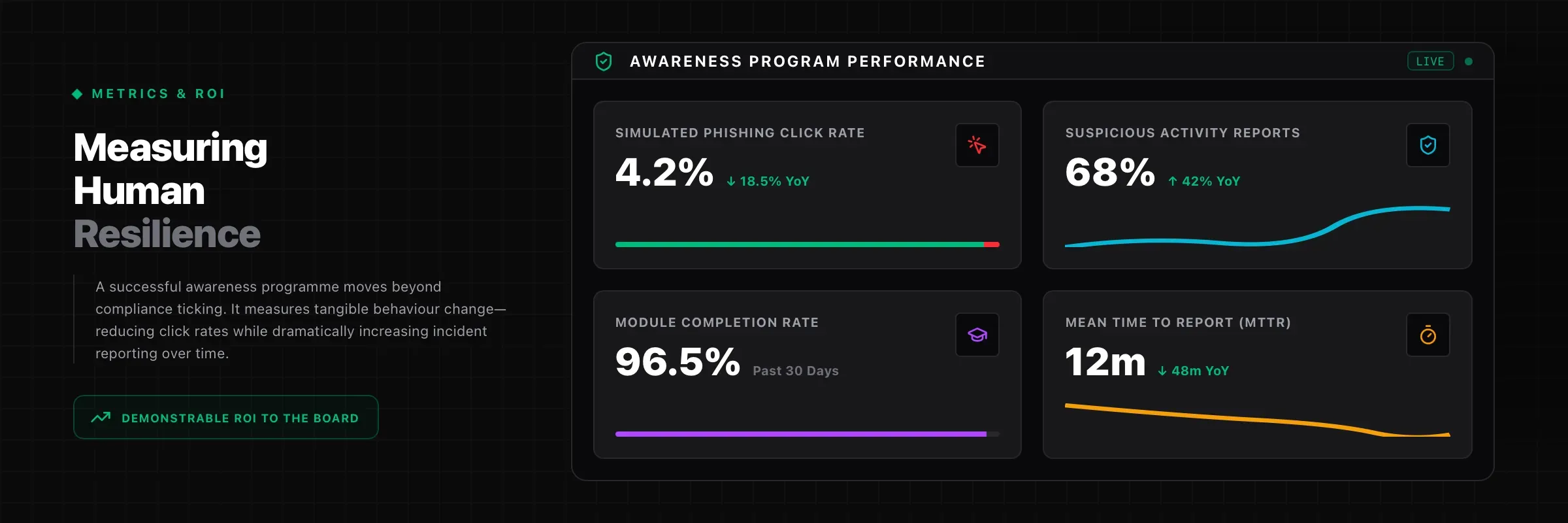
KPI | Good Benchmark | What to Do if Below |
|---|---|---|
Phishing click rate | Below 5% | Increase simulation frequency |
Phishing report rate | Above 60% | Focus on reporting culture |
Training completion | Above 95% | Mandate completion, link to HR |
Time to report an incident | Under 1 hour | Simplify reporting channels |
Repeat offenders | Below 3% | Targeted 1:1 coaching |
Larger organisations and government entities face unique challenges. The scale of employee populations, the complexity of IT environments, the sensitivity of the data handled, and the political consequences of a breach all demand a more structured, enterprise-grade approach to information security awareness.
Femto Security Enterprise security services deliver comprehensive awareness programmes at scale, with executive reporting, compliance mapping, and integration into broader security governance frameworks.
For government entities, the stakes are even higher. Breaches of public sector systems can compromise critical infrastructure, expose citizens' personal data, and undermine public trust. Femto Security Government security services are purpose-built for the unique regulatory, operational, and geopolitical context of public sector security in the UAE.
Our Red Teaming service is particularly valuable at the enterprise and government levels. It simulates full adversarial attack scenarios that test not just technology but also human responses, revealing exactly how employees behave under real attack conditions.
Executives sometimes question the return on investment of security awareness. The numbers make a compelling case:
The Cost of NOT Training:
Average cost of a data breach in the UAE: AED 28 million (IBM, 2025)
Average cost of a ransomware incident: AED 5–15 million, including downtime
VARA fines for non-compliance: Up to AED 50 million per violation
Reputational damage: Immeasurable, but studies show 30% of customers leave after a breach
The Cost of Training:
Comprehensive annual awareness programme: AED 200,000–500,000 for a 500-person organisation
ROI range: 10x to 50x when measuring breach cost avoidance
A well-structured information security awareness programme consistently delivers among the highest ROI of any cybersecurity investment because it directly addresses the most common attack vector the human.
Our blog on phishing awareness and building a human firewall for UAE enterprises goes deeper into the specific phishing threats facing UAE organisations in 2026 and how to counter them with awareness-led defence.
The organisations that will be most resilient in 2026 and beyond are not those with the most expensive firewalls or the most complex SIEM deployments. They are the ones where every employee from the receptionist to the CEO understands their role in keeping the organisation secure.
Information security awareness creates that culture. It turns the human element from the weakest link in the security chain into its strongest.
The path forward is clear: invest in continuous, relevant, engaging awareness training. Pair it with rigorous technical controls. Measure outcomes relentlessly. And embed security into the organisation's identity, not just its policy documents.
Femto Security partners with enterprises, VARA-regulated firms, and government entities across the UAE and GCC to build genuinely resilient security cultures not just compliant. From Security Awareness Training and Penetration Testing to Dark Web Monitoring and Red Teaming, our services address the full spectrum of human and technical risks.
Information security awareness is employees' understanding of cybersecurity risks, threats, and best practices in the workplace. It is important because human error accounts for the majority of security breaches globally. When employees know how to identify phishing emails, handle sensitive data correctly, and report suspicious activity, the organisation's overall risk profile drops dramatically.
Annual training is the absolute minimum and, on its own, is insufficient. Best practice in 2026 calls for ongoing, continuous education monthly phishing simulations, weekly micro-learning modules, quarterly deep-dive sessions, and annual comprehensive refreshers—the more frequent and contextual the training, the better the retention and behaviour change.
The essential topics include phishing and social engineering recognition, password hygiene, data classification and handling, safe remote working, incident reporting, physical security, and emerging threats like AI-generated attacks and deepfake fraud. Role-specific modules for finance, HR, IT, and executive teams should be layered on top of this foundation.
For VARA-regulated organisations, security training is explicitly required under VARA's governance and risk management standards. For organisations following NCA cybersecurity frameworks or pursuing ISO 27001 certification, staff awareness is a mandatory control. Femto Security's Compliance Services can help organisations align their awareness programmes with applicable regulatory requirements.
Femto Security's Security Awareness Training is built specifically for UAE and GCC enterprises, with scenarios tailored to regional threat actors, local regulatory requirements, and the cultural context of working in the Middle East. It integrates seamlessly with broader technical security services including penetration testing, dark web monitoring, and red teaming to create a unified, intelligence-led security programme rather than a standalone compliance exercise.
Security training refers to the formal, structured delivery of specific knowledge and skills—for example, how to use a VPN or identify a phishing email. Security awareness is the broader culture and attitude that emerges when training, communication, leadership behaviour, and policy work together consistently. Training is an input; awareness is the outcome. Both are necessary.
Absolutely. Small businesses are disproportionately targeted because attackers assume their defences are weaker. A lean, focused awareness programme, even one delivered through a two-hour monthly session plus regular phishing simulations can dramatically reduce risk. Femto Security works with organisations of all sizes across the UAE, from startups to government ministries.