
How VARA Compliance is Redefining Cybersecurity Standards for UAE Virtual Asset Businesses
In the global race to regulate digital assets, most jurisdictions focus on financial risks, investor protection, and anti-money laundering controls. Dubai took a different approach. When the Virtual Assets Regulatory Authority (VARA) published its comprehensive rulebooks, it embedded cybersecurity requirements so granular and so technically demanding that the compliance process itself became a full-scale security transformation for every virtual asset business operating in the emirate.
This blog is not a recap of what VARA is. It's a deep dive into a question that keeps CISO teams, compliance officers, and Web3 founders up at night: what does it actually take to achieve and sustain VARA-compliant cybersecurity in practice—not on paper, but in the real world of DeFi protocols, trading platforms, and crypto custodians?
Whether you are working toward a fresh VASP license or reinforcing an existing programme, the answer demands more than a checklist. It requires a fundamental rethinking of how security and compliance intersect. For organisations that want to build that programme properly from the ground up, Femto Security vCISO for VARA Compliance offers a structured path to do exactly that.
The VARA Technology Rulebook: A Security Standard Disguised as Regulation
Most people who hear "VARA compliance" think of licensing. They think about fee structures, disclosure filings, and legal entity requirements. That framing is understandable VARA licensing journey is genuinely complex. But embedded within the regulatory architecture is the Technology and Information Rulebook, and it reads less like a government circular and more like a Fortune 500 enterprise security policy.
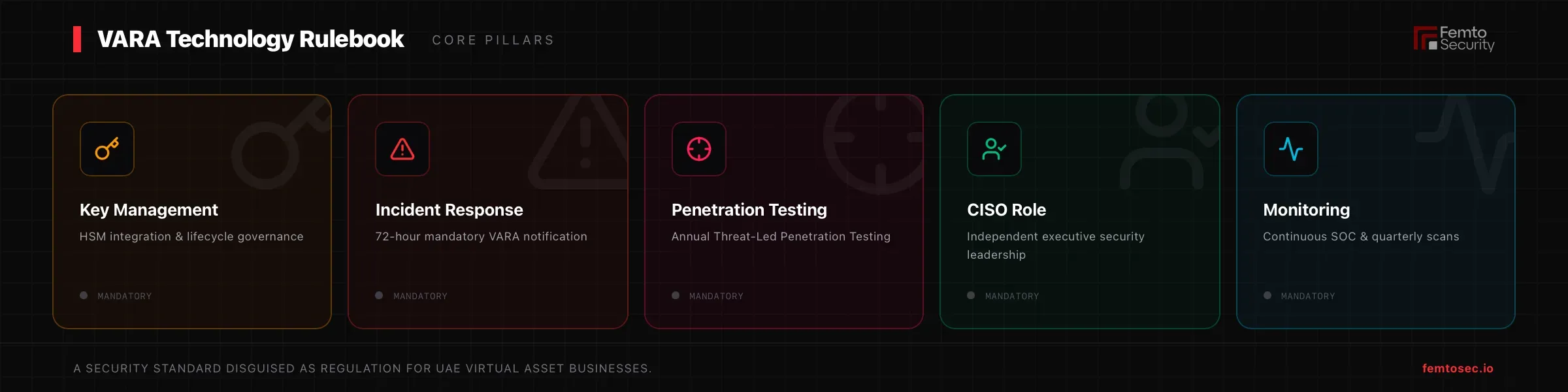
The Technology Rulebook mandates controls that span people, processes, and technology. It is not prescriptive about vendors or tools, it is prescriptive about outcomes. VARA does not tell you which SIEM to buy; it tells you that you must maintain real-time visibility into your environment. It does not name a specific cryptographic algorithm; it states that your key management lifecycle must be documented, auditable, and independent of operational access.
The result is a framework that forces licensed VASPs to think and operate like mature financial institutions even if they launched eighteen months ago from a co-working space in Business Bay. For a detailed breakdown of what the rulebook requires, this VARA compliance guide for crypto businesses covers the foundational regulatory context.
Core VARA Cybersecurity Requirements at a Glance
Requirement Area | Specific Control | Why It Matters |
|---|---|---|
Cryptographic Key Governance | HSM integration, lifecycle management, custody separation | Prevents insider theft and external compromise of wallet assets |
Incident Response | 72-hour mandatory VARA notification for material breaches | Ensures regulatory transparency; aligns with global standards like EU NIS2 and MAS TRM |
Red Team / TLPT | Annual Threat-Led Penetration Testing by independent certified firms | Validates real-world resilience beyond theoretical security controls |
CISO Appointment | Independent CISO role; cannot also be CTO or COO | Ensures security has a dedicated, conflict-free executive voice |
Continuous Monitoring | Real-time SOC + quarterly vulnerability scanning | Detects configuration drift, new vulnerabilities, and emerging threats proactively |
Business Continuity | Documented BCDR plans tested annually | Critical for custody platforms where downtime can lead to direct financial loss |
Staff Vetting | Background checks and security awareness training for all staff | Reduces insider threats often overlooked in Web3 organizations |
The Five Hardest Parts of VARA Compliance Cybersecurity in Practice
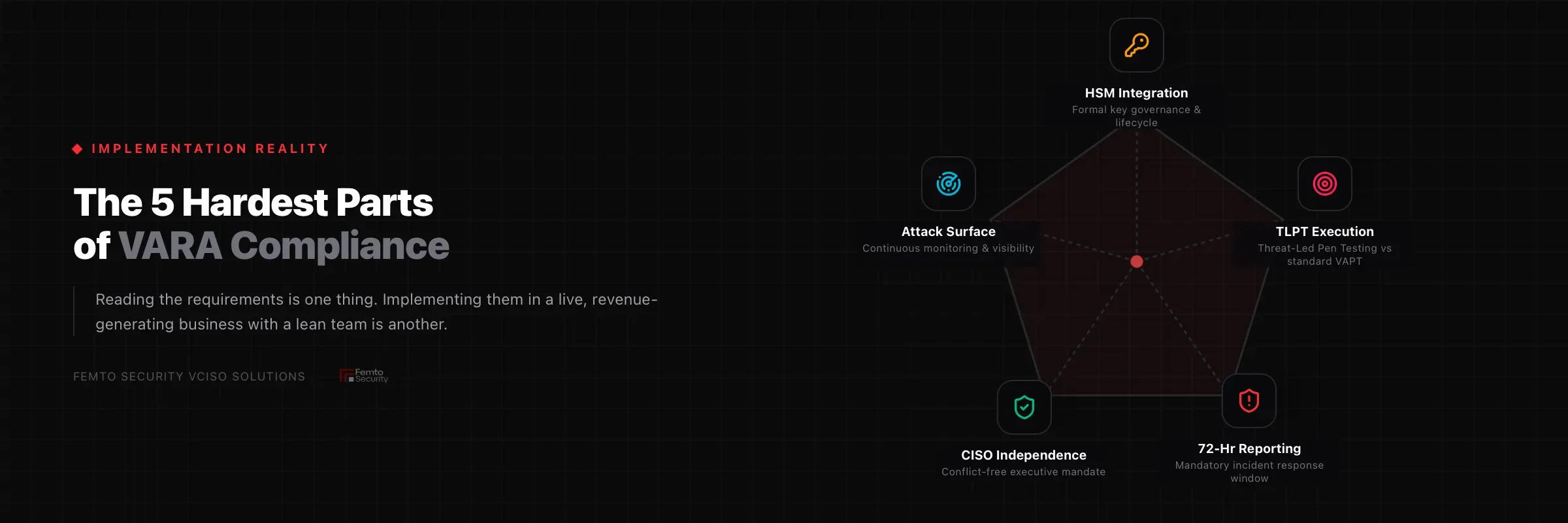
Reading the requirements is one thing. Implementing them in a live, revenue-generating business with a lean team, an aggressive roadmap, and a board asking about cost is another. Here are the five areas where firms consistently struggle.
1. Cryptographic Key Management and HSM Integration
For many Web3 companies, key management at launch means a hardware wallet in someone's desk drawer and a seed phrase split between two founders. VARA's Technology Rulebook draws a hard line against this. It requires formal key governance: Hardware Security Module (HSM) integration, documented custody roles, multi-party authorisation for high-value transactions, and a lifecycle policy covering key generation, rotation, and destruction.
Building this from scratch is non-trivial. Selecting the right HSM vendor, integrating with existing blockchain infrastructure, and documenting the process to VARA's standard requires deep technical expertise. Firms in this position often benefit from a dedicated smart contract auditing and security assessment to ensure that the on-chain layer is as secure as the key management layer below it.
2. Threat-Led Penetration Testing (TLPT)
VARA's red team requirement goes beyond a standard annual penetration test. It mandates what the European financial sector calls Threat-Led Penetration Testing simulations driven by real threat intelligence about who is actually attacking virtual asset platforms and how they are doing so. A TLPT exercise should model the actual tactics, techniques, and procedures (TTPs) of nation-state actors targeting crypto exchanges, DeFi protocols, and stablecoin issuers.
The difference between a standard penetration test and a TLPT is the difference between a fire drill and a real evacuation. Many providers offer one and describe it as the other. If you want to understand what genuine VARA-grade testing looks like, Femto Security red teaming services is purpose-built for this standard.
3. The 72-Hour Incident Response Obligation
Seventy-two hours sounds like a generous window until you are in the middle of an active incident at 2 AM and your incident response plan is a Google Doc that was last updated in Q3 of the previous year. VARA's 72-hour reporting requirement is not just a notification obligation, it is a forcing function that demands mature detection, triage, and escalation capabilities.
To reliably meet the 72-hour window, firms need: continuous monitoring with alerting, a defined incident classification matrix, a pre-approved communication template for regulatory notification, and a retainer with an external incident response partner. Without these in place before an incident occurs, the clock will run out before an adequate report can be filed.
4. Maintaining an Independent CISO
VARA requires every licensed VASP to appoint an independent Chief Information Security Officer. The word "independent" is doing significant work in that sentence. The CISO cannot be the CTO who also manages security as a side function. They cannot be the Head of Compliance wearing a second hat. Security leadership must have a dedicated mandate, direct board access, and genuine authority to halt operations when risk thresholds are breached.
For early-stage and mid-size VASPs, a full-time CISO hire may not be commercially viable. That is where the Virtual CISO model becomes strategically important providing VARA-aligned security leadership on a flexible engagement basis without the overhead of a permanent C-suite addition.
5. Continuous Monitoring and Attack Surface Visibility
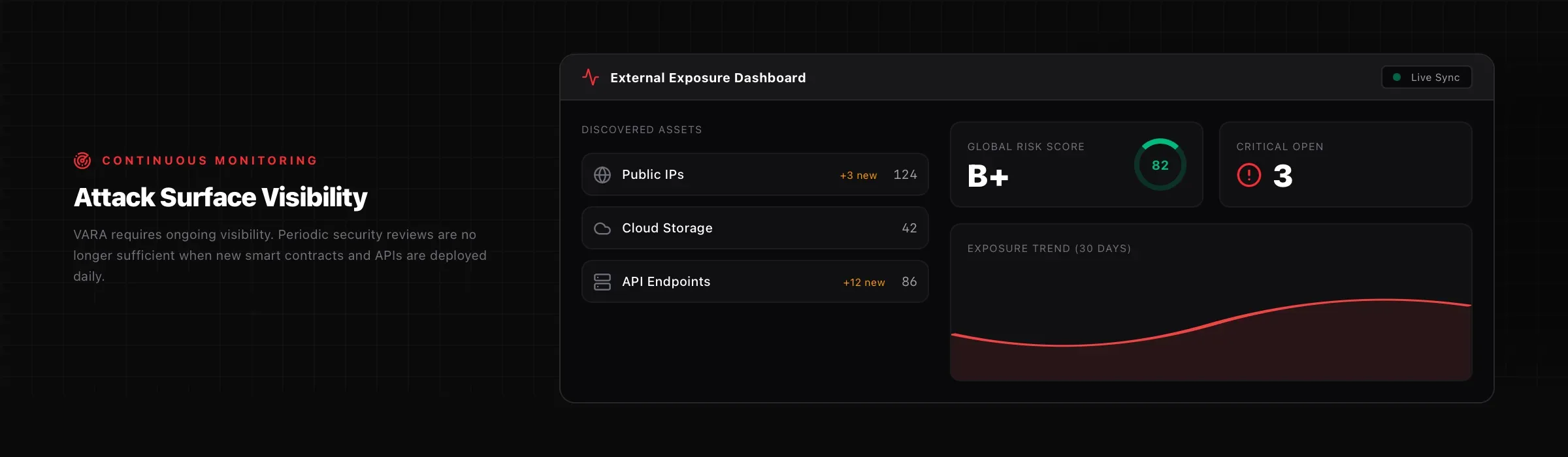
VARA's requirement for continuous monitoring means that periodic security reviews are no longer sufficient. The attack surface of a modern VASP is not static: new smart contract deployments, API integrations, cloud configuration changes, and third-party vendor updates all expand the exposure perimeter daily.
Managing this requires a combination of real-time threat monitoring, regular vulnerability scanning, and systematic tracking of every external-facing asset. Attack surface management provides exactly this visibility, continuously mapping what your organisation exposes to the internet and flagging new or changed assets before attackers find them first.
VARA Compliance Is Not Purely a Technical Exercise — The Human Layer
One of the most underrated dimensions of VARA compliance is the requirement for security awareness and staff vetting. The Technology Rulebook explicitly requires ongoing security training for all personnel not just the technical team. This reflects a reality that every mature security programme acknowledges: the most sophisticated technical controls in the world can be bypassed by a single employee who clicks a convincing phishing link.
In 2024, the UAE saw a significant increase in targeted social engineering campaigns against financial services employees, including those at digital asset firms. Attackers are not always trying to break through firewalls; increasingly, they are trying to manipulate the people who have legitimate access.
Building a genuine security culture not just a policy document and an annual training tick-box requires sustained investment in human-layer security. Femto Security security awareness programme is designed for financial services and Web3 contexts, with scenarios drawn from real UAE threat intelligence. This connects directly to broader efforts, such as building a human firewall for UAE enterprises in 2026, a topic that has become increasingly urgent as VARA-licensed firms become high-value targets.
Key Facts: VARA and UAE Cybersecurity in Numbers
Metric | Figure / Context |
|---|---|
72 Hours | VARA's mandatory window to report material cybersecurity incidents to the regulator |
100% of Licensed VASPs | Must appoint an independent CISO under VARA's Technology Rulebook |
Annual TLPT | Threat-Led Penetration Testing required every 12 months for all licensed entities |
Quarterly | Minimum frequency for vulnerability scans under VARA’s continuous monitoring requirement |
UAE Ranked #1 | Among Arab nations in the ITU Global Cybersecurity Index, reflecting strong digital security commitment |
$4.45M Average | Global average cost of a data breach in 2023 (IBM); higher risk exposure for VARA-licensed VASPs |
2,000+ VASPs | Estimated global entities that may seek UAE licensing as Dubai grows as a crypto hub |
The Dark Web Dimension: What VARA Compliance Misses and You Must Add
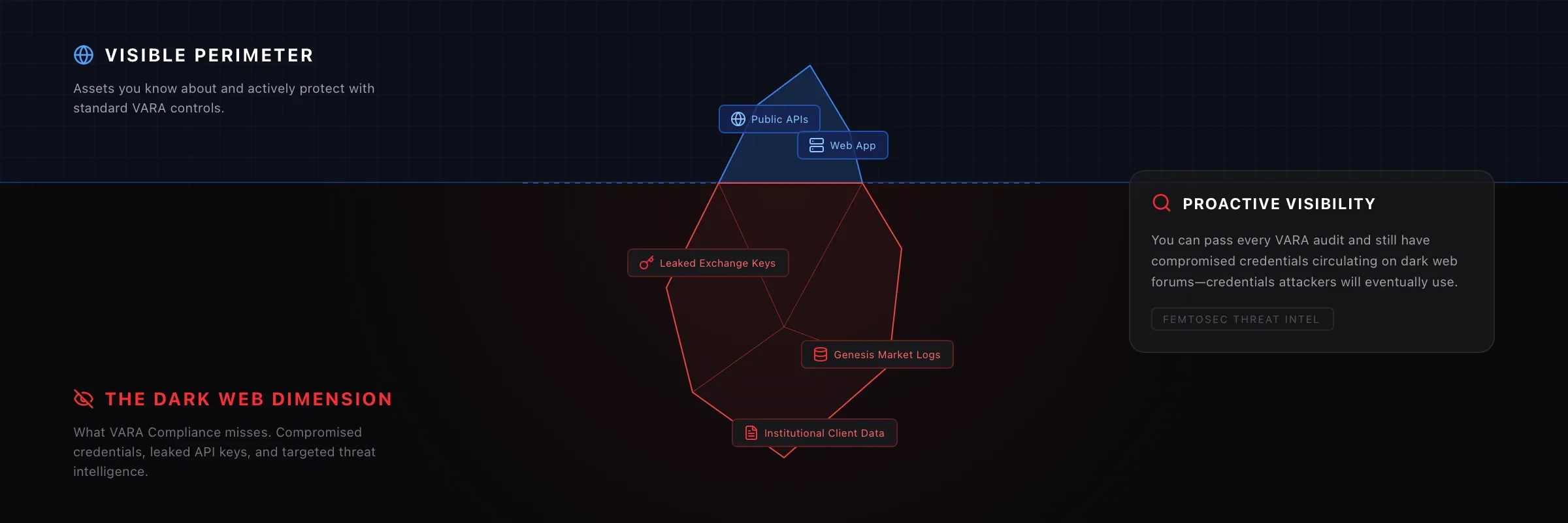
Here is something the VARA Technology Rulebook does not explicitly mandate, but every CISO in the digital asset space must address: dark web exposure monitoring. Licensed VASPs are high-value targets. The credentials of exchange employees, the wallet addresses of institutional clients, internal API keys, and unreleased product details all have market value on dark web forums and criminal marketplaces.
The gap between a firm having excellent internal security controls and that firm knowing whether its data is already being traded externally is significant. A company can pass every VARA audit and still have compromised credentials circulating on dark web forums credentials that attackers will eventually use to attempt account takeover, business email compromise, or targeted spear phishing.
Proactive dark web monitoring closes this visibility gap. By continuously scanning criminal forums, paste sites, and dark web marketplaces for references to your domain, employee credentials, and customer data, you can detect and respond to exposure before it becomes exploitation. For a VARA-licensed entity, this layer of intelligence is not optional; it is the difference between learning about a breach from VARA and learning about it before your attackers act on it.
Source Code Security: The Overlooked Requirement in VARA's Web3 Context
VARA's Technology Rulebook addresses technology governance broadly. Still, for VASPs whose product is software and in Web3, that is nearly all of them the security of the codebase itself deserves focused attention. A vulnerability in a smart contract can mean an irreversible loss of customer funds. A flaw in an exchange's order-matching engine can enable market manipulation. A backdoor in a custody platform's admin panel can expose wallets to insider exfiltration.
These risks require source code review a systematic security assessment of the application layer that goes beyond what black-box penetration testing can uncover. Source code review identifies logic errors, insecure dependencies, hardcoded secrets, and architectural flaws that only become apparent when a reviewer has access to the codebase.
For any VASP whose product includes smart contracts whether for staking, yield products, custody, or tokenised assets, smart contract auditing is an equally essential control. VARA's requirement for DLT-level security oversight makes this an implicit expectation of the licensing framework, even where it is not stated in a single named requirement.
Vulnerability Management: The Unglamorous Foundation of VARA Compliance
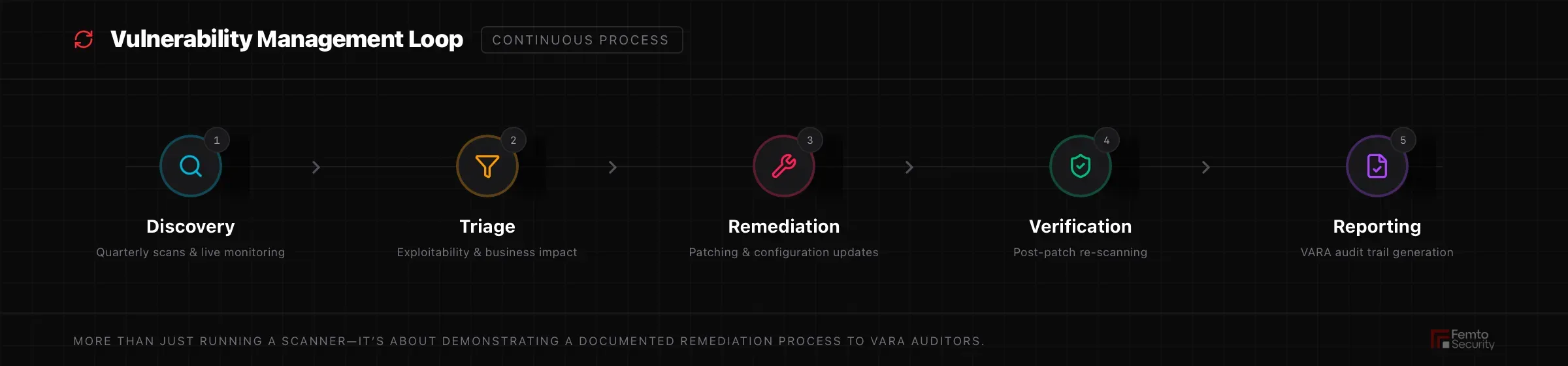
VARA's quarterly vulnerability scanning requirement often gets treated as an IT hygiene task rather than a strategic security activity. That is a mistake. Vulnerability management done properly is not just about running a scanner and generating a report it is about understanding which vulnerabilities represent real risk to your specific infrastructure, prioritising remediation based on exploitability and business impact and tracking closure with the rigour of a financial audit trail.
For VARA's purposes, the ability to demonstrate that you know your vulnerability posture, have a documented remediation process, and track and report your patch compliance rate to governance is as important as the technical output of the scans themselves. Vulnerability assessments conducted by an independent provider give you both the technical findings and the documentation artefacts needed for VARA audits.
AI-Powered Threats and the Next Frontier of VARA Compliance Cybersecurity
The VARA framework was published with a 2025/2026 horizon in mind, but the threat landscape is moving faster than regulatory updates. The most significant emerging risk for VARA-licensed VASPs is the convergence of AI and offensive security: AI-generated phishing campaigns targeted at crypto executives, automated smart contract exploitation tools, and AI-assisted social engineering that can bypass even well-trained staff.
Forward-looking VASPs are already augmenting their security programmes with AI-native testing capabilities. AI agentic pentesting represents the next evolution of penetration testing using AI agents to simulate sophisticated, adaptive attack patterns that traditional manual testing cannot replicate at scale. For VARA-licensed entities whose TLPT obligations require genuine threat simulation, this methodology provides both rigour and efficiency.
The regulatory trajectory is clear. As VARA continues to develop its framework the 2026 strategy guide outlines where the framework is heading the bar for technical security controls will only rise. Firms that treat VARA compliance as a one-time licensing hurdle rather than a continuous security maturity journey will repeatedly scramble to catch up.
VARA Compliance and Related UAE Regulatory Frameworks
VARA does not operate in isolation. VARA-licensed VASPs in Dubai also interact with adjacent regulatory frameworks that have security and data protection implications. Understanding how these frameworks interact is essential for firms with operations across multiple UAE jurisdictions or with international client bases.
Framework | Jurisdiction | Primary Focus | Key Intersection with VARA |
|---|---|---|---|
VARA Technology Rulebook | Dubai (ex-DIFC) | DLT, wallet security, crypto-native tech standards | Primary cybersecurity and technology framework for all Dubai-based VASPs |
DESC ISR | Dubai Government / Semi-Gov | Digital services & information security | Applies to government-related digital asset and blockchain initiatives |
UAE PDPL | Federal UAE | Personal data protection, DPO obligations | Governs how VASPs handle and protect customer data across the UAE |
DIFC DPDL | DIFC Free Zone | Data protection for DIFC entities | Relevant for VASPs operating within DIFC instead of VARA jurisdiction |
ISO 27001 | International Standard | Information security management system (ISMS) | Acts as a global baseline; supports audit readiness and aligns with VARA security expectations |
The intersection of VARA with the UAE's broader data protection architecture is particularly relevant for exchanges and custody platforms handling personal data at scale. ISO 27001 in the UAE provides a useful framework overlay firms that have achieved ISO 27001 certification often find that a significant portion of the VARA technical requirements can be evidenced through existing ISO documentation.
Building a VARA-Compliant Security Programme: A Practical Roadmap
For firms either approaching initial licensing or maturing an existing programme, the following phased approach provides a practical structure for building sustainable VARA compliance cybersecurity:
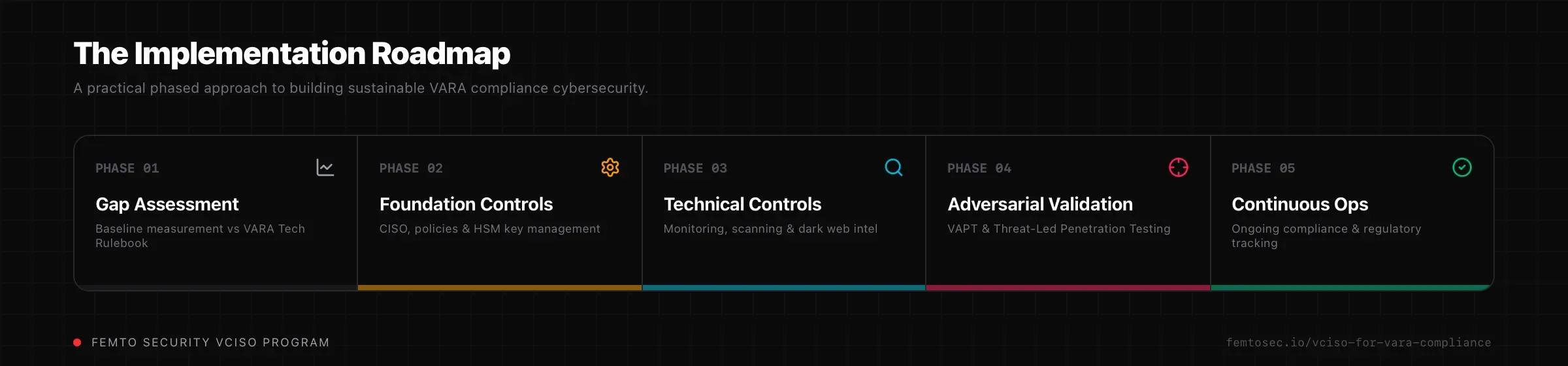
Phase 1: Gap Assessment and Baseline Measurement
Before any remediation work begins, you need an honest assessment of your current security posture measured against VARA's Technology Rulebook requirements. An independent third party should conduct this gap assessment, not your internal team, to ensure objectivity. The output should be a prioritised list of control gaps, a risk rating for each gap, and a remediation roadmap with realistic timelines and resource estimates.
Phase 2: Foundation Controls — CISO, Policies, and Key Management
The foundational controls that VARA requires CISO appointment, documented security policies, key management framework, and incident response plan must be in place before operational controls can be built on top of them. For firms without a full-time security leadership resource, a vCISO engagement provides the expertise needed to build these foundations quickly and to VARA's standard.
Phase 3: Technical Controls — Monitoring, Scanning, and Dark Web Intelligence
With foundational policies in place, the technical control layer can be built: continuous monitoring infrastructure, vulnerability scanning programmes, dark web intelligence feeds, and attack surface management tooling. Each control must be documented with evidence of operation VARA auditors will ask for logs, reports, and process records, not just configuration screenshots.
Phase 4: Adversarial Validation — Penetration Testing and Red Team
Once controls are operational, they must be independently validated. This means commissioning a formal penetration testing engagement for your infrastructure and applications, followed by a TLPT exercise that simulates real threat actor behaviour. Findings from these exercises feed directly back into the remediation programme and provide the audit evidence VARA requires.
Phase 5: Continuous Improvement and Regulatory Monitoring
VARA compliance is not a project with an end date it is an ongoing operational discipline. Firms need a mechanism to track regulatory updates, monitor changes to the Technology Rulebook, and continuously improve controls as the threat landscape evolves. For enterprise-scale programmes, Femto Security enterprise security services provide the breadth and depth needed for ongoing compliance assurance.
What VARA Compliance Signals to the Market
There is a commercial dimension to VARA compliance that should not be overlooked. In a market where institutional investors, sovereign wealth funds, and high-net-worth clients are making allocation decisions about digital assets, the presence or absence of a VARA licence and the security programme behind it is a material factor in due diligence.
Institutional counterparties conduct vendor security assessments before onboarding. Institutional custodians review the security posture of platforms they integrate with. Family offices conducting due diligence on a digital asset manager will ask about regulatory status, incident history, and independent security assessments. A mature VARA compliance programme is not just a regulatory obligation it is a competitive differentiator.
This is why the most forward-looking VASPs treat VARA compliance services not as a cost of doing business but as an investment in market positioning. The licence and the security programme behind it signal to the market that this organisation takes its obligations to clients, counterparties, and the broader financial system seriously.

Government and Regulated-Sector VASPs: A Higher Bar
For VASPs with government or regulated-sector clients such as central bank digital currency projects, sovereign digital asset initiatives, and government treasury tokenisation the security bar is even higher than VARA's baseline requirements. These engagements require security programmes that meet not only VARA's Technology Rulebook but also sector-specific government digital security standards.
The convergence of VARA compliance with government security requirements is one of the most technically complex areas in the UAE's emerging digital asset ecosystem. It requires expertise spanning regulatory compliance, public-sector security standards, and cutting-edge blockchain security a combination that very few providers can credibly deliver.
Conclusion:
The organisations that will define Dubai's digital asset ecosystem for the next decade are not the ones that achieve VARA compliance once and move on. They are the ones that internalise security as an organisational value where the CISO has a seat at the product table, where development teams understand secure coding practices, where board members can articulate their security risk posture, and where a real threat actor conducting reconnaissance on the organisation finds nothing worth exploiting.
That kind of organisation does not emerge from a one-time audit engagement. It is deliberately built over time through a combination of the right expertise, tools, and mindset. The VARA compliance framework, demanding as it is, provides the blueprint. Femto Security compliance services provide the team to help you build on it.
For those who want to go deeper on how Dubai is positioning itself as a global standard for crypto governance, this analysis of VARA as a global benchmark offers an important strategic perspective. And for teams working through the specific requirements of the licensing process, the complete guide to VARA regulations and licensing remains one of the most comprehensive resources available.
Dubai deliberately chose to make security non-negotiable in its digital asset framework. VARA compliance, for all its complexity, is ultimately a statement of intent: the UAE's intent to be the jurisdiction where digital assets are managed with the same rigour, transparency, and protection that the world's best financial institutions bring to traditional markets. For businesses that meet that standard, the reward is not just a licence. It is trust and in financial services, trust is everything.
Frequently Asked Questions (FAQs)
What is VARA compliance in cybersecurity?
VARA compliance refers to meeting the cybersecurity and regulatory requirements set by Dubai’s Virtual Assets Regulatory Authority. It includes controls such as key management, incident response, penetration testing, continuous monitoring, and the appointment of an independent CISO.
Why is VARA compliance important for VASPs?
VARA compliance is essential because it ensures:
Protection of digital assets from cyber threats
Regulatory approval for operating in Dubai
Increased trust from investors and institutional clients
Alignment with global cybersecurity standards
What are the key cybersecurity requirements under VARA?
The main VARA cybersecurity requirements include:
Cryptographic key management with HSM integration
72-hour incident reporting obligation
Annual Threat-Led Penetration Testing (TLPT)
Continuous monitoring and vulnerability scanning
Independent CISO appointment
Business continuity and disaster recovery planning
What is Threat-Led Penetration Testing (TLPT) in VARA?
TLPT is an advanced form of penetration testing that simulates real-world cyberattacks using actual threat intelligence. Unlike standard testing, it mimics tactics used by real attackers targeting crypto platforms.
How long do companies have to report incidents under VARA?
Organizations must report significant cybersecurity incidents to VARA within 72 hours, underscoring the criticality of strong detection and response systems.
Can a startup meet VARA cybersecurity requirements?
Yes, but it can be challenging. Startups often use solutions like:
Virtual CISO (vCISO) services
Managed security operations
Third-party compliance experts
to meet VARA standards efficiently.
What is the role of a CISO in VARA compliance?
A Chief Information Security Officer (CISO) ensures:
Security strategy aligns with VARA requirements
Risk management is properly implemented
Security decisions are independent of IT operations
Does VARA require continuous monitoring?
Yes, VARA mandates real-time monitoring, regular vulnerability scans, and ongoing visibility of the organization’s attack surface to detect threats proactively.
Continue Reading
October 6, 2026
What Is ISO 42001? The Complete AI Management System Guide
Everything about ISO 42001: what it requires, Annex A controls, certification steps, and how it compares with ISO 27001, the EU AI Act, and NIST.
September 24, 2026
VARA Cybersecurity Requirements | What Every VASP Must Do
VARA cybersecurity requirements explained: CISO, annual pen testing, 72-hour incident reporting and key security. Rules vs guidance, and evidence to keep.
September 14, 2026
ISO 9001:2015 vs ISO 9001:2026: What Actually Changed
Discover key changes in ISO 9001:2026 vs ISO 9001:2015. Learn about clause updates, quality culture, ethics, climate change, and the transition timeline.