
Autonomous AI PenTesting: The Future of Cybersecurity is Already Here
Imagine hiring a security guard who only checks the locks once a year and leaves for the other 364 days. That's essentially what traditional penetration testing has been doing to enterprise security for decades.
In 2026, the threat landscape has evolved into something far more aggressive, adaptive, and relentless. Ransomware gangs now use automation. Nation-state actors deploy zero-days within hours. And yet, most organizations still rely on manual penetration tests scheduled once or twice a year, leaving enormous windows of vulnerability that attackers are more than happy to exploit.
Enter autonomous AI pentesting arguably the most consequential shift in offensive security since the birth of ethical hacking itself. This isn't just a new tool in the toolkit. It's a paradigm shift: from snapshot-in-time security audits to continuous, intelligent, self-directed attack simulation that operates 24/7, scales across thousands of assets, and delivers proof-of-exploit evidence in real time.
This blog dives deep into what autonomous AI pentesting is, how it works, where it excels, where it still needs human judgment, and why forward-thinking organizations from UAE enterprises to global financial institutions are making it the cornerstone of their security strategy.
What is Autonomous AI PenTesting?
Autonomous AI pentesting (also called AI-driven penetration testing, agentic pentesting, or automated offensive security) refers to the use of artificial intelligence primarily agentic AI architectures and reinforcement learning to simulate cyberattacks with little to no human intervention.
Unlike automated vulnerability scanners that simply check for known CVEs, autonomous AI pentesting systems think like attackers. They map attack surfaces, chain exploits, pivot through environments, validate vulnerabilities with real payloads, and generate detailed remediation reports all autonomously.
The critical distinction is this: traditional scanners find potential vulnerabilities. Autonomous AI pentesters prove them by actually exploiting them.
This approach aligns naturally with services like AI Agentic Pentesting, where intelligent agents simulate real-world attack scenarios that static tools cannot replicate.
Key Fact: According to industry research, AI-powered penetration testing can reduce enterprise security testing costs by 70–80% while compressing testing cycles from weeks to just hours.
Why Traditional Penetration Testing is No Longer Enough
To understand the value of autonomous AI pentesting, you first need to appreciate the structural limitations of traditional approaches.
The 364-Day Problem
A typical organization schedules a penetration test once or twice per year. That means for roughly 364 days out of 365, their security posture is assumed not verified. Every new code deployment, configuration change, cloud misconfiguration, or third-party integration introduced in that window represents an untested attack vector.
In an environment where modern DevOps teams push hundreds of code updates per week, this model is fundamentally broken.
The Human Bandwidth Problem
Skilled penetration testers are expensive and rare. A senior penetration tester can only work on one engagement at a time, and comprehensive testing of a complex enterprise environment covering web apps, APIs, network infrastructure, cloud configurations, and Active Directory can take weeks.
For organizations running hundreds of microservices or multi-cloud architectures, full manual coverage is simply not achievable within a budget that doesn't break the bank.
The Coverage Problem
Manual testers focus their effort based on scope, time, and intuition. They may miss obscure API endpoints, shadow IT assets, or recently exposed services simply because those assets weren't on the radar when the scope was defined.
This is precisely why Attack Surface Management has become an essential companion to penetration testing continuously discovering and monitoring every asset an attacker could target.
How Autonomous AI PenTesting Works: The Technical Architecture
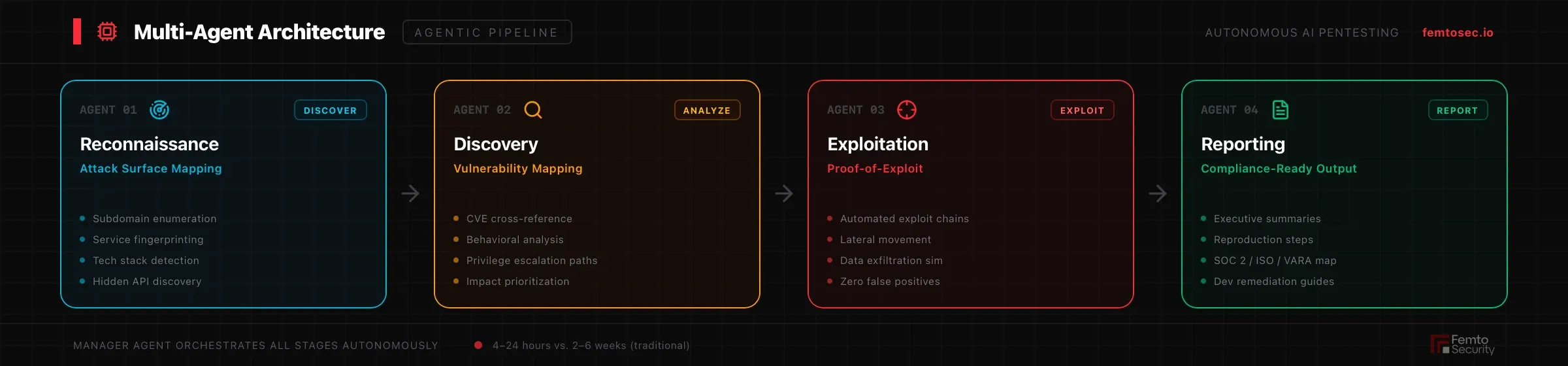
Modern autonomous AI pentesting platforms are built on multi-agent architectures, where a "manager" agent orchestrates several specialized "worker" agents through a structured attack workflow. Here's how the pipeline typically operates:
Stage 1: Reconnaissance Agent
The reconnaissance phase is where the AI maps the attack surface. This agent:
Identifies all subdomains, IP ranges, and exposed services
Discovers hidden APIs, admin panels, and misconfigured cloud storage buckets
Enumerates software versions and technology stacks
Detects authentication mechanisms and access controls
The output feeds a continuously updated asset inventory something that manual testers can only approximate during their engagement window.
Stage 2: Discovery and Vulnerability Mapping Agent
Armed with the asset map, the discovery agent:
Cross-references all discovered assets against the latest CVE databases
Performs behavioral analysis to identify logical flaws not covered by signature-based detection
Prioritizes vulnerabilities by exploitability and business impact
Identifies privilege escalation pathways and lateral movement opportunities
This phase benefits enormously from AI's ability to process vast amounts of threat intelligence, a capability that complements Vulnerability Assessments and provides security teams with far richer prioritization data.
Stage 3: Exploitation Agent
This is where autonomous AI pentesting truly differentiates itself. The exploitation agent:
Uses tools like Metasploit, Nmap, and custom exploit scripts to attempt unauthorized access
Chains multiple low-severity vulnerabilities to achieve high-impact outcomes
Simulates attacker behavior, including lateral movement and data exfiltration
Maintains proof-of-exploit evidence (screenshots, logs, payload outputs) for reporting
The "no exploit, no report" philosophy adopted by leading platforms means only confirmed exploitable vulnerabilities are flagged dramatically reducing the false-positive noise that buries security teams.
Stage 4: Reporting Agent
The final agent synthesizes findings into:
Executive summaries with business risk context
Technical reports with step-by-step reproduction instructions
Compliance-mapped findings (SOC 2, ISO 27001, PCI-DSS, VARA)
Developer-ready remediation guidance with code-level recommendations
Autonomous AI PenTesting vs. Traditional Methods: A Side-by-Side Comparison
Feature | Traditional Pen Testing | Autonomous AI Pen Testing |
|---|---|---|
Testing Frequency | 1–2× per year | Continuous / on-demand |
Time to Results | 2–6 weeks | Hours |
Coverage | Scoped, limited assets | All assets, unlimited scope |
False Positive Rate | Moderate–High | Near-zero (proof-of-exploit only) |
Cost per Engagement | $15,000–$100,000+ | Significantly lower at scale |
CI/CD Integration | Manual handoff | Native pipeline integration |
Scalability | Limited by team size | Thousands of endpoints simultaneously |
Compliance Reporting | Manual document creation | Auto-generated, audit-ready |
Business Logic Testing | Excellent | Improving, still needs humans |
Novel Threat Detection | Human-dependent | AI/ML-assisted pattern detection |
Key Benefits Driving Enterprise Adoption
1. Continuous Security Validation
The most transformative benefit of autonomous AI pentesting is the shift from periodic to continuous security validation. By integrating directly into CI/CD pipelines, AI pentesting systems test every new code release before it reaches production.
This closes the security gap that traditional testing leaves wide open the period between engagements when new vulnerabilities are introduced and remain undetected.
For enterprises managing complex environments, this continuous validation model pairs well with Red Teaming services engagements, where human-led adversarial exercises complement AI-driven automated scanning.
2. Near-Zero False Positives
One of the most persistent pain points in vulnerability management is alert fatigue security teams are overwhelmed by hundreds of scanner findings, most of which turn out to be false positives that waste remediation cycles.
Leading autonomous AI pentesting platforms address this by requiring a proof-of-exploit: a vulnerability is reported only if the AI has successfully exploited it with a real payload. This philosophy transforms security reports from noise into signal.
3. Dramatic Cost Reduction
Enterprise-grade penetration testing has historically been a luxury accessible mainly to large organizations with substantial security budgets. Autonomous AI changes this equation fundamentally.
By automating the reconnaissance, discovery, and exploitation phases that consume most of a human tester's time, AI platforms reduce costs by an estimated 70–80% compared to traditional engagements without sacrificing depth of coverage.
This democratizes serious security validation for mid-market companies and emerging enterprises that previously couldn't afford comprehensive testing.
4. Scalability Across Complex Environments
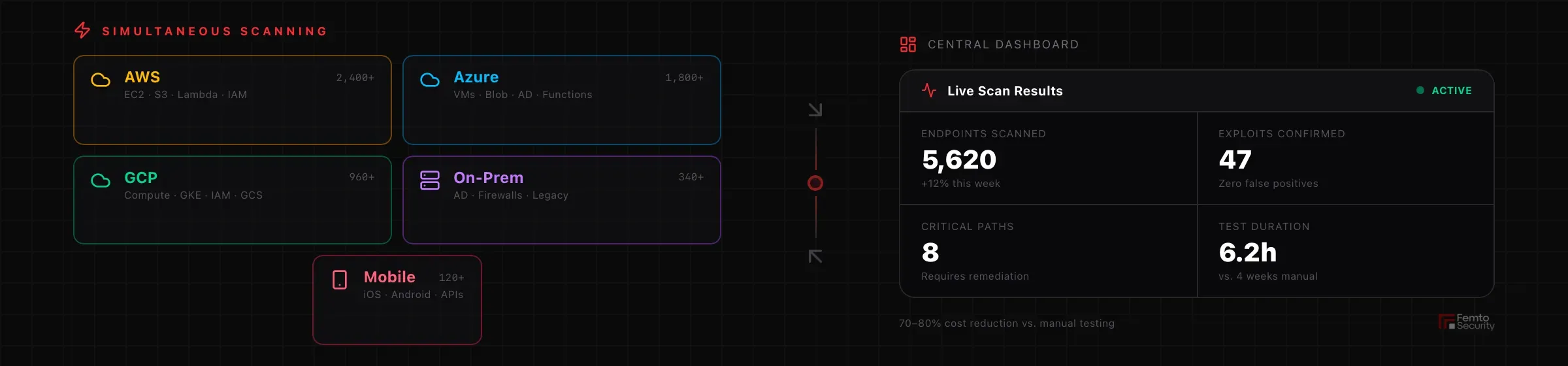
Modern enterprise environments are sprawling. Hundreds of microservices, multi-cloud deployments across AWS, Azure, and GCP, hybrid on-premises infrastructure, third-party APIs, mobile backends, and IoT devices all creating an attack surface that grows faster than any human team can track.
Autonomous AI agents can simultaneously probe thousands of endpoints across all these environments, something that would require armies of human testers working in parallel.
Leading Autonomous AI PenTesting Platforms in 2026
Platform | Type | Core Strength |
|---|---|---|
NodeZero (Horizon3.ai) | SaaS | Most mature platform; network/cloud/Active Directory attacks with proof-of-exploit |
Shannon (Keygraph) | Open Source | White-box pentester analyzing source code for zero-false-positive targeted exploits |
PentestGPT | Open Source | LLM-guided interactive assistant for human-directed testing workflows |
XBOW | SaaS | Multi-agent execution engine purpose-built for deep application testing |
RidgeBot | SaaS | Specializes in autonomous vulnerability mining and automated lateral movement |
Where AI Excels — And Where Humans Still Lead(H2)
Autonomous AI pentesting is powerful, but intellectually honest organizations acknowledge that it isn't a complete replacement for human expertise. Understanding this balance is critical to building a mature security program.
Where AI Excels
Known CVE exploitation: AI systems are exceptionally fast and thorough at matching infrastructure against known vulnerability databases and exploiting well-documented attack paths.
Continuous monitoring: No human team can match AI for 24/7, always-on security monitoring across thousands of assets.
Compliance documentation: Auto-generating audit-ready reports aligned with frameworks such as ISO 27001, SOC 2, and VARA compliance is a natural fit for AI's document-generation capabilities.
API security testing: AI agents excel at systematically probing API endpoints to uncover authentication bypasses, injection vulnerabilities, and access-control misconfigurations.
Where Human Expertise Remains Essential
Business logic flaws: Complex logical vulnerabilities such as privilege escalation that requires understanding multi-step business workflows, cross-user data manipulation, or financial calculation errors require human testers who understand the application's intent, not just its structure.
Novel attack vectors: Highly creative, novel attack chains that don't follow known patterns still benefit enormously from experienced human intuition. This is the domain of professional Penetration Testing engagements that go beyond automated tooling.
Social engineering: Phishing simulations, vishing attacks, and physical security assessments require human actors areas where Security Awareness training plays a crucial role in building organizational resilience.
AI-specific vulnerabilities: Ironically, traditional pentesting tools including many autonomous AI platforms don't cover risks specific to AI systems themselves: prompt injection, model evasion, data poisoning, and training data extraction. Testing AI systems requires specialized methodologies beyond standard pentesting frameworks.
The ideal security posture combines AI-driven automation for continuous coverage with periodic deep human-led engagements for complex, context-dependent scenarios.
Autonomous AI PenTesting and Compliance: A Natural Fit
One often underappreciated benefit of autonomous AI pentesting is how naturally it maps to regulatory and compliance requirements particularly in highly regulated markets like the UAE.

VARA Compliance and Cybersecurity Testing
For virtual asset service providers (VASPs) operating in Dubai under the Virtual Assets Regulatory Authority (VARA), continuous security validation isn't just a best practice it's increasingly a regulatory expectation. VARA's framework explicitly requires robust cybersecurity controls, and autonomous AI pentesting provides the continuous evidence of security efficacy that regulators want to see.
If you're navigating VARA compliance, our dedicated vCISO for VARA Compliance service provides expert guidance on building security programs that satisfy regulatory requirements while leveraging the latest in autonomous testing technology. You can also explore our detailed VARA Dubai Regulations for a comprehensive overview of obligations.
ISO 27001 and Continuous Testing
ISO 27001 certification requires organizations to maintain an active, ongoing information security management system, not a point-in-time snapshot. Autonomous AI pentesting supports this by generating continuous evidence of security posture assessment, which simplifies both initial certification and ongoing surveillance audits.
For organizations pursuing ISO 27001 certification in the UAE, our blog provides the strategic framework you need.
Smart Contract and Blockchain Security
For Web3 organizations and DeFi platforms, autonomous AI pentesting must extend into the smart contract layer. AI-assisted code analysis can identify reentrancy vulnerabilities, integer overflows, and access control flaws at scale though deep smart contract security still benefits from expert human review through specialized Smart Contract Auditing services.
Critical Risks and Operational Considerations
Deploying autonomous AI pentesting isn't without risks that security teams must carefully manage.
Production Environment Risk
Aggressive exploitation agents can cause unintended service disruptions if run against production systems without proper controls. Responsible platforms include throttling mechanisms and sandboxing options, but organizations must configure them thoughtfully. Always establish clear rules of engagement before any autonomous pentesting engagement.
Scope Creep and Lateral Movement
AI agents following attack chains can inadvertently move beyond the intended scope if not properly bounded. This is particularly risky in interconnected cloud environments where a single misconfiguration can provide a path to adjacent systems outside the testing boundary.
The AI vs. AI Security Gap
Perhaps the most forward-looking concern: traditional penetration testing including most autonomous AI pentesting platforms doesn't cover vulnerabilities in AI systems. As organizations deploy AI-powered applications, chatbots, recommendation systems, and decision engines, entirely new attack surfaces emerge:
Prompt injection: Manipulating AI system behavior through crafted inputs
Data poisoning: Corrupting training data to degrade model performance or introduce backdoors
Model evasion: Crafting inputs that fool AI classifiers while appearing normal to humans
Training data extraction: Recovering sensitive information memorized during model training
Testing these vulnerabilities requires specialized expertise beyond standard pentesting frameworks, an area where the security industry is actively evolving methodologies.
Dark Web Exposure
Autonomous AI pentesting validates what attackers can do from outside your perimeter but it doesn't tell you what's already been exposed on criminal forums, paste sites, and dark web marketplaces. Stolen credentials, leaked source code, and compromised API keys circulating on underground markets represent attack enablers that no pentesting tool can see.
This is why Dark Web Monitoring is an essential complement to any autonomous pentesting program providing security teams with visibility into threat actor activity before it escalates into an active breach.
Autonomous AI PenTesting for Enterprise and Government
Enterprise Applications
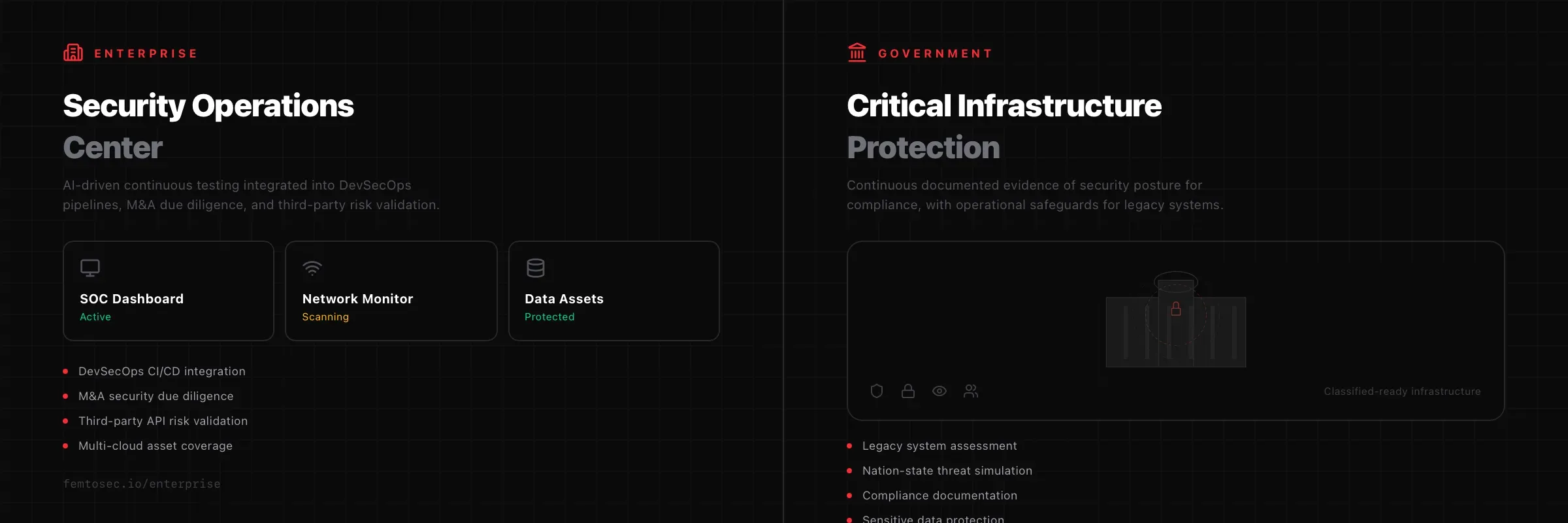
For large enterprises managing complex hybrid environments, autonomous AI pentesting delivers value across multiple use cases:
DevSecOps integration: Testing every pull request and deployment pipeline stage before code reaches production, catching vulnerabilities at the cheapest point in the development lifecycle.
M&A security due diligence: Rapidly assessing the security posture of acquisition targets in weeks rather than months, providing accurate risk quantification for deal valuation.
Third-party risk validation: Continuously testing the security of vendor APIs and integrations that represent indirect attack paths into enterprise systems.
Femto Security Enterprise security services are designed to integrate autonomous AI testing into broader security programs tailored to large-scale environments.
Government and Critical Infrastructure
Government agencies face unique challenges: highly sensitive data, strict compliance requirements, legacy systems that are difficult to update, and threat actors ranging from criminal ransomware gangs to nation-state adversaries.
Autonomous AI pentesting provides government agencies with continuous, documented evidence of security posture supporting compliance requirements while providing actionable remediation guidance for complex legacy environments. Femto Security Government security solutions address these unique requirements with appropriate operational safeguards.
The Human-AI Collaboration Model: Best Practice for 2026
The most effective security programs aren't choosing between human expertise and autonomous AI they're designing deliberate collaboration models that leverage the strengths of both.
Here's what a mature human-AI pentesting program looks like in practice:
Continuous AI baseline: Autonomous AI agents run 24/7 against the full asset inventory, continuously validating that no exploitable paths exist and alerting immediately when new vulnerabilities emerge.
Triggered human review: When the AI discovers complex attack chains, unusual access patterns, or vulnerabilities requiring business context to assess, human experts are engaged to validate impact and assess exploitability.
Quarterly deep dives: Human-led Red Teaming engagements conducted quarterly focus specifically on areas where AI struggles: business logic, social engineering, novel attack techniques, and insider threat scenarios.
Source code security: AI-assisted Source Code Review combining static analysis automation with human expert review for complex codebases, catching vulnerabilities that dynamic testing alone misses.
Compliance reporting: AI-generated compliance evidence supplemented by human expert attestation for regulatory submissions and audit responses.
This layered model delivers the coverage, speed, and cost-efficiency of AI alongside the contextual judgment and creative thinking that human experts uniquely provide.
Real-World Impact: What the Numbers Say
The business case for autonomous AI pentesting becomes compelling when you look at the data:
Fact: The average time to detect a breach is 197 days. Continuous AI pentesting can reduce the time to detectable vulnerability windows from months to hours.
Fact: The average cost of a data breach in 2025 reached $4.88 million globally, with higher costs in regulated industries like finance and healthcare.
Fact: Human penetration testers can realistically test 50–100 endpoints per day. AI agents can simultaneously assess thousands of endpoints across all environments.
Fact: Organizations with mature security testing programs experience 50% fewer high-severity incidents compared to those with annual-only testing cadences.
Fact: AI pentesting platforms report false-positive rates of under 5% compared to 30–40% for traditional vulnerability scanners dramatically reducing remediation cycles.
These aren't hypothetical projections. They represent the measurable outcomes organizations are achieving as they transition from periodic manual testing to continuous AI-driven security validation.
Phishing, Social Engineering, and the Human Layer
While autonomous AI pentesting excels at technical attack simulation, the human attack surface remains critically important—and distinctly human.
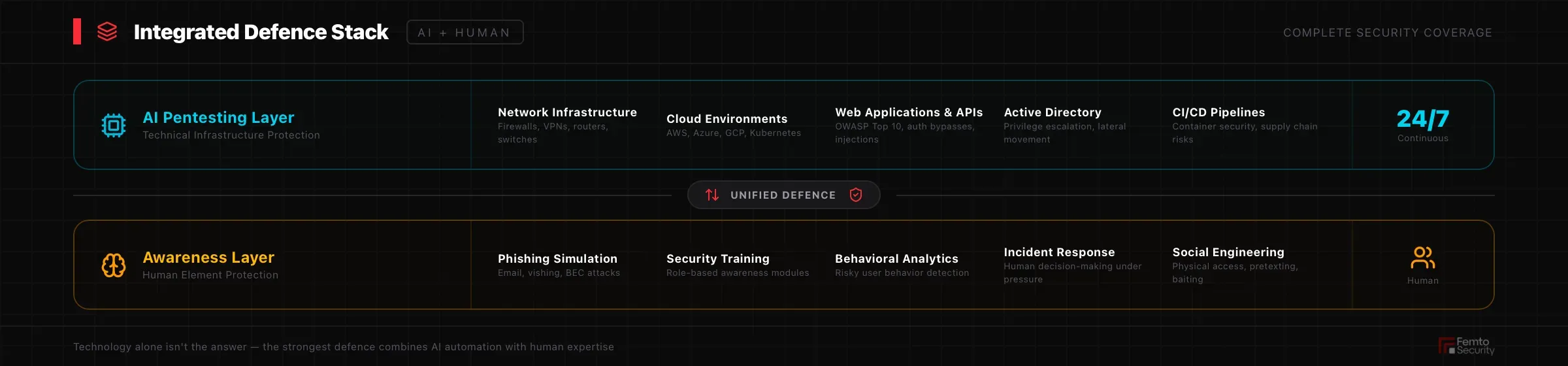
Phishing remains the entry point for the majority of successful breaches. No amount of technical penetration testing addresses the risk of an employee clicking a malicious link, sharing credentials with a fake IT helpdesk, or falling for a business email compromise scam.
This is why technical autonomous testing must be paired with human-layer defenses. Our 2026 Phishing Awareness Guide provides practical guidance on building a human firewall to complement your technical security controls.
Security Awareness programs that run simulated phishing campaigns, contextual training, and behavioral analytics are the human equivalent of autonomous AI pentesting continuously measuring and improving the security posture of the most vulnerable layer in any organization.
Choosing an Autonomous AI PenTesting Provider: What to Look For
Not all AI pentesting platforms are created equal. When evaluating providers, look for these critical capabilities:
Proof-of-exploit requirement: Reject any platform that reports vulnerabilities without demonstrating successful exploitation. High false-positive rates waste your team's time and erode trust in the tool.
Safe testing guarantees: Ensure the platform has robust production-safe controls, including rate limiting, sandboxing options, and configurable impact boundaries.
Compliance mapping: Look for native integration with compliance frameworks relevant to your industry SOC 2, ISO 27001, PCI-DSS, VARA, HIPAA that generate auto-generated, audit-ready reports.
CI/CD integration: The platform should integrate natively with your development pipeline and not require manual triggering.
Human escalation path: The best platforms know their limitations and provide clear escalation paths to human experts for complex findings that require contextual assessment.
Coverage breadth: Evaluate coverage across network, cloud, web applications, APIs, Active Directory, and container environments your attack surface doesn't respect artificial boundaries.
For organizations seeking expert guidance on selecting and deploying the right security testing approach, Femto Security Compliance Services team can help design a testing program aligned with your specific risk profile and regulatory environment.
The Future of Autonomous AI PenTesting: What's Coming
The trajectory of autonomous AI pentesting over the next two to three years points toward several significant developments:
AI vs. AI testing: As AI systems become ubiquitous targets, specialized autonomous agents designed to test AI infrastructure probing for prompt injection, model extraction, and adversarial robustness will become standard components of security programs.
Real-time exploit chaining: Current platforms are excellent at single-step exploitation. The next generation will become dramatically more sophisticated at chaining dozens of low-severity findings into realistic high-impact attack scenarios that reflect how actual threat actors operate.
Natural language interfaces: Security teams will increasingly interact with AI pentesting systems through conversational interfaces asking questions like "what's the highest-risk path from the internet to our payment database?" and receiving instant, evidence-backed answers.
Regulatory recognition: Regulatory frameworks in the UAE, EU, and globally are beginning to recognize continuous AI-driven testing as a valid and in some cases preferred evidence source for compliance requirements. This will accelerate adoption among regulated industries.
Autonomous remediation: Beyond finding vulnerabilities, the next frontier is AI systems that automatically generate and, in controlled environments, deploy fixes, creating a closed-loop security automation system.
Conclusion:
The security gap between traditional annual pen tests and the actual threat environment isn't a minor inefficiency; it's an existential risk for organizations handling sensitive data, financial assets, or critical infrastructure.
Autonomous AI pentesting closes that gap. By shifting from snapshot assessments to continuous, intelligent attack simulation, organizations finally achieve security validation that keeps pace with both their own development velocity and the sophistication of threat actors.
But technology alone isn't the answer. The organizations getting the most value from autonomous AI pentesting are those that pair it deliberately with human expertise experienced penetration testers for complex business logic, security awareness programs for the human layer, dark web monitoring for external threat intelligence, and compliance-savvy advisors who translate technical findings into regulatory evidence.
The future of cybersecurity is a deliberate partnership between AI-driven automation and human judgment. The organizations that build that partnership now rather than waiting for a breach to force the issue are the ones that will define what secure looks like in the years ahead.
Ready to explore how autonomous AI pentesting fits into your security strategy? Explore Femto Security's full range of cybersecurity services or connect with our team to discuss your specific security requirements.
Frequently Asked Questions (FAQs)
What is autonomous AI pentesting, and how is it different from traditional penetration testing?
Autonomous AI pentesting uses artificial intelligence, particularly agentic AI systems and reinforcement learning to continuously simulate cyberattacks without requiring human testers to run each test manually. Traditional penetration testing is conducted by human experts on a scheduled basis (typically once or twice a year), producing a point-in-time snapshot of security posture. Autonomous AI pentesting runs continuously, testing every new code deployment and infrastructure change in near real time.
Can autonomous AI pentesting completely replace human penetration testers?
Not entirely, and the most effective programs don't try to make that trade-off. AI excels at continuous coverage, speed, scale, and the exploitation of known CVEs. Human testers excel at business logic flaws, novel attack techniques, social engineering, and contextual vulnerability assessment. The best approach combines AI-driven continuous testing with periodic deep human-led engagements.
Is autonomous AI pentesting safe to run on production environments?
Leading platforms include safety controls such as rate limiting, sandboxing, and configurable impact boundaries that make production testing feasible. However, organizations should always establish clear rules of engagement, start with staging environments, and carefully configure impact boundaries before running aggressive exploitation against production systems.
How does autonomous AI pentesting support VARA compliance in the UAE?
VARA's cybersecurity requirements for virtual asset service providers include expectations around continuous security validation and robust technical controls. Autonomous AI pentesting provides continuous, documented evidence of security posture assessment, auto-generated compliance-mapped reports, and the ability to demonstrate ongoing security program effectiveness to regulators. Paired with a dedicated vCISO for VARA Compliance, it forms a powerful compliance foundation.
What types of vulnerabilities can autonomous AI pentesting detect?
AI pentesting platforms cover a broad range of vulnerabilities, including network and infrastructure vulnerabilities, web application flaws (OWASP Top 10 and beyond), API security issues, cloud misconfigurations (AWS, Azure, GCP), Active Directory and identity attacks, container and Kubernetes vulnerabilities, and credential-based attacks. They are generally less effective at detecting business logic flaws and AI-specific vulnerabilities, such as prompt injection.
How much does autonomous AI pentesting cost compared to traditional testing?
Industry data suggests AI-driven testing reduces enterprise security testing costs by 70–80% at scale compared to traditional engagement-based models. Exact pricing varies by platform and scope, but the continuous coverage delivered by AI platforms at a fraction of the cost of equivalent manual testing represents a compelling ROI for most enterprise security budgets.
What is the role of dark web monitoring alongside AI pentesting?
Autonomous AI pentesting validates what attackers could do from outside your perimeter. Dark web monitoring tells you what threat actors already have stolen credentials, leaked data, compromised API keys, and intelligence about planned attacks circulating in underground markets. Together, they provide both proactive security validation and real-time threat intelligence, creating a comprehensive external security program.
Continue Reading
October 9, 2026
LLM Security Testing | OWASP Risks, Tools & Best Practices
LLM security testing explained: compare pentesting, red teaming, and automated scanning, and learn how to test agents, RAG apps, and AI-powered tools.
October 7, 2026
How to Implement the NIST AI RMF | The Four Core Functions
The NIST AI RMF explained: what Govern, Map, Measure and Manage require, the seven trustworthy AI traits, and how to put each function into practice.

September 30, 2026
AI Supply Chain Security | Risks, Attacks & How to Secure It
AI supply chain security explained: how models, datasets, and agent tools get compromised, real attack case studies, and the controls that stop them.