
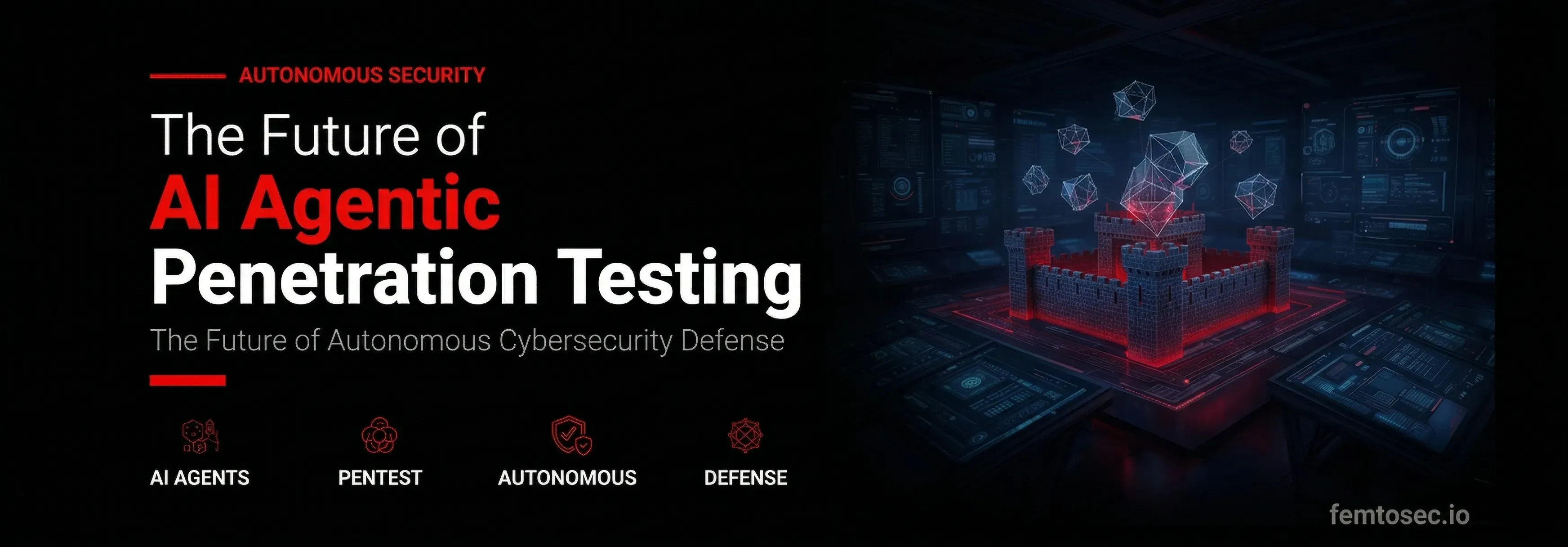
AI Agentic Penetration Testing: The Future of Autonomous Cybersecurity Defense
Continue Reading
October 9, 2026
LLM security testing explained: compare pentesting, red teaming, and automated scanning, and learn how to test agents, RAG apps, and AI-powered tools.
October 7, 2026
The NIST AI RMF explained: what Govern, Map, Measure and Manage require, the seven trustworthy AI traits, and how to put each function into practice.

September 30, 2026
AI supply chain security explained: how models, datasets, and agent tools get compromised, real attack case studies, and the controls that stop them.
Cybersecurity is undergoing a profound transformation as organizations face increasingly sophisticated cyber threats. Traditional security methods are no longer sufficient to detect complex vulnerabilities or stop modern attackers. This is where AI Agentic Penetration Testing emerges as a revolutionary solution.
By combining artificial intelligence with offensive cybersecurity techniques, Autonomous AI Pen Testing enables organizations to simulate real-world attacks continuously and detect weaknesses before hackers exploit them. Unlike conventional security testing, AI-driven penetration testing operates faster, smarter, and more efficiently, offering businesses a proactive defense strategy.
AI Agentic Penetration Testing refers to the use of autonomous AI agents that can conduct penetration tests without constant human supervision. These AI agents replicate the decision-making process of professional ethical hackers as they analyze attack paths and vulnerabilities across networks, applications, and cloud environments.
Unlike traditional penetration testing, which often takes weeks to complete, AI-powered agents can perform assessments in hours while maintaining deep vulnerability coverage. According to cybersecurity platforms that implement AI pentesting, automated testing can be 10x faster than manual security assessments while maintaining accuracy and validating vulnerabilities.
Traditional penetration testing remains an essential cybersecurity practice, but it has limitations when addressing modern cyber threats.
Challenge | Description |
|---|---|
Limited Frequency | Testing often happens quarterly or annually |
High Cost | Skilled pentesters require significant time and resources |
Slow Remediation | Weeks may pass before vulnerabilities are reported |
Partial Coverage | Complex environments may leave hidden attack surfaces |
AI Agentic Penetration Testing follows a structured methodology that closely resembles real-world cyberattack strategies.
Automated Reconnaissance
AI agents gather intelligence on network infrastructure, domains, APIs, and applications.
Vulnerability Detection
Machine learning algorithms analyze system configurations and identify weaknesses.
Exploit Simulation
AI safely attempts to exploit vulnerabilities to determine the real-world impact.
Attack Chain Mapping
Autonomous agents combine multiple vulnerabilities to simulate advanced attack scenarios.
Security Reporting
Detailed reports highlight risk severity, affected systems, and remediation steps.
AI-driven systems can continuously run tests on demand, enabling organizations to identify vulnerabilities immediately after deployment or infrastructure changes.
For deeper adversary simulation exercises, organizations can deploy advanced cybersecurity testing such as red teaming.
AI-powered penetration testing provides significant advantages over traditional security testing approaches.
1. Continuous Security Testing
Unlike manual tests, autonomous AI testing can run 24/7 and detect vulnerabilities in real time.
2. Faster Threat Detection
AI can complete penetration tests in 4–24 hours, compared to the weeks required for traditional testing.
3. Reduced False Positives
AI agents validate vulnerabilities by simulating real exploit attempts.
4. Scalable Security Testing
AI testing easily scales across cloud systems, networks, APIs, and IoT infrastructure.
5. Cost Efficiency
Automated testing reduces operational costs while increasing testing frequency.
Organizations managing Web3 infrastructure or blockchain platforms can further secure their systems with smart contract auditing.
Cybersecurity compliance has become increasingly important for organizations operating in regulated environments. Dubai’s Virtual Assets Regulatory Authority (VARA) is one of the most advanced frameworks for regulating digital asset security.
Understanding the evolving regulatory landscape is essential for organizations working with cryptocurrency, fintech, or blockchain technologies. Insights on the regulatory framework can be explored through VARA Framework. AI Agentic Penetration Testing helps companies meet compliance requirements by continuously validating security controls and identifying vulnerabilities before regulatory audits.
Cybersecurity experts now emphasize a layered defense strategy in which multiple security measures work together to protect digital assets.
Security Layer | Function |
|---|---|
AI Agentic Penetration Testing | Continuous vulnerability testing |
Vulnerability Assessments | Risk identification and prioritization |
Dark Web Monitoring | Detect leaked credentials or data |
Security Awareness | Reduce human error and phishing risks |
A strong cybersecurity strategy also includes vulnerability scanning and continuous risk monitoring through vulnerability assessments.
AI Agentic Penetration Testing is rapidly gaining adoption across multiple industries.
Large organizations operate complex infrastructures with cloud services, SaaS platforms, and hybrid networks. AI-driven penetration testing ensures continuous monitoring and protection of these environments. Companies operating critical infrastructure or enterprise IT systems can strengthen their defenses using government solutions.
The growth of decentralized finance has introduced new cybersecurity challenges. Smart contract vulnerabilities, protocol exploits, and wallet attacks have resulted in billions of dollars in losses.
AI-driven penetration testing helps detect logic flaws and security weaknesses before they affect blockchain systems.
Organizations can further improve their blockchain security posture through mastering vara compliance.
One of the major sources of cyber attacks comes from data leaks on underground forums and marketplaces. Organizations must continuously monitor these environments to detect stolen credentials and leaked sensitive information.
While AI Agentic Penetration Testing dramatically improves efficiency, human expertise remains crucial in cybersecurity. Security professionals analyze complex attack scenarios, validate high-risk vulnerabilities, and develop long-term defensive strategies. Organizations must also train employees to recognize phishing attacks, social engineering attempts, and other human-targeted threats.
Feature | Traditional Penetration Testing | AI Agentic Penetration Testing |
|---|---|---|
Testing Speed | 2–4 weeks | 4–24 hours |
Testing Frequency | Periodic | Continuous |
Cost | High | Lower operational cost |
Coverage | Limited scope | Full attack surface discovery |
False Positives | Possible | Near-zero due to validation |
The cybersecurity industry is rapidly shifting toward AI-native security architectures. In the coming years, AI penetration testing platforms will incorporate advanced capabilities such as:
Predictive threat modeling
Autonomous vulnerability patch recommendations
AI-driven incident response
DevSecOps integration
These advancements will allow organizations to detect vulnerabilities before attackers even attempt exploitation.

While AI Agentic Penetration Testing provides significant advantages, organizations must also understand its potential risks and limitations. Autonomous security systems require proper governance, monitoring and validation to ensure safe and effective operation.
One major concern is false positives or automated misinterpretation of vulnerabilities, which can occur if AI systems lack sufficient contextual understanding. This is why human oversight remains critical when deploying Autonomous AI Pen Testing solutions.
Organizations implementing AI-based security must also maintain strong cybersecurity frameworks such as vulnerability assessment and penetration testing.
Agentic AI introduces new security challenges because these systems can make autonomous decisions and execute actions independently.
Risk | Description |
|---|---|
Prompt Injection | Attackers manipulate AI instructions to bypass security |
Data Leakage | AI agents may expose sensitive information |
Unauthorized Access | Poor access control may allow AI misuse |
Misconfigured AI Agents | Incorrect boundaries may cause unintended testing |
Modern software development requires security to be integrated throughout the development lifecycle. AI Agentic Penetration Testing can be embedded directly into DevSecOps pipelines to detect vulnerabilities before applications reach production environments.
AI-powered testing tools automatically scan newly deployed infrastructure and identify weaknesses within minutes, allowing developers to address security issues during development rather than after release. Continuous testing significantly reduces exposure to cyber threats.
The cybersecurity industry is rapidly adopting AI-driven security testing due to its scalability and efficiency.
The integration of Artificial Intelligence into offensive security is fundamentally redefining the speed and depth of vulnerability management.
Key Performance Metric | Impact Statistic | Strategic Value |
|---|---|---|
Detection Efficacy | 3x Improvement | AI identifies complex, chained vulnerabilities that manual testing often misses |
Operational Velocity | 85% Faster Cycles | Accelerates the "Time-to-Remediate" by automating the reconnaissance phase |
Asset Visibility | 95% Infrastructure Coverage | Provides near-total visibility across cloud, hybrid, and shadow IT environments |
Reliability | 24/7 Validation | Shifts security from annual audits to continuous, automated threat validation |
Despite the capabilities of AI-driven testing systems, human cybersecurity experts remain essential for complex security analysis.
AI agents excel at:
Automated reconnaissance
Vulnerability scanning
Attack path mapping
Large-scale infrastructure testing
However, human pentesters are still required for:
Business logic vulnerabilities
Advanced exploit development
Strategic threat modeling
Complex red team operations
Studies show that AI penetration testing can dramatically accelerate vulnerability discovery while allowing security teams to focus on higher-level threat analysis.
Cyber threats often originate from underground markets, dark web forums, and hacker communities where stolen credentials and exploits are traded.
AI-powered penetration testing platforms can integrate threat intelligence feeds and dark web monitoring tools to identify compromised assets and leaked credentials before attackers exploit them.
Blockchain and cryptocurrency platforms are prime targets for cybercriminals due to the high financial value of digital assets.
AI-powered penetration testing helps secure:
Smart contracts
Crypto exchanges
Decentralized applications (dApps)
Blockchain infrastructure
Autonomous AI testing can simulate attacks such as reentrancy exploits, wallet vulnerabilities, and API weaknesses that could compromise crypto systems. Organizations operating within the Dubai digital asset ecosystem can learn about regulatory requirements through vara compliance services.
Different industries benefit from autonomous cybersecurity testing in unique ways.
Metric | Statistic |
|---|---|
Vulnerability detection improvement | 3x higher with AI testing |
Reduction in testing time | Up to 85% faster |
Security coverage | Up to 95% infrastructure coverage |
Continuous testing | 24/7 automated security validation |
With digital transformation accelerating across sectors, organizations must adopt continuous security testing models rather than relying on occasional security audits.
The future of cybersecurity will likely be defined by AI-native security platforms that autonomously detect, analyze, and respond to threats.
Industry analysts predict that agentic AI will become a core component of enterprise cybersecurity systems within the next few years.
Key future developments include:
AI-driven threat hunting
Self-healing security systems
Autonomous incident response
Predictive vulnerability discovery
These innovations will enable organizations to shift from reactive security to predictive cybersecurity defense.
AI Agentic Penetration Testing represents the next evolution of cybersecurity defense. By combining artificial intelligence with offensive security techniques, organizations can continuously identify vulnerabilities, simulate real-world attacks, and strengthen their digital defenses.
Autonomous AI Pen Testing is not simply an automation tool it is a strategic cybersecurity capability that enables organizations to stay ahead of modern cyber threats.
As cyber attacks grow in scale and sophistication, businesses must move toward continuous, AI-driven security testing combined with expert human oversight. Organizations that adopt these technologies early will achieve stronger resilience, better compliance, and greater protection for their digital infrastructure.